How Much Does Dog Boarding Cost? Prices per Night by State and City
Published on November 7, 2026
A night of dog boarding in the United States typically costs $62. That is the median price kennels and dog hotels publish for one dog in a standard run or room, and the middle half of boarding businesses charge between $50 and $75. Where you live moves that number a long way: the median is $74 a night in California and $52 in North Carolina, and a few big cities sit well above their own state. This guide gives the prices by service, by state and by major city, works through what a week costs once the extras are added, and explains how to read a kennel’s price list before you book.
Prices in this guide come from the published price lists of more than 400 dog boarding kennels and dog hotels listed in this directory, collected in September and October 2026. We show the median (the middle price) so one very cheap or very expensive one does not skew it. Each boarding price is one night for one dog in the business’s standard run or room, before tax; suites and larger dogs cost more. The “middle half” is the range from the 25th to the 75th percentile, so a quarter of businesses charge less than its low end and a quarter charge more than its high end. Prices change, so treat these as a guide and confirm the current rate with the kennel itself.
National Dog Boarding Prices by Service
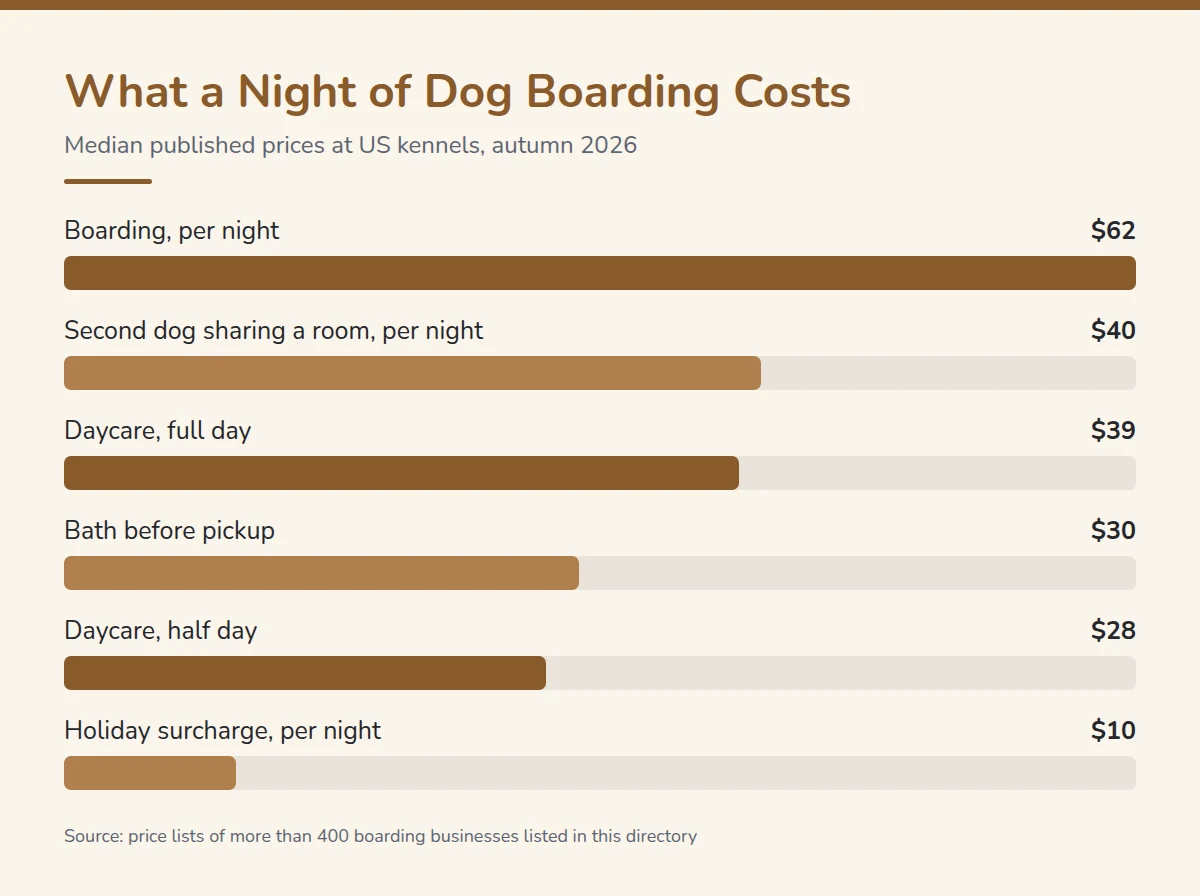
| Service | Typical price (median) | Middle half of boarding businesses |
|---|---|---|
| Dog boarding, per night | $62 | $50 to $75 |
| Each additional dog sharing a room, per night | $40 | $30 to $50 |
| Dog daycare, full day | $39 | $30 to $50 |
| Dog daycare, half day | $28 | $24 to $34 |
| Medication, per dose or per day | $5 | $2 to $5 |
| Holiday surcharge, per night | $10 | $5 to $44 |
| Bath before pickup | $30 | $22 to $40 |
Table 1. Typical published prices across the United States, for services with at least ten priced boarding businesses. Extra dogs, medication and holiday dates are charged on top at most kennels, so those rows show what the businesses that list them charge.
A standard nightly rate buys a run or room of the kennel’s basic size, the feeding of the food you send on the schedule you give, fresh water, daily cleaning, a set number of outdoor breaks, and staff on site through the day. Beyond that the definitions drift. Some kennels fold group play, a long walk or a bedtime treat into the base price. Others sell each one separately, which is why a $50 rate with everything added on can end up costing more than a $65 rate that includes it all. Ask what the headline price covers before you compare two quotes.
Five things explain most of the spread between $50 and $75, and the prices beyond it.
Run or suite. The median is for the standard run or room. A suite with a raised bed, more floor, a window or a webcam is a tier up, and kennels price it that way.
The size of your dog. Many kennels charge by weight band, and the cost behind the surcharge is real. Under the federal Animal Welfare Act housing standard, the floor a dog needs is calculated from its length plus six inches, squared, so space requirements climb far faster than the dog does. A giant breed needs the floor of several toy dogs, more food and a stronger handler. Our guide to how your dog’s weight class shapes a boarding stay explains the tiers and what to ask when a dog sits on the boundary between two of them.
Playtime included or extra. The nightly rate at one kennel includes two group play sessions. At another it includes two short solo breaks and sells play by the session. The second kennel is not necessarily dearer, but its headline rate is not the price you will pay.
Region. Boarding is labor. The federal occupational wage survey for 2025 puts the median hourly wage of animal caretakers at $18.60 in California and $18.35 in Arizona, the two states at the top of our table, against $15.74 in Texas and $13.92 in Oklahoma. The order of the state table below tracks the order of caretaker wages almost exactly, with only Oklahoma and North Carolina swapping places. Rent and licensing costs pull the same way.
Holiday dates. Kennels fill in the weeks when the most people leave home. AAA expected a record 72.2 million Americans to travel over the July 4th week in 2026, and 122.4 million over the most recent year-end holidays. Most kennels add a surcharge on those dates, and many set a minimum stay.
Prices also move from year to year. The consumer price index for pet services, which covers kennel boarding, daycare, sitting, walking, grooming and training, rose about 3.6 percent in the year to September 2026, a little faster than average hourly pay. A quote you get next summer may sit a little above the tables here.
What a Week of Boarding Costs: A Worked Example
Take the national figures in Table 1 and a seven-night trip.
- One dog, standard run, seven nights: $62 x 7 = $434. At the edges of the middle half, the same week runs from $350 (7 x $50) to $525 (7 x $75).
- A second dog from your home sharing the room: add $40 x 7 = $280, for $714.
- One of the dogs takes a daily tablet: add $5 x 7 = $35, for $749.
- The trip falls on holiday dates: add the $10 median surcharge for each of the seven nights, $70, for $819.
- A bath before pickup: add $30, for $849.
So two dogs, one on medication, over a holiday week with a bath at the end comes to $849 at the national medians, before tax, while one dog on ordinary dates with no extras is $434. The cost calculator on this site does the same sum for any city in the directory, using that city’s own median where we have one.
Dog Boarding Prices by State
| State | Dog boarding, per night (median) | Middle half |
|---|---|---|
| California | $74 | $60 to $95 |
| Arizona | $67 | $49 to $99 |
| Florida | $60 | $44 to $70 |
| Texas | $56 | $48 to $65 |
| Oklahoma | $55 | $51 to $72 |
| North Carolina | $52 | $44 to $69 |
Table 2. Median nightly price for one dog in a standard run or room, for states with at least 15 priced boarding businesses.
California tops the table at $74, with a middle half that reaches $95, and North Carolina is lowest at $52. The middle half tells you how much a state’s own kennels disagree with each other. Arizona’s spread, from $49 to $99, is the widest here, so two kennels a few miles apart can be far apart in price and it pays to collect two or three quotes. Oklahoma’s median is a dollar below Texas’s, but its middle half, $51 to $72, sits higher at both ends, so a cheap night is easier to find in Texas.
States With Fewer Priced Kennels, Grouped by Region
Where a state has fewer than 15 priced boarding businesses, a single kennel’s prices would move its median too much, so those states are pooled by region.
| Region | States with fewer than 15 priced boarding businesses | Dog boarding, per night, median (combined) |
|---|---|---|
| Midwest (other states) | Illinois, Indiana, Kansas, Michigan, Minnesota, Missouri, Nebraska, Wisconsin | $60 |
| South (other states) | District of Columbia, Georgia, Kentucky, Maryland, Tennessee, Virginia | $62 |
| West (other states) | Colorado, Nevada, New Mexico, Oregon, Washington | $68 |
Table 3. Combined median for states with fewer than 15 priced boarding businesses, grouped by region.
New York and Pennsylvania have too few priced boarding businesses to show even a regional figure. For those two states, use the national table above.
Dog Boarding Prices in Major Cities
| City | Dog boarding, per night (median) | Middle half |
|---|---|---|
| Houston, Texas | $60 | $50 to $65 |
| Tampa, Florida | $60 | $52 to $63 |
| Jacksonville, Florida | $62 | $39 to $70 |
| Dallas, Texas | $60 | $52 to $66 |
| Seattle, Washington | $72 | $64 to $82 |
| Oklahoma City, Oklahoma | $60 | $54 to $72 |
| San Diego, California | $98 | $76 to $99 |
| Louisville, Kentucky | $50 | $30 to $68 |
Table 4. Median nightly price in cities with at least ten priced boarding businesses.
A city appears here only when at least ten priced boarding businesses are listed in it. Every other city in the directory uses its state figure from Table 2 or its regional figure from Table 3, because a median built on a handful of kennels would say more about those kennels than about the city. The city figures show how far a city can drift from its state. San Diego’s $98 median sits well above California’s $74, and its middle half, $76 to $99, starts above the state median. Seattle at $72 is above the pooled West figure of $68. Louisville is the cheapest city in the table at $50, but its $30 to $68 middle half is the widest, so quotes there deserve the closest reading. Houston, Dallas, Tampa and Oklahoma City all land on $60, within a few dollars of their states.
The Charges That Grow the Bill
The nightly rate is the start of the bill, not the end of it. These are the lines that get added, with the national figures where we have them.
A second dog sharing the room. The median charge for an additional dog sharing a room is $40 a night, with a middle half of $30 to $50, against $62 for the first dog, so two housemates in one room cost less than two rooms. The saving only makes sense for dogs that already sleep and eat calmly together at home. California’s boarding law allows one pet per enclosure unless the owner agrees otherwise, so the choice is yours, and you can still ask for meals to be fed apart. Rooming your dog with a stranger’s dog is a different decision. Our guide to buddy suites and pair housing covers what the research found and what to ask before you agree.
Medication. Kennels that list it charge a median of $5 per dose or per day, with a middle half of $2 to $5. The fee pays for a handler to give the dose on time and write it down. For a dog on several drugs, ask whether the charge is per dose or per day, and how each dose is logged. Older dogs are the usual case here. Our guide to senior dog boarding covers what a reliable medication routine looks like and the questions that reveal whether a kennel has one.
Holiday surcharge. The median holiday surcharge is $10 a night, but the middle half runs from $5 to $44, the widest spread of any line in Table 1, so this is the extra to ask about first. Some kennels add a few dollars, while a quarter of those that list a surcharge charge $44 or more a night, most of the price of the night itself. Peak calendars usually cover Thanksgiving, the December holidays, spring break, the July 4th week and most long weekends, and many kennels set a minimum stay for them. Two of those dates come with fireworks, which matter more than the surcharge if your dog fears noise. Our guide to boarding over fireworks weekends explains what a kennel can and cannot do on those nights.
Bath before pickup. The median is $30, with a middle half of $22 to $40. It is an optional add-on that sends a dog home clean after a week of play yards, and a kennel with a grooming room will usually offer a full groom as well. Do not let the bath replace your own check of skin, paws and coat at pickup.

Evaluation and vaccination proof. Most kennels will not put a new dog into group play, and some will not board one at all, without an evaluation first: a half day or full day in the facility, often charged at the daycare rate, that shows staff how the dog behaves around strangers and other dogs. Budget the daycare row in Table 1 for it. Vaccination proof is the other precondition. Every reputable facility asks for proof of current vaccinations before a dog walks in, and the vet visit that produces it sits outside the boarding bill. Rabies and the DHPP combination are standard, Bordetella is close to universal, and some kennels also want canine influenza, which is a two-dose series for a dog that has never had it. Puppies are the dogs most often caught out by the timing. Our guide to puppy boarding age and vaccinations explains the cutoffs. Intact dogs are the other group that evaluations single out, because many daycares bar them from group play and house them alone instead. Our guide to boarding an intact dog or a female in heat covers what to tell the kennel and how it changes the stay.
Tax. The figures in this guide are before tax, and whether tax is added depends on the state. Minnesota, for example, lists the lodging, boarding and care of animals in kennels among its taxable services, with veterinary boarding excluded. Ask whether a quote includes tax before you compare it with another.
Boarding, a Pet Sitter or Daycare: Which Costs Less?

The three are different products, and the cheapest on paper is not always the cheapest for your trip.
Daycare is a day rate with no overnight stay. The median full day is $39 and the median half day is $28, against $62 for a night of boarding, so for a work day or an evening out it is the cheaper choice. For a trip it is not an option by itself, but it is the usual on-ramp: a trial day lets staff meet your dog before a first stay, and many kennels sell the same play sessions to boarding guests as an add-on.
A pet sitter comes to your home for timed visits, or stays overnight, and charges per visit or per night rather than per kennel night. Sitter rates vary so much with the length and number of visits that a single figure would mislead, and industry estimates differ, so compare like with like: a sitter booked for three visits a day is a very different product from one who sleeps in your house. The dog keeps its own bed, its own routine and its own yard, which for an anxious or elderly dog can be the deciding factor. What it gives up is supervision between visits and, in most places, any licensing at all. Colorado’s pet care facilities act does not apply to anyone boarding three or fewer animals, and England requires no licence for a sitter who cares for a dog in the dog’s own home, so the checking falls to you. Our guide to trading down safely when boarding gets expensive sets out which savings leave the essentials in place and which only look like savings.
Boarding costs more per night than a daycare day because it buys the night: a building, a licence, insurance and someone responsible for your dog at three in the morning. Whether your dog should stay behind at all is a separate question, and one to settle before you price anything. Our guide to taking the dog or boarding the dog weighs the trip against the dog.
How to Read a Kennel’s Price List
Kennel price lists are not standardized, so two that look alike can bill very differently. Read for these before you compare.
Per night or per day. Most kennels bill by the night, some by the calendar day, and many add a day, or a daycare fee, for pickups after a set checkout time. A seven-night stay can be billed as eight days.
What the base rate includes. Meals, walks, play sessions, bedtime treats, webcam access and photo updates are each either inside the rate or on the add-on list. Price your dog’s real needs, not the headline.
Size and room tiers. Find which weight band your dog falls in and whether the quote is for the standard run or a suite. Ask what the standard run actually is, because that is the room the medians in this guide describe.
Multi-dog pricing. Check whether a second dog is priced per dog or per room, and whether the discount applies only to dogs from the same household.
Peak calendar and minimum stays. Ask for the kennel’s list of surcharge dates and whether any carry a minimum stay. Both change the price of a trip that straddles a holiday.
Deposits and cancellation. A deposit should come off the final bill, and holiday dates usually carry stricter cancellation terms. Long stays are often paid in full before the first night, which is when the refund clauses matter most. Our guide to deposits, prepayment and refunds explains which terms to find before you pay and why paying by card preserves a route back to the money.
Tax and fees. Confirm whether the quote is before or after tax, and whether there is a booking or administration fee that is never credited.
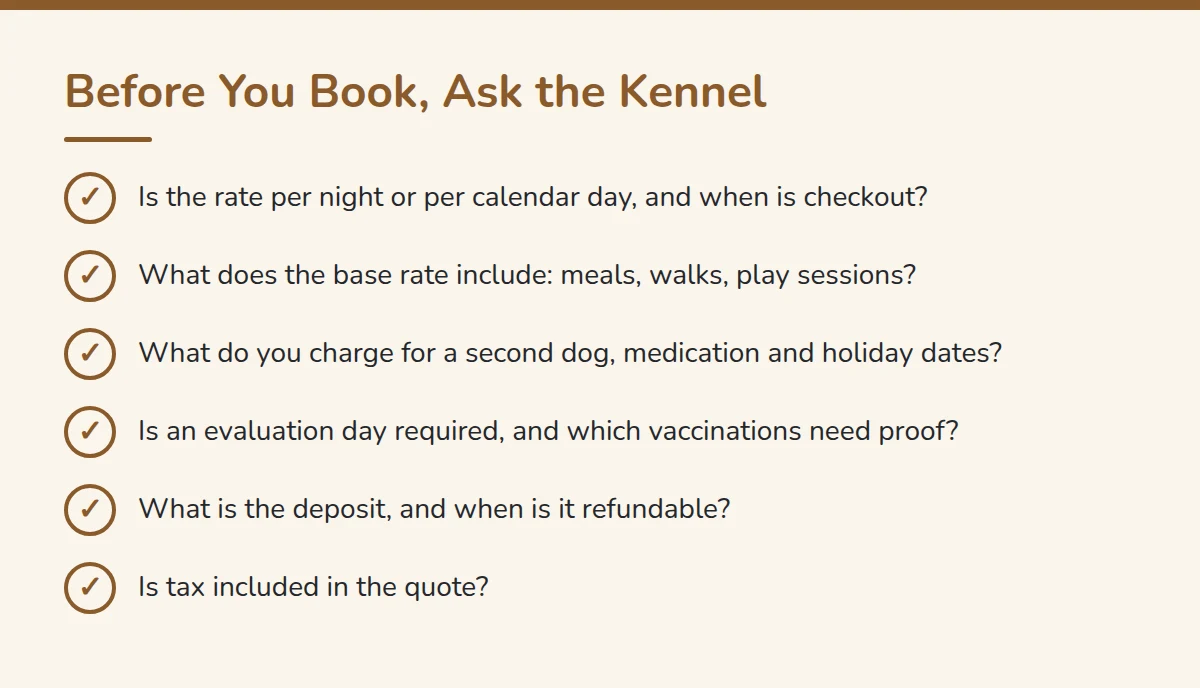
Then put these questions to the kennel, in writing if you can:
- Is the rate per night or per calendar day, and what are the checkout times?
- What does the base rate include, and what is the full price for my dog with the things it actually needs?
- What do you charge for a second dog, for medication and for holiday dates, and which dates count?
- Do you need an evaluation day before a first stay, and which vaccinations do you need proof of?
- What is the deposit, when is it refundable, and is there a minimum stay on my dates?
- Is tax included in the quote?
If this is your first stay, the questions above are only part of the preparation. Our first-time dog boarding guide walks the whole arc from vaccinations to pickup.
Find Dog Boarding Near You
Every city below has its own page in this directory listing the boarding kennels and dog hotels there, with the prices they publish. Where a city has at least ten priced businesses, its page uses its own median; the rest use the state or regional figure from the tables above.
- Arizona: Avondale, Mesa, Oro Valley, Phoenix, Sahuarita, Tucson
- California: Campbell, Clovis, Corona, Culver City, El Segundo, Encino, Fontana, Fresno, Glendale, Harbor City, Inglewood, Long Beach, Los Angeles, Mckinleyville, Milpitas, Mira Loma, Oakland, Pomona, Rancho Cordova, Rancho Cucamonga, Rialto, Riverside, Sacramento, San Diego, San Francisco, San Jose, San Leandro, Santa Clara, Santa Monica, South San Francisco, Studio City, Sunnyvale, Upland, West Sacramento
- Colorado: Aurora, Centennial, Colorado Springs, Denver
- District of Columbia: Washington
- Florida: Brandon, Clearwater, Coral Gables, Jacksonville Beach, Jacksonville, Lutz, Miami Beach, Miami, Tampa, Thonotosassa, Valrico
- Georgia: Atlanta, Sandy Springs
- Illinois: Chicago, Oak Park
- Indiana: Fort Wayne, Indianapolis, Jeffersonville, New Albany, Noblesville
- Kansas: Olathe, Shawnee
- Kentucky: Buckner, Louisville, Mt Washington
- Maryland: Baltimore, Bowie, Clinton, Lothian
- Massachusetts: Boston
- Michigan: Detroit, Royal Oak, St. Clair Shores, Troy
- Minnesota: Apple Valley, Bloomington, Burnsville, Eagan, Eden Prairie, Edina, Jordan, Lakeville, Minneapolis, Prior Lake, Richfield, Savage, St. Louis Park
- Missouri: Kansas City
- Nebraska: Elkhorn, Omaha
- Nevada: Las Vegas, North Las Vegas
- New Jersey: Hoboken
- New Mexico: Albuquerque
- New York: New York
- North Carolina: Charlotte, Concord, Durham, Morrisville, Pineville, Raleigh
- Ohio: Columbus, Hilliard
- Oklahoma: Edmond, Oklahoma City, Tulsa
- Oregon: Portland
- Pennsylvania: Langhorne, Philadelphia, Phoenixville, Trevose
- Tennessee: Collierville, Memphis, Nashville
- Texas: Austin, Bellaire, Converse, Coppell, Dallas, Del Valle, El Paso, Fort Worth, Houston, Plano, Richardson, San Antonio
- Virginia: Virginia Beach
- Washington: Burien, Seattle
- Wisconsin: Milwaukee
Frequently Asked Questions About Dog Boarding Costs
How much does dog boarding cost per night? The median published price is $62 a night for one dog in a standard run or room, and the middle half of boarding businesses charge $50 to $75. Suites, large dogs, extra dogs, medication and holiday dates are added on top.
How much does it cost to board a dog for a week? At the national median, seven nights cost $434 before extras, and the middle half of kennels would charge between $350 and $525 for the same week. Add $280 for a second dog sharing the room, $35 for daily medication, and $70 if all seven nights carry the median $10 holiday surcharge.
Which state has the most expensive dog boarding? Of the states with enough priced kennels to measure, California, at a median of $74 a night with a middle half of $60 to $95. Its priciest city in our table, San Diego, has a median of $98.
Where is dog boarding cheapest? North Carolina has the lowest state median at $52 a night. Louisville, Kentucky, has the lowest city median at $50 and the lowest start to a city’s middle half, at $30, with Jacksonville, Florida, next at $39, so those are the easier places to find a cheap night.
Do kennels charge more for two dogs? They charge more, but far less than double. The median for an additional dog sharing a room is $40 a night, against $62 for the first dog, so two housemates in one room cost well under the price of two separate rooms.
How much is a holiday surcharge for dog boarding? The median is $10 a night, but the middle half runs from $5 to $44, so some kennels add a few dollars and a quarter of those that list one charge $44 or more a night. Ask for the surcharge dates and the amount before you book a holiday week.
Is dog daycare cheaper than boarding? Per day, yes. The median full day of daycare is $39 and a half day is $28, against $62 for a night of boarding. Daycare does not include an overnight stay, so it only replaces boarding on days you are home by evening.
Further reading (sources)
- Bureau of Labor Statistics on the consumer price index for pet services and the kennel boarding, daycare and sitting the index covers
- Bureau of Labor Statistics for 2025 wages of animal caretakers, including the top-paying states
- Legal Information Institute with the federal floor-space formula for dogs in 9 CFR 3.6
- AAA on its forecast for July 4th week travel in 2026 and the record year-end holiday travel forecast
- California Legislative Information for the boarding rule of one pet per enclosure unless the owner agrees
- Minnesota Office of the Revisor of Statutes on the sales tax statute that lists kennel boarding and care among taxable services
- Colorado Office of Policy, Research and Regulatory Reform with its 2025 sunset review of the Pet Animal Care and Facilities Act
- GOV.UK for England’s home boarding guidance, which leaves sitters in the dog’s own home unlicensed
- American Veterinary Medical Association on what to check and ask before boarding your pet