Size, Not Breed: How Your Dog's Weight Class Shapes Their Boarding Stay
Published on September 27, 2026
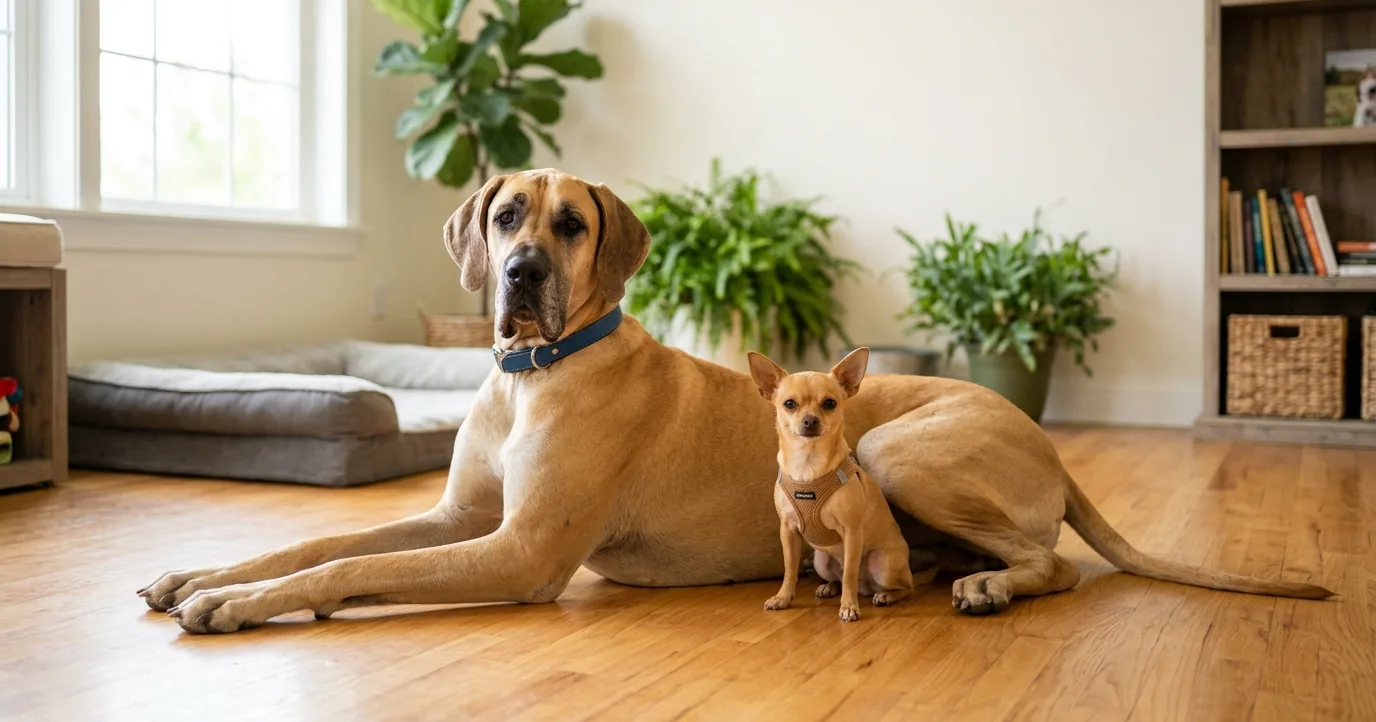
The first question a boarding kennel asks about your dog is rarely the breed. It is the weight. That one number decides more of the stay than anything else on the intake form: the run your dog sleeps in, the price band you pay, the yard it plays in, how much food goes in the bowl, and which injuries staff should be watching for. It is also the one fact every dog has. A mixed-breed dog with no group label still stands on a scale.
This guide works through the weight classes together, from toy dogs to giants, because the risks at each end of the scale mirror each other, and what protects a six-pound dog is often the opposite of what a 150-pound dog needs. Breed adds a layer on top, and our guide to breed-specific boarding covers coat, working drive and temperament. Size sets the physical ground rules underneath all of it.
Why the Kennel Asks for the Weight First
Weight is objective in a way breed rarely is. For most boarded dogs the breed box holds a guess, as our guide to boarding a dog with no breed label explains, while a scale reading is a scale reading. Weight also changes the physical job. Floor space, food, bedding, handling and cleanup all grow with the dog.
Size says little about personality, though. The American Kennel Club points out that small breeds turn up across many of its breed groups and that not all small dogs are lap warmers; some are as tough as nails. So treat size as the first sort, not the only one. It tells staff what the dog’s body needs. It does not tell them how the dog behaves.
There is also no universal line between small, medium and large. The AKC’s puppy growth guide calls dogs up to 20 pounds small, 21 to 50 medium, 51 to 100 large, and anything heavier giant. The kennel space allowances summarized by Purdue University’s veterinary college draw their lines at 33 and 66 pounds instead. Kennels set their own bands, so a “large” dog at one facility can be a “medium” at the next. Ask for the numbers, not the names.
Floor Space: How Much Room Each Size Needs
No federal rule sets the run size for an ordinary US boarding kennel. The Animal Welfare Act’s space standards cover dogs used in research, exhibited to the public, bred for commercial sale or transported in commerce, and state rules vary. The federal formula is still the clearest yardstick I know of for sizing a run to a dog, and you can run it at home:
- Measure your dog from the tip of the nose to the base of the tail, in inches.
- Add six inches, then multiply the result by itself. That is the minimum floor in square inches. Divide by 144 for square feet.
- For headroom, the federal standard wants the enclosure at least six inches taller than the dog’s head when it stands normally.
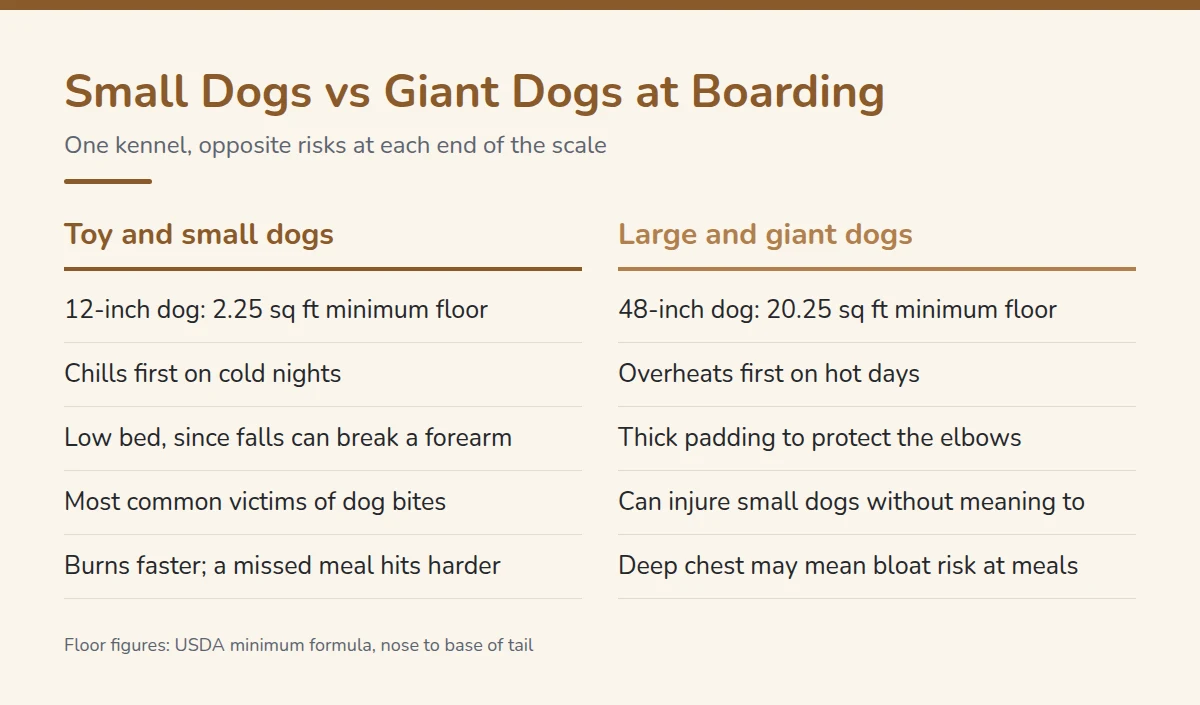
Because the formula squares the length, space needs climb much faster than the dog does. The USDA’s own reference table puts a 12-inch dog at 2.25 square feet, a 30-inch dog at 9 square feet and a 48-inch dog at 20.25 square feet: four times the length, nine times the floor. The weight-based version tells the same story. The allowances Purdue summarizes for dogs housed alone are 8 square feet under 33 pounds, 12 square feet from 33 to 66 pounds, and 24 square feet above 66, so the top band doubles.
Treat all of these as floors, not targets. The USDA calls its figures minimums and encourages more space, and Purdue’s authors write that the allowances lack a solid scientific basis. Dogs use extra room when they get it. In one study summarized in the same Purdue paper, a dog in a 10.8 square foot kennel covered about 500 metres over 12 hours, while a dog in a 75.3 square foot kennel covered about 4,000.
England’s licensing standard is written around the dog rather than a table. A boarding kennel’s sleeping area must let each dog sit and stand at full height, lie fully stretched out, wag its tail, walk and turn around without touching the walls, and its floor must be at least twice the area the dog needs to lie flat. New builds also need at least 1.9 square metres (about 20 square feet), and kennels meeting the higher standards behind the top star ratings need 2.85 square metres (about 31). For a Chihuahua the fixed minimum is generous. For a giant breed stretched out on its side, the twice-the-lying-flat-area rule is the one that bites.
The tail clause is not a quirk. Dogs that wag hard against walls can open wounds on the tip of the tail, and VCA’s veterinarians note that these wounds often will not heal because the wagging does not stop. It is the big dog in a narrow run whose tail reaches both walls.
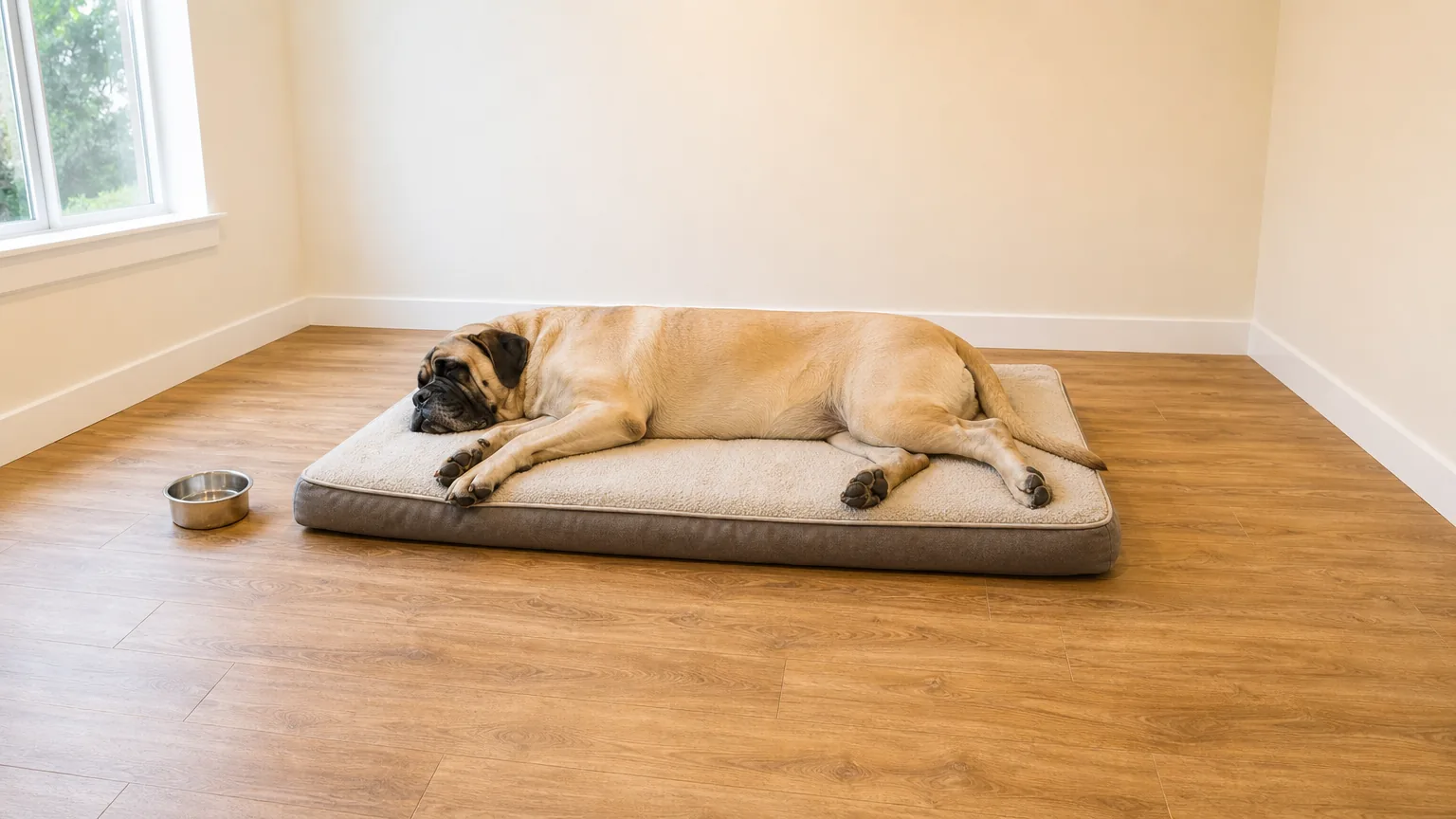
When you tour, ask for the actual dimensions of the run your dog will sleep in, not the name of the room. Picture your dog lying flat on its side: is there space past the nose, the tail and the paws? For a giant breed, the biggest run in the building may be the only one that passes, so ask whether it is held for your dates.
Heat, Cold and Bedding at Each End of the Scale
Size changes how a dog copes with temperature, and in opposite directions. A study of 905,543 UK dogs under veterinary care found that dogs over 50 kilograms (about 110 pounds) had 3.42 times the odds of heat-related illness of dogs under 10 kilograms (22 pounds). Dogs heavier than average for their breed and sex were at higher risk too. The authors put the small-dog advantage down to physics: small bodies lose heat faster, so they can exercise for longer before overheating.
The same physics runs the other way at night. The toy dog that shrugs off a warm afternoon is the one that chills first on a cold floor. England’s standard asks kennels to keep some part of every sleeping area above 10°C (50°F) and below 26°C (about 79°F), and to watch each dog for signs it is too hot or too cold. One thermostat setting cannot suit both ends of the scale, which is why placement matters. Ask where the smallest guests sleep relative to outside doors and air-conditioning vents, and where the giants sleep relative to sunny windows. In summer, big dogs should get the shade and the early and late play slots.
Bedding follows the same split.
Large and giant dogs need padding. VCA Animal Hospitals warns that any large or giant dog, of any age, can develop an elbow hygroma, a fluid-filled swelling over the joint, from repeatedly lying on hard floors such as concrete. The prevention is bedding with real padding and cover over the hard floor where the dog rests. A thin mat on concrete does little for a 150-pound dog. Look for a thick, padded bed big enough for the whole dog, elbows included.
Toy and small dogs need warmth, kept low. Toy and miniature breeds are prone to forearm fractures after falling or jumping, and one biomechanics study found their forearm bones break more readily than a large dog’s when loaded in proportion to body size. A tall cot, a grooming table or a handler carrying a wriggling dog at chest height are all fall risks. A low bolstered bed with a blanket keeps a small dog warm without giving it a ledge to leap from. England’s standard requires soft bedding adapted for young, old or infirm dogs to help them regulate body temperature, and the smallest guests gain the most from it.

Play Groups: Why Size Is the First Cut
Size matters most when dogs share a yard. England’s day care standard requires a facility to be able to separate dogs and tells staff to consider the “age, size and behaviour differences between dogs to minimise the risk of injuries.” It also asks for 6 square metres (about 65 square feet) of space per dog.
The injury data points the same way. In a review of 185 dogs treated for dog bites at a veterinary teaching hospital, small dogs of 10 kilograms or less were the most common victims and were more likely to have multiple wounds, and every death involved a chest or abdominal injury. A far larger registry of 12,412 bitten dogs treated at veterinary trauma centres found that 95 percent survived, and that heavier dogs were more likely to. The authors suggest a heavier dog is simply harder for an attacker to overpower or get a grip on.
Mismatched play does not need an aggressive dog to go wrong. A shoulder barge that two retrievers trade happily can knock a small dog flat, and a 90-pound dog that stumbles into a six-pound one outweighs it fifteen times over. A small dog that yelps and bolts can also turn a game into a chase in seconds.
Size matching is where grouping starts, not where it ends. Within a weight band, dogs still need matching on play style and energy, since a bulldozing 20-pound terrier and a timid 20-pound spaniel cross are both “small.” The rule applies with more force to a roommate, and our guide to dogs sharing a kennel explains how the pairing research matched dogs on size and energy. Small-dog yards also need their own fencing. England requires gaps small enough that a dog’s head cannot pass through, and a gap that holds a Labrador is an exit for a four-pound dog.
Ask how groups are built, what the largest weight gap allowed in one group is, and what happens when a small dog wants out.
Feeding: Portions Scale, but Not in a Straight Line
A dog’s energy needs do not rise in step with its weight. The Merck Veterinary Manual gives resting energy as 70 multiplied by body weight in kilograms raised to the power of 0.75. Run the numbers and a dog ten times heavier needs only about 5.6 times the resting calories. Pound for pound, the smaller dog burns about 1.8 times as much.
That has three practical consequences at boarding.
- Small dogs have less margin. They burn through reserves faster, so a skipped meal matters sooner, and very small or very young dogs can be prone to low blood sugar when meals are missed.
- Measuring errors are bigger in small bowls. A heaped kennel scoop is a rounding error in a giant’s dinner and a large share of a toy dog’s. Send meals portioned by weight and packed one per bag.
- Weight change reads differently. A pound lost over a week is noise on a mastiff and ten percent of a ten-pound dog. Ask for your dog to be weighed at check-in and at pickup. England’s standard requires long-stay dogs showing significant weight loss or gain to be seen by a vet.
At the other end of the scale, deep-chested large and giant dogs carry the risk of bloat. Their feeding rules (calm meals, rest either side, no raised bowl) are covered in our boarding feeding guide, along with what to do about the dog that stops eating.
What the Size Surcharge Pays For
Some kennels charge by room size, some by weight band, and some charge one rate for every dog. When the price climbs with size, the costs behind it are real: more floor per dog (on the USDA formula, a giant needs the floor of several toy dogs), more food if the kennel supplies it, bigger bedding and more laundry, more cleanup, and sometimes two handlers for a dog stronger than one person. Small is not automatically cheaper either. A separate small-dog wing, its own yard and fencing, and more frequent checks all cost money.
A fair price tracks the room and the care, not a label. Before you book, ask:
- Which band is my dog in, and where exactly are the lines?
- If two dogs from my home share a room, is the price for the room or for each dog?
- What happens if the check-in weight crosses a line?
- Is a larger room available, and what does it add?
Get the answers in writing. Rates vary widely by region and facility, so compare what each price includes rather than the headline figure.
Boundary Dogs and Dogs Still Growing
A dog two pounds over a line can end up in a yard with dogs twice its size, or charged the next band up. Ask the kennel to place a dog near a boundary by build and play style rather than the scale alone, and to tell you which group it chose and why. A sturdy, confident 27-pound dog and a fine-boned, nervous 27-pound dog may belong in different yards. Weigh your dog before the stay rather than repeating last year’s number.
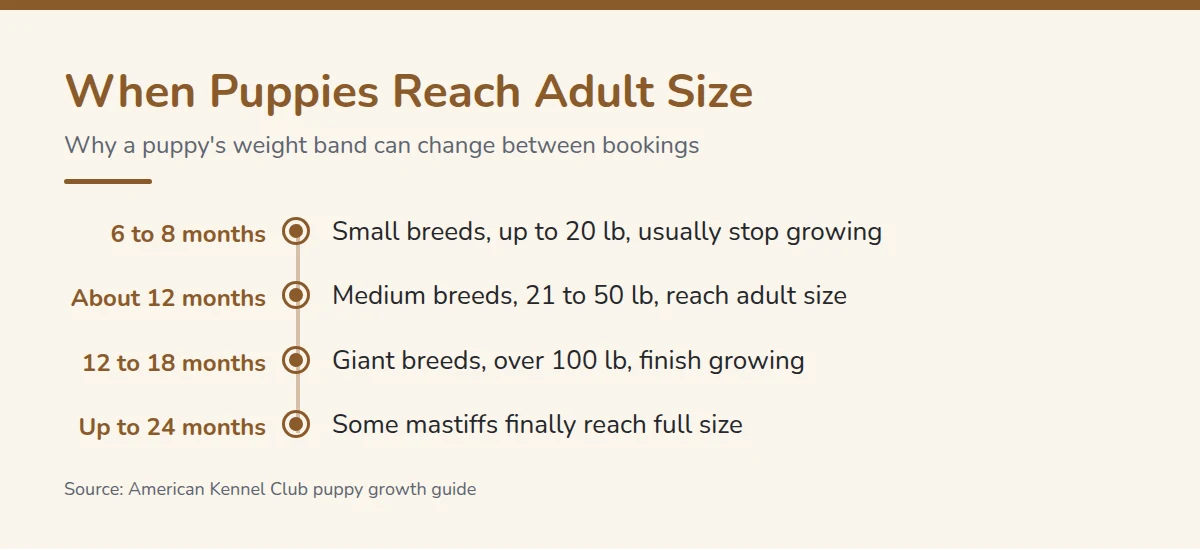
Puppies move between bands. The AKC puts the end of growth at around six to eight months for small breeds and around a year for medium breeds, while giant breeds keep growing until 12 to 18 months and some mastiffs until about two years. A giant-breed puppy booked in spring can be in a different band by autumn, so check the run and the price each time. A big puppy’s body also arrives before its judgment. A five-month-old giant can outweigh the adults in the medium yard while still playing like a puppy, and placement has to weigh both. Our guide to puppy boarding covers the vaccine and readiness side.
What to Tell the Kennel, and What to Ask
Give staff the size facts they cannot guess:
- Your dog’s weight, measured this month, and whether that is normal for it.
- Its length from nose to base of tail and its standing height, so staff can check the run.
- How it sleeps, sprawled flat or curled tight, and whether it runs hot or cold.
- How it plays with dogs bigger and smaller than itself.
- Its food, portioned by weight and packed per meal.
Then ask the questions that show whether a kennel thinks in sizes:
- What are the dimensions of the run my dog will sleep in?
- Are small and large dogs housed and played apart, with separate fencing?
- How do you place a dog that sits near a band line?
- Where do your smallest and largest guests sleep relative to vents, doors and windows?
- Will you weigh my dog at check-in and pickup?
Specific answers mean the kennel sizes its care to the dog. “We have rooms for every size” is a sales line, not an answer. Anything touching your dog’s own medical risk, from bloat to joint trouble to a growing puppy’s exercise limits, belongs with your veterinarian before you book.
Further reading (sources)
- USDA APHIS on calculating a dog’s minimum floor space and headroom
- Purdue Extension for weight-based kennel space allowances and the thin science behind them
- GOV.UK with the English kennel standards on sleeping space, temperature and bedding
- GOV.UK on the day care rule that groups must account for size
- Hall, Carter and O’Neill for heatstroke risk by body weight in UK dogs
- Shamir and colleagues on small dogs as the most frequent bite victims
- Cook and colleagues with body weight and survival in 12,412 bitten dogs
- Brianza and colleagues on why toy breeds break forearms in falls
- VCA Animal Hospitals for elbow hygromas in big dogs that rest on hard floors
- VCA Animal Hospitals, whose tail first-aid page covers wounds from wagging against walls
- Merck Veterinary Manual on the resting energy formula behind portion sizes
- American Kennel Club with when puppies of each size finish growing
- American Kennel Club, listing small breeds across many of its breed groups