Take the Dog or Board the Dog? How to Decide Whether Your Dog Should Come on the Trip
Published on October 31, 2026
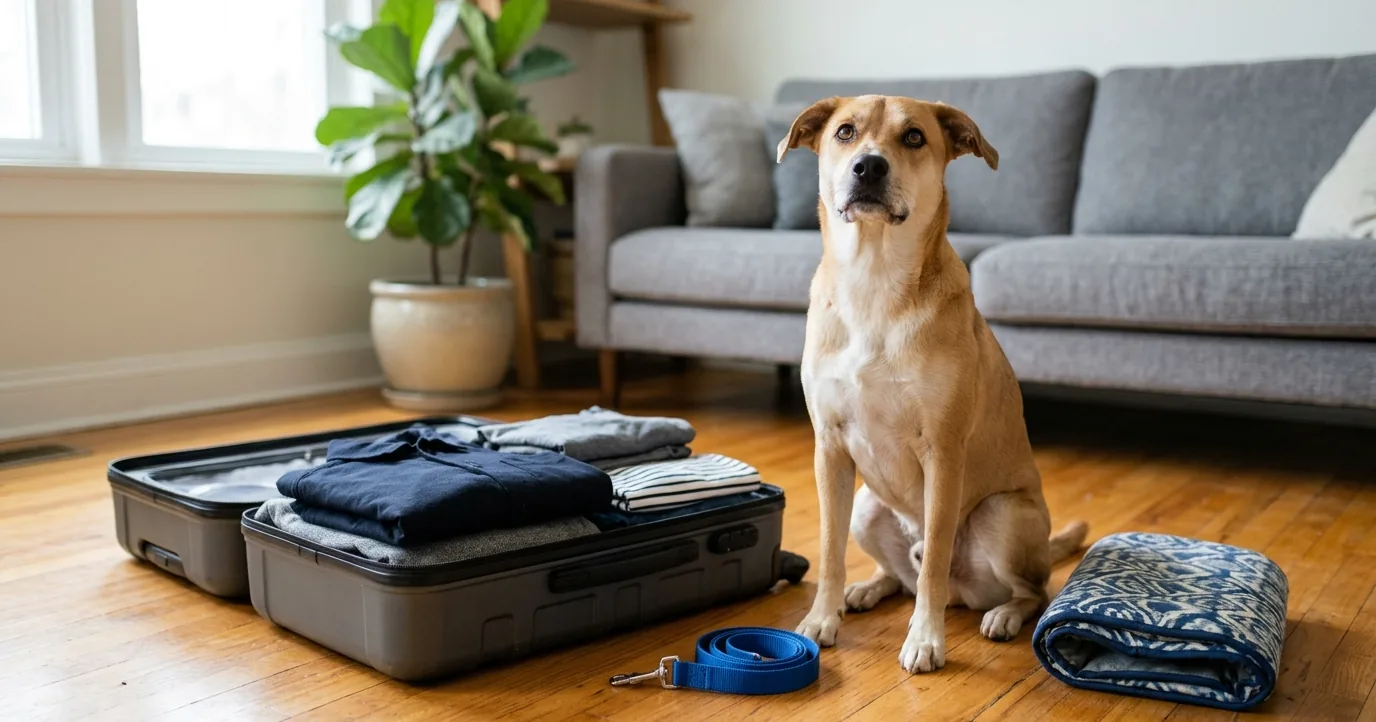
Most advice about boarding starts after the big decision has been made. The dog is staying behind, so the questions are which kennel, what to pack and how drop-off will go. The question that comes first gets far less attention: should this dog be coming on this trip at all? Owners tend to answer it with guilt rather than evidence. Taking the dog feels like the loving choice and boarding feels like the compromise, so dogs get taken on trips that are holidays for everyone but them, and some owners cancel trips their dog would happily have skipped.
Neither choice is automatically the kind one. For a dog that travels well, a road trip built around long walks and a cottage with a garden can be the best week of its year. For a dog that vomits in the car, wilts in the heat or panics when left somewhere strange, the same week is a run of long drives, hot car parks and hours alone in a rental, and a well-run kennel would have been the easier place to spend it. The American Veterinary Medical Association (AVMA) starts its owner travel brochure in the same place. “First, it’s important to consider whether travel is right for your pet,” it says, and when the answer is no, it suggests a reliable pet sitter or a boarding facility your vet recommends. This guide weighs the trip first and the dog second, then sets out when each choice wins.
Picture the Trip From Your Dog’s Side
Start with an hour-by-hour sketch of the trip as your dog would live it. Holiday plans are built around the highlights: the hike, the beach afternoon, the dinner by the harbour. Your dog’s week is made of everything in between, including the hours in transit, the hours in the car while you stop for lunch, and the hours waiting in a rental while you do the things it cannot join. Add those up for each day, honestly.
A city break is the classic mismatch. Museums, theatres, restaurants and theme parks rarely admit dogs, so a dog on that kind of trip spends most of its waking hours shut in a room it does not know. The AVMA brochure plans for exactly this: if your pet must be left alone in a hotel room, it says, hang a do-not-disturb sign and tell housekeeping and the front desk. It also warns that in unfamiliar surroundings, a pet’s appetite, energy and behaviour may change.
Being left somewhere new is harder for some dogs than others. The ASPCA lists moving to a new home among the changes that can trigger separation anxiety, and describes what that distress looks like when a dog is left: urinating, defecating, barking, howling, chewing, digging or trying to escape. A week in a rental is not a house move, but a dog that already struggles alone at home is unlikely to find a strange cottage, full of unfamiliar noises, any easier.
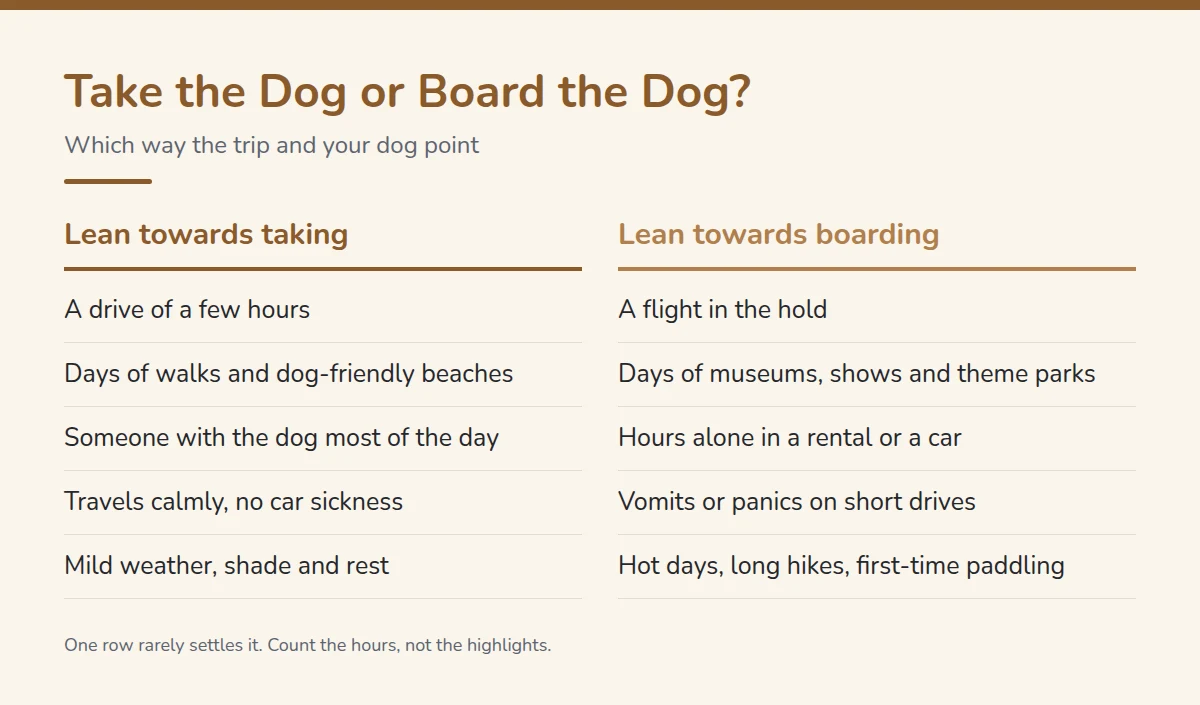
A workable rule of thumb follows. If the dog would spend more of its waking hours shut away than out with you, a good kennel, where staff take it out to play and stretch several times a day, is usually the better week for it. If the trip is built around things a dog can share, bringing it starts to make sense.
The Journey: Car, Plane or Border Crossing
By car. Car trouble is widespread and mostly ignored. When University of Pisa researchers surveyed 907 owners, 23.8 percent reported that their dog had problems on car journeys, and 96 percent of that group had never tried any treatment. A dog that drools and vomits on a 20-minute drive will not enjoy a nine-hour one. That alone is not a reason to leave it behind, because motion sickness can be treated, and the AVMA’s advice is to tell your vet, who may prescribe medication for long trips. Resist the urge to raid the medicine cabinet. The American Kennel Club notes that Dramamine is usually not a vet’s first choice for motion sickness in dogs, that it can make some dogs excitable or hyperactive instead of calm, and quotes a vet who says medicines like maropitant generally work better against nausea. Our guide to car sickness on the way to the kennel covers retraining a nervous traveller, which pays off whichever way you decide, since a boarded dog still has to be driven to the kennel.
Long drives also need stops. The AVMA suggests stopping every two hours so a dog can exercise and relieve itself, wearing its collar, tags and leash whenever it is out of the car. Put those stops into the timings before deciding that a twelve-hour drive is fine.
The car park problem. Road trips involve stops where dogs are not welcome: lunch, the supermarket, a castle, a museum. Each one is a heat problem. In a Stanford study, researchers measured the temperature inside a dark sedan on 16 clear, sunny days with outside temperatures between 72 and 96°F. Whatever the starting point, the interior warmed by about 40°F within an hour, with 80 percent of that rise in the first 30 minutes. Even on the coolest day it reached 117°F, and opening the windows an inch and a half made no real difference. The AVMA’s advice is blunt: never leave pets unattended in a car. About 32 US states also have laws aimed specifically at animals left in parked vehicles in conditions that endanger them. Count the stops where the dog cannot come in. Each one means somebody stays with it, or the stop comes off the plan.
By air. Flying changes the calculation most. Small dogs can often travel in the cabin in a carrier that fits under the seat in front; most bigger dogs go in the hold, if the airline will carry them at all, and the AVMA tells owners to check each airline’s restrictions on breed, size, weather and time of year. One route big dogs used to take into the cabin has closed, too. Under a Department of Transportation rule in force since January 2021, US airlines may treat emotional support animals as pets rather than service animals.
Flying is hard on dogs even when it goes smoothly. In a Canadian study, 24 beagles were driven to Montreal and then flown to Toronto. Their cortisol, the main stress hormone, was higher after the drive to the airport and after the flight than at the start, and loading and unloading produced the biggest jumps in heart rate. Half the dogs had been sedated with acepromazine, and it made no difference to any of the measures. Sedation brings risks of its own: the AVMA says tranquilisers and sedatives can increase the risk of heart or breathing problems and are generally not allowed by airlines, so speak to your vet before giving any. Flat-faced breeds are the clearest case. The AVMA warns that short-nosed pets are more at risk of overheating and breathing problems during travel, especially air travel, and that if it is not necessary to take them, owners should consider other options. Our guide to boarding brachycephalic breeds covers what a kennel stay should look like for them instead.
Across a border. International trips bring paperwork that can settle the question on its own. Under rules the CDC introduced in August 2024, every dog entering or returning to the United States needs a CDC Dog Import Form receipt and a microchip, and must be at least six months old. That includes a dog coming home from a weekend in Canada or Mexico, though for those trips the form is the only document required. A dog that has been in a country the CDC rates high-risk for dog rabies in the past six months needs more paperwork again. The AVMA notes that preparing for international travel can take six months or more. A puppy under six months cannot meet the rules at all, and for a short trip abroad, months of vet visits and forms are rarely worth it for the dog.
The Trip Itself: Heat, Water and Long Days on Foot
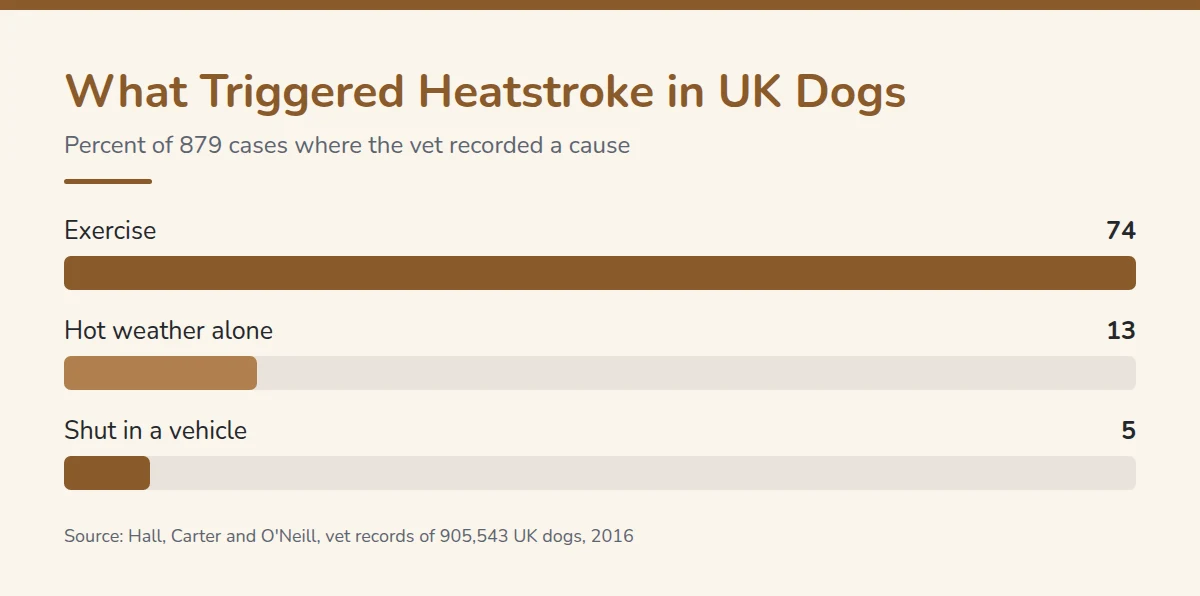
Heat. Hot cars get the headlines, but they are not where most dogs overheat. Researchers at Nottingham Trent University and the Royal Veterinary College searched the 2016 veterinary records of 905,543 UK dogs and found 1,259 cases of heat-related illness. Where the vet had recorded what triggered it, 74 percent of cases were brought on by exercise, 13 percent by hot weather alone and 5 percent by being shut in a vehicle. Exertional heatstroke, the authors concluded, “affects more dogs, and kills more dogs, than confinement in a hot vehicle.” Flat-faced dogs had higher odds of all three types. A follow-up study by the same group found that the median temperature on the days dogs fell ill was just 16.9°C, about 62°F.
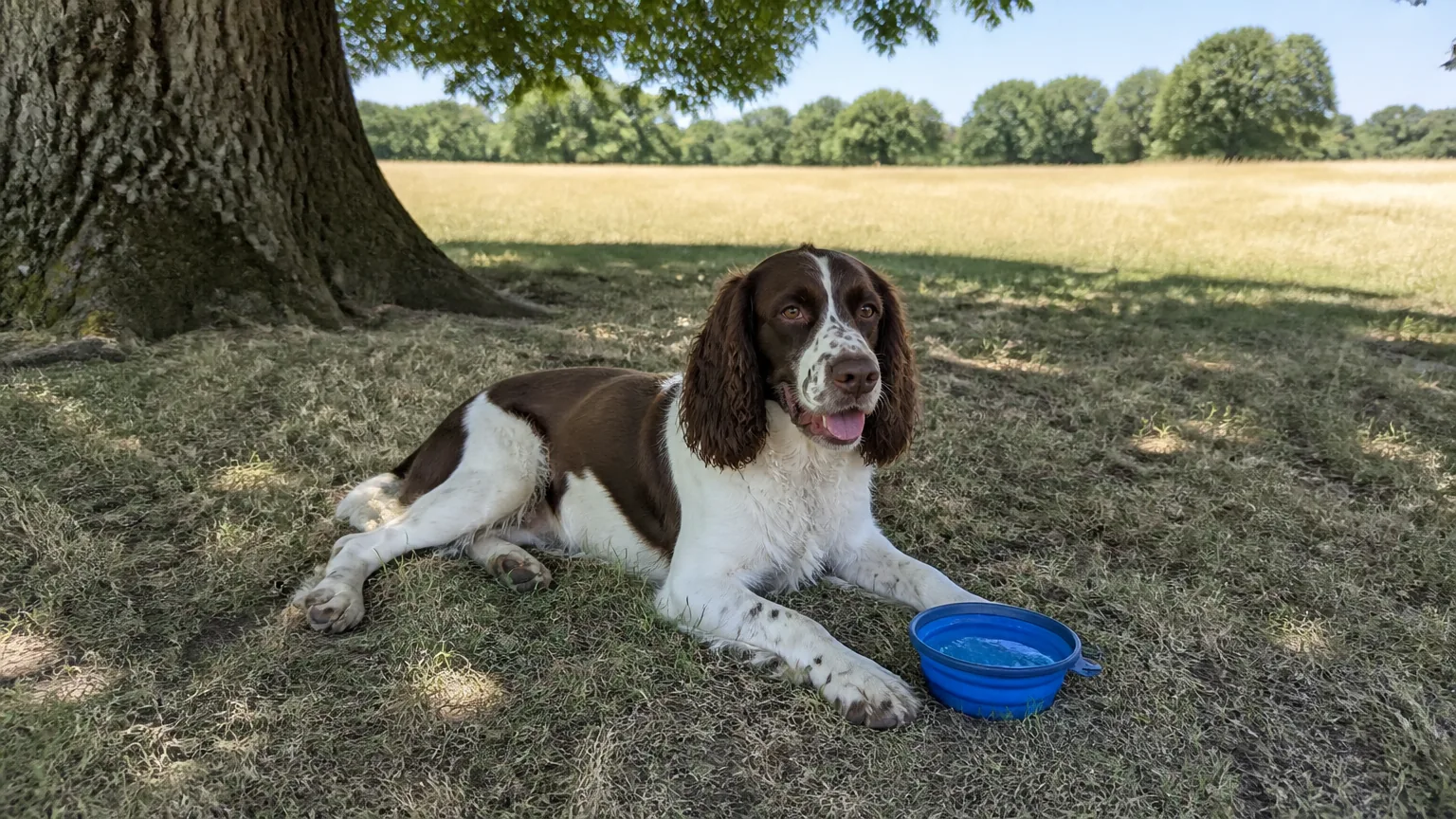
Holidays tend to pack more exercise into warmer days than a dog’s normal week: a ten-mile hike, an afternoon chasing a ball on an open beach, a day of city walking on hot pavement. If the trip is in summer, or somewhere hotter than home, ask whether your dog would get shade and rest in the middle of the day. For a heat-sensitive dog, a well-run kennel with cool indoor rest and turnout timed around the heat may be the safer place to spend a July week.
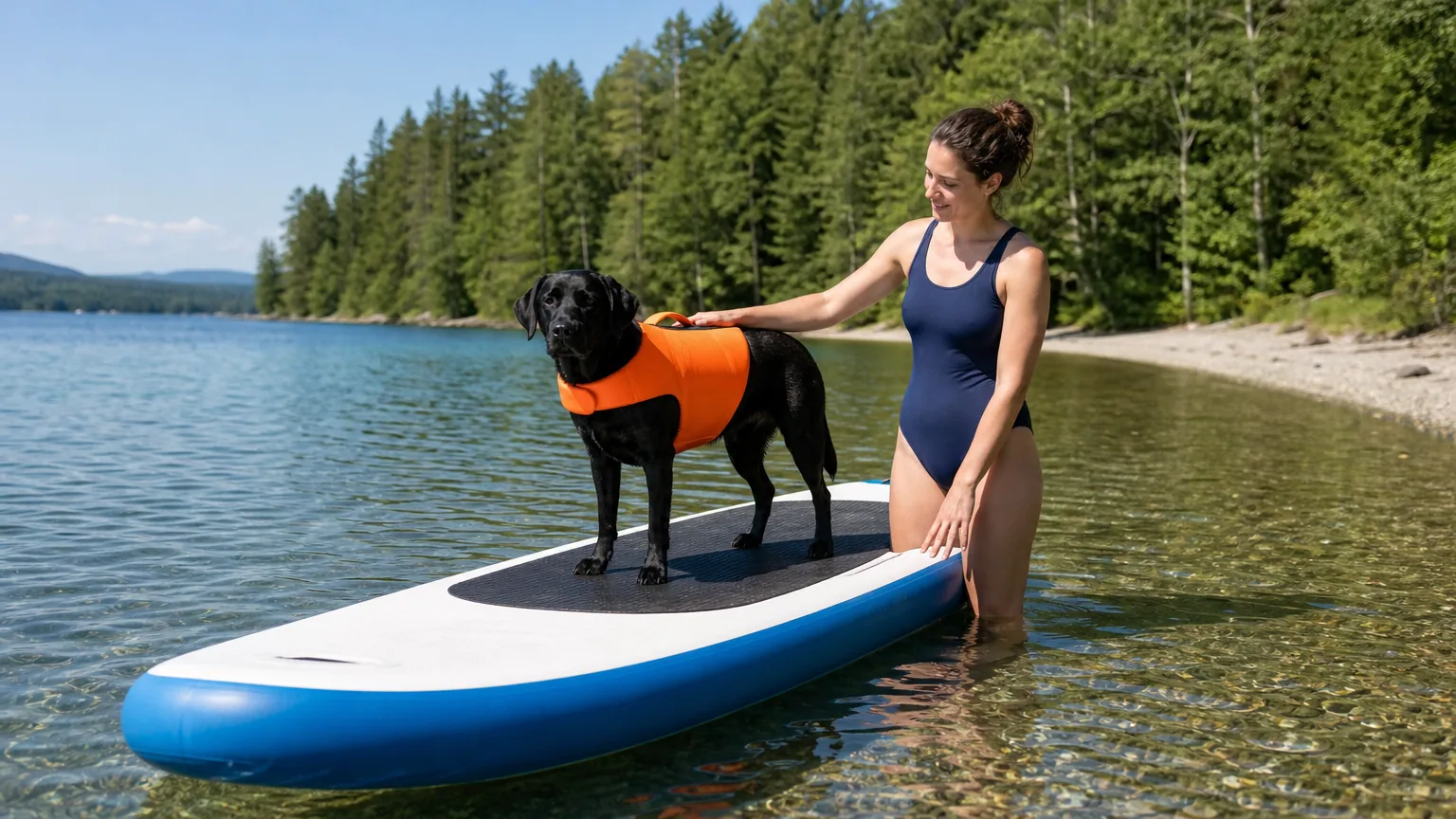
Water. Boating, kayaking and paddle boarding look like ideal holiday activities to share with a dog, and the American Kennel Club’s guidance sets a useful bar for joining in. The trainer Nicole Ellis tells the AKC that any dog “fit enough to swim and climb back on the board with your assistance” can come along. The dog needs its own life jacket, ideally with a handle so you can lift it back aboard by the jacket rather than its collar. Training starts with the board on dry ground, and even a trained dog may jump off at any time. Salt water is a hazard in its own right: a few gulps can cause diarrhea, and large amounts can be fatal, so bring fresh water for the dog to drink. Reflective water and a life jacket also add to the heat. If the trip is built around the water and your dog has never set foot on a board or a boat, either start practising weeks before you go, or accept that it will spend those days waiting on shore.
Long days on foot. Mobility is the quieter factor. An older or arthritic dog, a toy breed or a dog recovering from an injury may not manage the miles of pavement that a sightseeing day involves, and holiday rentals bring stairs and slippery floors it does not have at home. A stroller or carrier can let a small dog join a city break, but only if it is already used to riding in one. For an older dog, neither choice is easy, because both mean somewhere unfamiliar. The question is which offers more rest and less strain: a quiet cottage with you nearby most of the day, or a kennel that knows how to care for older dogs, as our guide to senior dog boarding explains.
Five Questions About Your Dog
Then turn to the dog. Answer these from what your dog does now, not what you hope it would do on the day.
- How does it travel? Drooling, lip licking, panting, whining or vomiting on short drives predict a hard long one, unless you treat the problem first.
- How does it cope alone somewhere new? A night at a friend’s house or a hotel tells you more than how it behaves alone at home.
- Is it fit for this itinerary? Age, weight, joints, breathing and heat tolerance all count, and flat-faced breeds carry extra risk both in the air and in hot weather.
- How does it handle confinement? A dog that settles calmly in a crate copes better with a hotel room, and with a kennel suite.
- How did its last boarding stay go? A dog that ate, played and came home tired is a good candidate to board again. One that stopped eating, lost weight or came home with stress diarrhea is telling you something, and our guide to kennel stress sets out the signs.
When Boarding Is the Kinder Choice
Boarding usually wins when:
- The dog would fly in the hold, above all if it is a flat-faced breed.
- The itinerary would leave it alone in a room or a car for most of each day, as city breaks, theme parks, weddings and conferences tend to.
- It is carsick or frightened in transit, and the journey is long.
- The trip is hot, or built around water it has never tried.
- The trip crosses a border for only a few days, or the dog is a puppy under six months.
Boarding has costs for the dog too, and it is worth being honest about them. When UK researchers measured 29 pet dogs at home and again in a boarding kennel, markers of arousal, cortisol among them, were higher in the kennel. They found no definitive evidence that the dogs were negatively stressed by the stay, and they described the emotional meaning of the readings as ambiguous. In other words, a kennel stay tends to raise a dog’s arousal, and whether that tips into distress depends on the dog and on the kennel. So choose the kennel carefully, using the checklist in our guide to what a real kennel inspection checks, and book a trial night before a long stay.
When Bringing the Dog Is the Kinder Choice
Taking the dog usually wins when:
- The journey is a drive of a few hours, and the dog travels calmly.
- The days are built around things a dog can share: walks, dog-friendly beaches, a cottage with a garden.
- Someone will be with the dog for most of each day, or there is a plan for the hours when nobody can be.
- The weather is mild, or the plan works around the heat with shade, water and rest.
- The dog has struggled at kennels before, or has medical needs that no kennel near you can meet.
Some dogs fit neither list: poor travellers that also cope badly with kennels. For them, the AVMA’s other suggestion, a reliable pet sitter, may beat both options. If the dog does come, the brochure’s packing list is a good start: proof of vaccinations and medical records, tags showing where you are staying, microchip details that are up to date, enough food for the whole trip, every medication it needs, and the number of a 24-hour emergency vet near your destination.
The Bottom Line
Plan the trip the way your dog would experience it, hour by hour. Count the hours in transit, the hours in the heat and the hours alone somewhere strange. If most of the week would be spent with you, doing things a dog enjoys, take the dog. If most of it would be spent waiting for you, a well-run kennel is not the guilty option. It is the kind one.
Further reading (sources)
- American Veterinary Medical Association on whether travel is right for your pet, and how to plan if it is
- ASPCA for what separation anxiety looks like and what can set it off
- Mariti and colleagues with a survey of 907 owners on dogs that struggle in the car
- American Kennel Club on why Dramamine is rarely a vet’s first pick for travel sickness
- McLaren and colleagues for how fast a parked car heats up on a mild, sunny day
- Animal Legal and Historical Center with a state-by-state table of laws on animals left in parked cars
- Federal Register carrying the transport department’s rule letting airlines treat emotional support animals as pets
- Bergeron and colleagues on stress hormones and heart rate in beagles during air transport
- CDC setting out what every dog needs to enter or return to the US
- Hall, Carter and O’Neill for exercise, not hot cars, as the leading trigger of heatstroke in UK dogs
- Hall and colleagues on the outdoor temperatures on days UK dogs got heatstroke
- American Kennel Club with what a dog needs before it joins you on a paddle board
- Part and colleagues on arousal markers in pet dogs at home and in a boarding kennel