Puppy Boarding: When It's Safe, What Vaccinations Are Required, and What to Watch For
Published on July 18, 2026

A puppy is not a small adult dog, and boarding one is not a scaled-down version of boarding a grown dog. The immune system is still catching up, the brain is moving through developmental windows that shape adult temperament, and a body that weighs fifteen pounds is sharing a building with dogs that weigh eighty. Most reputable facilities have an age cutoff for exactly these reasons, and the good ones will explain it rather than just quote it. Here is what those policies are protecting against, what your veterinarian needs to have finished first, and how to judge whether your particular puppy is ready for a night away.
The Age Cutoff and Why It Exists
Most well-run boarding facilities will not take a puppy under four months, and plenty set the line at six. That range is not arbitrary. It tracks the point at which the core vaccination series is finished and the puppy has meaningful protection against the diseases that spread fastest in group housing.
The reasoning runs deeper than paperwork. Very young puppies cannot hold their bladder overnight, cannot regulate body temperature as reliably as adults, and cannot recover from a frightening experience the way a settled two-year-old can. A facility that happily takes a nine-week-old puppy for a week is not being flexible. It is telling you it has not thought carefully about what that puppy needs.
The cutoff also varies by jurisdiction. Some states and municipalities set minimum ages or separate housing requirements for young animals in their kennel licensing rules, and a facility may hold a stricter line than the law requires. Ask what the policy is and, more usefully, why it sits where it does.
Vaccinations: Why the Series Has to Be Finished
This is the part owners most often get wrong, and the misunderstanding is understandable. A puppy that has had “its shots” has often had some of its shots. The core puppy series is a sequence, not a single event, and partial protection is the reason facilities count doses rather than take your word that the puppy is vaccinated.
Puppies are born with maternal antibodies that fade over the first few months. Those antibodies protect the puppy early on, but they also block vaccines from taking full effect, which is why the series is repeated at intervals rather than given once. Standard veterinary guidance is a DHPP series (distemper, hepatitis, parvovirus, parainfluenza) given every two to four weeks starting around six to eight weeks of age, with the final dose at or after sixteen weeks. That last dose matters most, because it is the one given after maternal interference has typically waned. Rabies is generally given around twelve to sixteen weeks depending on state law, which sets the timing rather than the veterinarian.
For boarding specifically, facilities also require Bordetella and often canine influenza. These are not part of the core series but they are the ones most relevant to a building full of dogs sharing air. Bordetella needs roughly a week between the dose and check-in to produce a useful response, and influenza is a two-dose series several weeks apart for a dog that has never had it. That timeline is the practical constraint most owners hit: a puppy starting from scratch may need a month or more of lead time before a facility will accept it. The full picture on kennel cough and respiratory disease is worth reading before you book, because respiratory illness is the single most common thing a young dog brings home from a stay.
Vaccination protocols are a veterinary decision, not a kennel one. Your veterinarian sets the schedule based on your puppy’s age, health, and local disease risk, and is the right person to confirm your puppy is protected before it enters a group setting.

Why Puppies Should Not Be in Adult Group Play
If there is one operational detail worth checking above all others, it is this one, because a puppy in an open playgroup with adult dogs faces two separate risks.
The first is physical. Growth plates in a young dog do not close until somewhere between nine and eighteen months depending on breed size, and a collision with an adult dog at speed can cause an injury that shapes the rest of that dog’s life. Puppies also have no reliable sense of when to disengage. They will keep pestering a tolerant adult until the adult stops being tolerant.
The second is behavioural, and it lasts longer. Puppies move through fear periods, roughly at eight to eleven weeks and again somewhere in the six to fourteen month range, during which a single frightening experience can leave a lasting impression. A grown dog that corrects a pushy puppy sharply is behaving normally. A puppy on the receiving end during a fear period can come out of it wary of dogs it does not know, and undoing that takes months of careful work.
What good facilities do instead is run size-matched and age-matched playgroups, keep sessions short, and staff them with someone who reads canine body language and interrupts early rather than waiting for a scuffle. Our guide to day camp and structured socialization covers what well-run group play should look like. For a puppy, ask specifically: who does my dog play with, how big are the groups, how long are the sessions, and who is in the room the whole time?
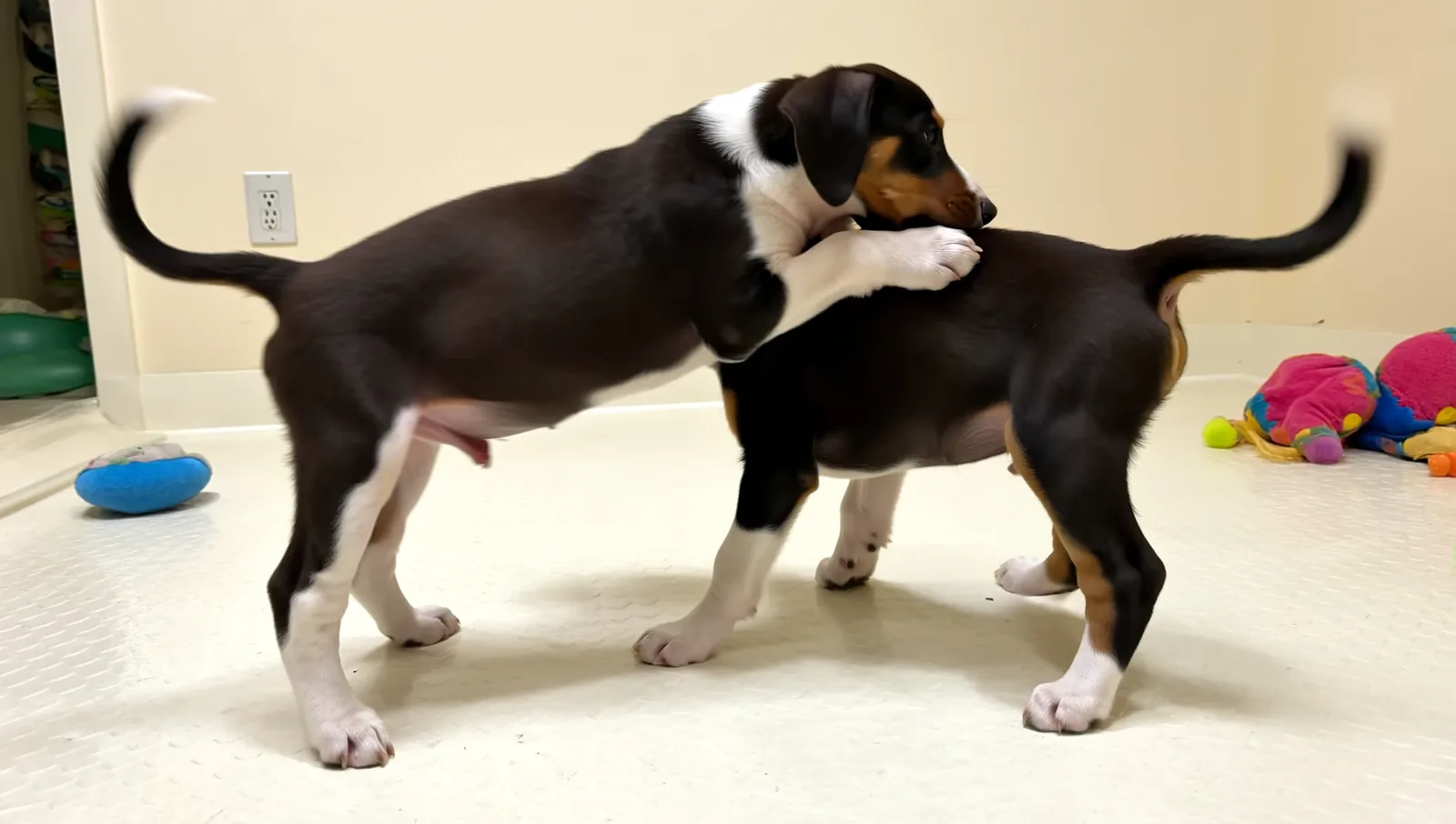
The Socialization Upside, and When It Backfires
There is a genuine case for boarding a young dog, worth stating plainly because the risks above can make it sound like the answer is always no.
Veterinary behaviour guidance has moved firmly toward early, well-managed social exposure. The socialization window closes early, and puppies that meet a variety of people, dogs, surfaces, and sounds before it does tend to become more resilient adults. A confident puppy that has a positive, well-supervised first stay learns that its people leave and then come back, a useful lesson to install early rather than at three years old during a family emergency.
The picture reverses for an under-socialized puppy. A young dog that is already unsure, that has had little exposure outside the home, or that is showing avoidance around strangers will not be fixed by several days in a kennel. Intense, prolonged exposure it cannot escape is not socialization, it is flooding, and it tends to deepen the fear rather than resolve it. That puppy needs graduated exposure first, and a facility honest enough to tell you how it actually went.
The distinction is not the puppy’s age. It is whether the exposure is something the puppy can process at a pace it can handle.
Building Up to the First Overnight
The most reliable predictor of a good first boarding stay is that it was not the puppy’s first anything. Well before the trip, book a tour and let the puppy walk the floor. Follow it with a half-day of daycare, then a full day, then one night before you ever book a week.
Send familiar items: a blanket from home, the food the puppy already eats measured into labelled portions, and a worn t-shirt. Do not switch food and environment in the same week if you can avoid it, because a puppy’s digestion is quick to protest and you will not know which change caused it. Much of the general preparation in our first-time boarding guide applies here, with the timeline stretched: for a puppy, start earlier and add more steps.
Be honest with the facility about house-training status. A puppy that is eighty percent reliable at home is going to have accidents in a strange building, and staff who know that in advance will build in more frequent potty breaks rather than treating it as a surprise.
What to Watch for at Pickup
Some post-stay flatness is normal in any dog. A puppy that sleeps hard for a day, drinks a lot, and is subdued for an evening is usually just catching up. What matters is the trajectory over the following week.
Watch for these:
- House-training regression. The most common one, and usually temporary. Return to the schedule you used when training started rather than assuming the puppy has forgotten.
- Crate or confinement resistance. A puppy that previously settled in its crate and now panics at the door has associated confinement with being left. Rebuild it slowly with food and short intervals.
- New wariness around dogs or people. Particularly a specific type: larger dogs, men, a certain handling style. This is the sign that most warrants a conversation with the facility about what happened during play sessions.
- Appetite that does not recover. A skipped meal on day one is normal. A puppy still eating poorly after two or three days home needs a veterinary call, because young dogs have thin reserves.
- Coughing, nasal discharge, or lethargy. Respiratory illness typically shows up three to ten days after exposure, so the stay looking fine at pickup does not rule it out.
- Loose stool beyond a couple of days, especially with blood or lethargy, which warrants a same-day veterinary call rather than watchful waiting.

Most of these resolve with a return to routine. The general pattern of stress during and after a kennel stay is worth understanding, because a puppy shows the same signs an adult does, just louder and with less reserve. If a behaviour change is still present after two weeks, or if your puppy is frightened rather than simply tired, get a trainer or veterinary behaviourist involved early. Fear learned young is much easier to address in the first month than in the first year.
The Questions Worth Asking on the Tour
- What is your minimum age, and what do you require beyond the core series?
- How long before check-in do you need the Bordetella dose given?
- Who will my puppy play with, and how do you group dogs by size and age?
- How many potty breaks does a puppy get, and who is in the building overnight?
- What happens if my puppy is not coping? Will you call me, and at what point?
A facility that answers these specifically, and that is willing to tell you your puppy is too young or not ready yet, is one worth trusting. A facility that waves the questions away has told you something too. The same instinct applies at the other end of life: our senior boarding guide makes the same argument in reverse, which is that a dog outside the healthy-adult middle needs a facility that adjusts rather than one that simply accepts.
Boarding a puppy well is mostly a matter of timing. Wait for the vaccine series to finish, build up in stages instead of starting with a week, insist on age-appropriate play, and watch the week after carefully. Done in that order, a first stay becomes a useful piece of a young dog’s education rather than something it has to recover from.
Further reading (sources)
- American Animal Hospital Association on how the core puppy vaccine series is scheduled
- American Veterinary Society of Animal Behavior for why early socialization matters more than waiting
- American Kennel Club with a plain-language puppy vaccination timeline
- VCA Animal Hospitals on puppy behaviour and the socialization window
- Merck Veterinary Manual for how maternal antibodies interfere with vaccination