Deposits, Prepayment, and Refunds at Dog Boarding: The Money Terms Owners Sign Without Reading
Published on October 13, 2026

In late August, KTLA reported on a Los Angeles family who paid $10,000 to place their two Bernese Mountain Dogs in a board-and-train program in Studio City that was meant to run for about four weeks. Around 48 hours after drop-off, staff phoned to say that their two-year-old, Dunkin, had died. A loss like that is not a money problem, and the station’s reporting does not say what became of the fee. What the figure does show is the scale of what owners now commit to a long stay: a five-figure sum, handed over under terms that are usually signed at a counter or clicked through online and rarely read again.
This guide covers the money side of long and expensive bookings, from the clauses worth finding before you pay to the order to work through if you need money back. It is general information rather than legal advice. Where the sum is large, or a dog has been hurt or killed, a lawyer who knows consumer law where you live is worth consulting.
Deposit, Prepayment or Package: Know Which One You Are Paying
Boarding businesses take money in three main ways, and each one puts a different amount at risk.
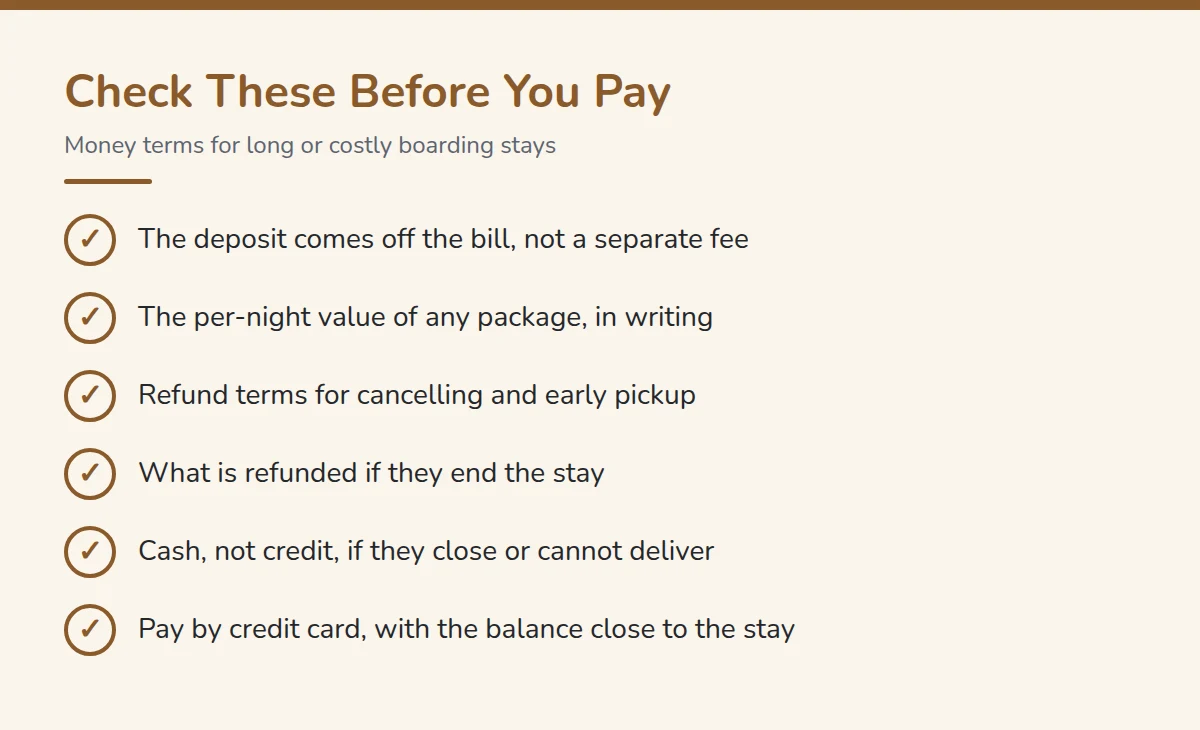
A deposit holds your dates. It is usually a fixed sum or the price of the first night or two, and it should come off the final bill. Check that it does. Some businesses charge a separate booking fee that is never credited and never refunded, which is a different thing wearing the same name.
Full prepayment means the whole stay is charged at booking or at drop-off. It is common for peak weeks, long stays and training programs, and it moves all of the risk onto you. If the stay goes wrong, the question is no longer whether you will pay but whether you can get the money back.
A package or program price bundles a long stay into one figure. That is convenient, and often cheaper per night, but it hides the number any refund will be calculated from: what one night or one week is worth. Ask for that figure in writing before you pay. Spread evenly, the Studio City fee works out at roughly $1,250 per dog per week, but a training program’s price also pays for the trainer’s time, and some contracts treat the whole fee as earned the day the program starts. If the agreement does not say how the price divides across the stay, any argument about unused weeks becomes an argument about arithmetic.

Watch, too, for refunds paid as credit. A credit toward a future stay is only worth something if you would board there again and the business is still trading when you want to. After a stay that ended badly, neither may be true.
The Clauses Worth Finding Before You Pay
Most boarding agreements keep the money terms to a paragraph or two near the signature line. Read them for these:
- Cancellation by you. How much notice you have to give, and what you lose at each point: the deposit, a percentage, or the whole stay. Holiday dates often carry stricter terms.
- Early pickup. What happens to unused nights if you collect early. “No refunds for early departure” is a common line. Ask whether it still applies when leaving early was not your choice.
- A stay ended by the business. The grounds for ending one (behavior, illness, a vaccination problem), how much notice you get, who cares for your dog until you arrive, and what is refunded.
- Closure or cancellation by the business. Whether the refund comes back to your card or as credit, and how quickly.
- Program terms. For board-and-train, when the fee counts as earned, and whether a program that ends in its first week is refunded pro rata. Our guide to vetting a board-and-train facility covers the rest of that contract.
- Veterinary costs. These sit outside the boarding fee. The emergency care authorization you sign at drop-off decides who pays and up to what limit, and it deserves the same reading.
Signing does not make every clause enforceable. In the UK, the Consumer Rights Act 2015 includes a list of terms that may be regarded as unfair, and three of them map directly onto boarding. One lets a business keep your money when you cancel without giving you the equivalent when it cancels. Another makes a customer who pulls out pay a disproportionately high sum for services that were never supplied. A third lets the business keep payment for services not yet supplied when it is the business that ends the contract.
In the US there is no single national rule, so the answer depends on the agreement and on state law. California is one strict example: in a consumer contract for services, a clause that fixes damages in advance is void unless the actual loss would be impracticable or extremely difficult to fix. Whether a particular forfeiture would survive a challenge is a question for a lawyer where you live, but the fine print is not always the final word.
When a Stay Ends Early
Prepaid nights go unused for three broad reasons, and contracts tend to treat them very differently.
Your dog gets sick. If your dog goes to a vet and then home, or you cut a trip short to collect a dog that is unwell, the early pickup clause usually decides what happens to the nights left over. Plenty of operators refund or credit nights lost to a medical departure, but that is a policy rather than a law, so ask before you book. Vet bills are separate and follow the emergency care authorization, which our guide to the incident call covers alongside the kennel’s phone policy. If the illness came from the facility’s own failings, you are in the third group below, not this one.

The facility asks you to collect your dog. Kennels reserve the right to end a stay, and rightly: no business should keep a dog it cannot handle safely. Dogs get sent home for fighting in group play, climbing fences, or failing to settle and eat. The money is the part to settle in advance. Ask what would trigger an early end, whether a quieter setup such as solo turnout would be tried first, who looks after your dog if you are a flight away, and what is refunded. A business that keeps the full fee for nights it has chosen not to provide is on uncomfortable ground in the UK, where the Consumer Rights Act lists that as potentially unfair. If your dog is anxious or reactive, raise all of this at booking, and read our guide to boarding anxious or reactive dogs before you choose.
The facility fails. It closes mid-stay, loses its license, moves your dog somewhere you never agreed to, or harms your dog through neglect. None of that is a cancellation. It is a business failing to deliver what you paid for. In the US, the federal rules behind credit card disputes treat services “not delivered as agreed” as a billing error, and the official commentary to those rules lists delivery of services different from those agreed upon, and late delivery, among the examples. A dog driven to a kennel nobody had told the owner about, as in the Studio City account, is exactly the kind of change our guide to overflow and off-site housing warns about.
In the UK, every service contract carries a duty to perform with reasonable care and skill. When a business falls short, the customer can require it to perform the service again or, where that is impossible or is not done within a reasonable time, claim a price reduction, which can be the full price. Any refund is due within 14 days of the business agreeing to it, by the same method you paid unless you agree otherwise.
If the business has collapsed altogether, US bankruptcy law gives people who paid deposits for personal or household services that were never provided a priority claim, currently capped at $3,800 per person. Priority puts you ahead of ordinary creditors, not at the front of the line, and it only helps if money is left after the claims ranked above yours. When a business closes owing you money, a card dispute is usually the faster route.
One caution for the worst case. The unused part of the fee is the simplest part of any claim after a serious injury or a death. Vet bills, a necropsy and the loss of the dog itself are separate claims and a matter for a lawyer. Do not accept a payment described as a full and final settlement, or sign anything that says so, until you have had that advice. Our guide to what to do when you suspect mistreatment covers documenting what happened.
Why the Way You Pay Matters
The same prepayment can be easy or nearly impossible to recover, depending on whether it went on a credit card, a debit card or a bank transfer.
In the US, paying by credit card brings two federal rights under the Fair Credit Billing Act.
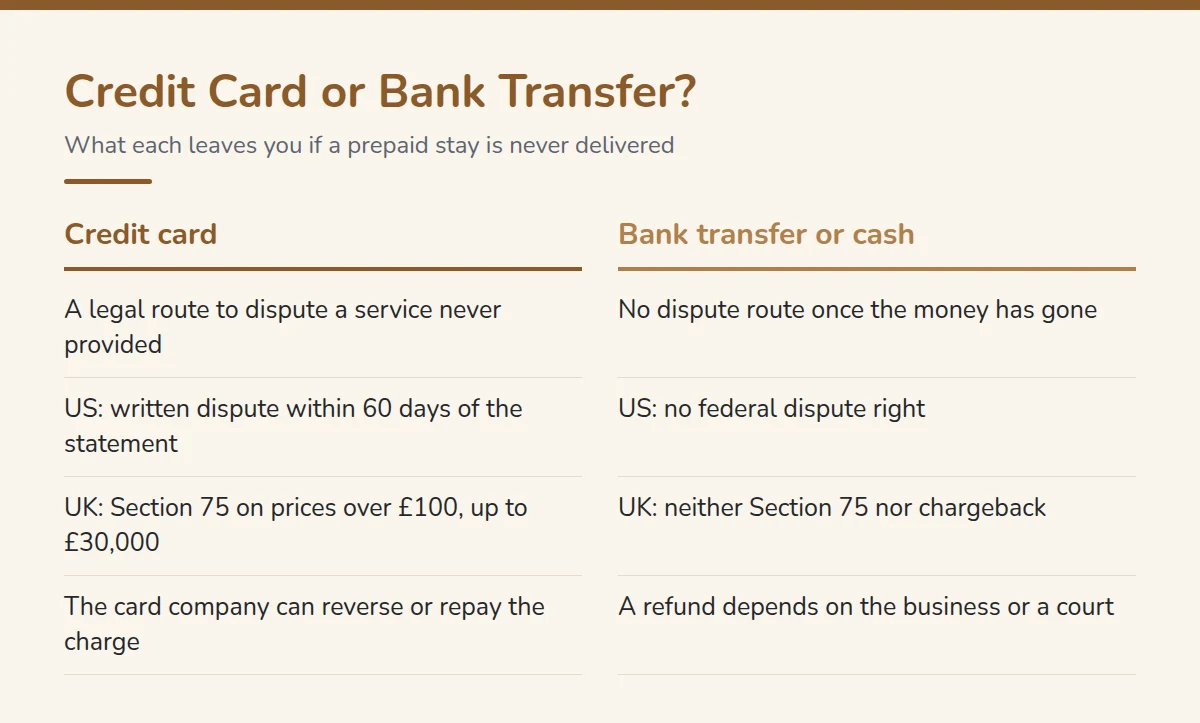
The first is the billing error dispute. A charge for services not delivered as agreed qualifies, and the card issuer cannot reject a non-delivery claim without a reasonable investigation showing the service was in fact provided. You do not have to contact the business first. The catch is time: your written dispute has to reach the issuer within 60 days after it sent the first statement showing the charge. A deposit paid in spring for a summer stay can be outside that window long before anything goes wrong. The FTC’s guidance on late deliveries says that when the expected delivery date falls more than 60 days after the statement, you are likely outside the Act’s protection, though some issuers may extend the dispute period. Ask anyway.
The second lets you raise your claims against the business with the card issuer itself, provided the charge was over $50, it was made in your home state or within 100 miles of your billing address, and you made a good faith attempt to sort it out with the business first. There is no 60-day clock, but it only reaches the part of the charge you still owed the card company when you raised the problem, so it is strongest before the balance is paid off.
A debit card carries neither right. The FTC warns that you may not be able to get a refund for non-delivery on a debit card, and suggests asking your bank about any voluntary protections it offers. A bank transfer, a payment app, a check or cash carries nothing comparable. Once the money has gone, getting it back depends on the business agreeing or a court ordering it.
In the UK, the equivalents are Section 75 and chargeback. Under Section 75 of the Consumer Credit Act 1974, a credit card company shares liability for a business’s breach of contract or misrepresentation when the cash price is over £100 and no more than £30,000. The Financial Ombudsman Service notes that it applies even if only part of the price went on credit, so a deposit paid by credit card can bring the whole booking within it. Debit cards fall outside Section 75, but your bank can raise a chargeback under the card scheme’s rules. A bank does not have to raise one, though the Ombudsman counts a service that was never provided, or a cancellation with no refund, among the usual valid reasons. The time limit is usually around 120 days, which can run from the date you expected the service. A bank transfer gets neither.
The practical rules follow from that:
- Pay deposits and prepayments by credit card where you can.
- Keep the deposit small and the balance close to the stay. For a long stay, ask to pay the balance at drop-off or week by week, which shrinks the sum at risk and keeps each charge close to the nights it pays for.
- Be wary of a discount for paying a large prepayment by transfer or cash. On a weekend stay it can be a fair trade. On a month-long program it is the price of giving up your quickest route back to the money.
- Keep the statement that first shows the charge, and note the date it was sent. In the US, your 60 days run from then.
Getting Money Back: The Order to Work Through
- Gather the paperwork. The agreement, the terms page as it stood when you booked (screenshot it), the booking confirmation, receipts, card statements, messages, and a short timeline with dates. In the UK, what a business says or writes about its service is treated as part of the contract if you took it into account when booking, so keep its website pages and messages too.
- Work out the figure. Unused nights multiplied by the per-night value, or the unearned share of a program, less anything the agreement fairly lets the business keep. A specific number is easier to agree to than a request for “a refund”.
- Ask in writing. Keep it short and factual: what you paid, what was not provided, the figure, the clause you are relying on, how you want it paid (back to the card you used), and a deadline such as 14 days. Calm and specific gets further than angry and general.
- Open a card dispute if the clock is running. A US billing error dispute does not have to wait for the business to reply, and the 60-day window will not wait either. Send it in writing to the issuer’s address for billing inquiries and keep a copy. In the UK, ask your card company about Section 75 or a chargeback. If it turns you down or handles the claim badly, you can complain to the Financial Ombudsman Service.
- Tell someone who can act. In the US, your state consumer protection office takes complaints against businesses, and USAGov keeps a directory of them. If the business is licensed, tell the licensing body too, especially where your dog’s welfare was at stake. In the UK, the Citizens Advice consumer service can advise on the dispute and passes reports to Trading Standards, which can act against a business but will not recover an individual refund.
- Use small claims court as the backstop. It is designed for people without lawyers. In California, for example, an individual can claim up to $12,500, lawyers cannot come to court with you, and the filing fee runs from $30 to $100. Limits elsewhere differ, so check your own court’s website.
Questions to Ask Before You Pay

- Is this a deposit that comes off the bill, or a separate fee?
- What is the per-night or per-week value of this package or program?
- What do I get back if I cancel a month out, a week out, or the day before?
- What happens to unused nights if my dog comes home early because of illness?
- When would you end a stay, and what would you refund if you did?
- If you close or cannot provide the stay, is the refund cash or credit, and how fast?
- Can I pay part now and the rest at drop-off, or weekly for a long stay?
- Can I pay the whole amount by credit card?
Read the Money Terms Like the Welfare Terms
Owners who tour a kennel with a checklist often sign its agreement without reading the paragraph about refunds. The two belong together. A business that sets out plainly what you get back if it ends a stay, if your dog falls ill, or if it cannot deliver what it sold you has thought through how those things happen. One that will not put it in writing has told you something as well.
Further reading (sources)
- KTLA on the Studio City board-and-train death and the $10,000 program fee
- Consumer Financial Protection Bureau with its official commentary on services not delivered as agreed
- Federal Trade Commission for the 60-day dispute window, late deliveries and debit cards
- Legal Information Institute on the right to raise claims against a card issuer
- Legal Information Institute with the bankruptcy priority for consumer deposits
- California Legislative Information for the limit on preset damages in consumer contracts
- California Courts on small claims limits, fees and the no-lawyer rule
- USAGov with its directory of state consumer protection offices
- legislation.gov.uk for the Consumer Rights Act list of terms that may be unfair
- legislation.gov.uk on consumer rights and remedies under a services contract
- Financial Ombudsman Service with how chargeback and Section 75 claims work
- Citizens Advice for reporting a business to Trading Standards