Is Your Kennel's Licence Actually Current? Expired Permits, Renewal Backlogs, and What Unlicensed Boarding Means for Your Dog
Published on October 25, 2026
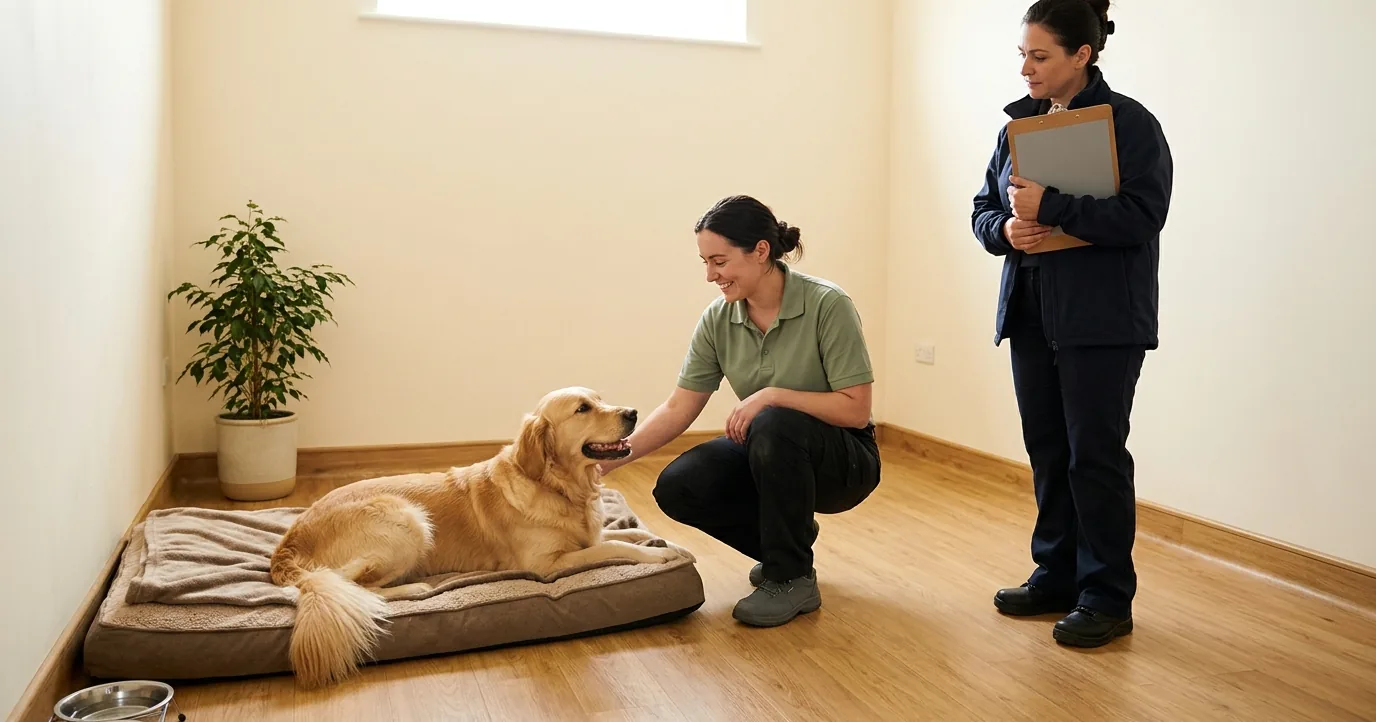
Within a day of each other in October 2026, two boarding kennels made the news for the same paperwork failure, and they could hardly have handled it more differently.
In Carthage, Missouri, the attorney general sued a kennel whose state licence had expired on 31 January 2025 and then again on 31 January 2026. On two separate visits, inspectors documented more than two dozen dogs being boarded there regardless, along with advertising for boarding on the property and beside Highway 59. The operator refused the required annual inspection, told the inspector to leave immediately, and said no further inspections would be allowed. The Jasper County Circuit Court has already entered a default judgment after the operator failed to appear, finding violations of the state’s licensing and inspection requirements and granting a permanent injunction.
On the other side of the Atlantic, a kennel at Beeston Regis, near Sheringham in north Norfolk, closed after the district council refused to renew its licence. The old licence had expired on 19 May. The council received a renewal application on 15 June, inspected on 6 August, and found the kennel short of the minimum standards, handing the operator a list of actions to complete. Dog owners had already noticed something was wrong: several reported cancelled bookings and said the kennel had stopped taking dogs earlier in the summer. The council says north Norfolk is now left with just one licensed kennel.
Neither case, as reported, involves an injured dog, and that is what makes them useful. Most owners check a kennel’s licence once, if they check at all, and assume it stays valid. Licences run to a fixed end date, renewals take weeks, and what happens in between depends on the operator. Here is how the gap opens, how to spot it before you book, and what quietly disappears when a business keeps boarding through it.
Lapsed, Refused, Revoked: Three Different Endings
Owners tend to hear all three of these as “they lost their licence”. They mean different things, and each one tells you something different about the business.
Lapsed. The licence reached its end date without a new one being granted. Nobody has to find a fault for this to happen. Missouri’s licences for boarding kennels run for a year at a time and all of them expire on 31 January. In England, a council grants a licence for one, two or three years, depending on the kennel’s risk rating and standards. A lapse can be pure administration, such as a missed reminder, a late form or an unpaid fee. It can also be a decision by an operator who does not expect to pass the next inspection.
Refused. The operator applied, for a new licence or a renewal, and the regulator said no. In England, a refusal comes after an inspection, and the council must refuse if it thinks the applicant cannot meet the licence conditions or that granting the licence could harm the welfare of the animals. Missouri’s director may refuse to issue or renew a licence for reasons that include breaking the licensing law or its rules, or failing to provide adequate food, water, housing or sanitation. A refusal is a judgement on the premises, or on the operator, as they stood on inspection day.
Revoked. An existing licence is taken away before its end date, usually because conditions are being breached or animals are at risk. This is the enforcement end of the scale. Suspended and surrendered licences sit close to it, and our guide to UK boarding licences and star ratings covers both, including a Shropshire operator who surrendered a suspended licence and kept trading for 18 months.
For a kennel that keeps taking dogs, the legal position is the same in all three cases. Operating a boarding kennel without a valid licence is a class A misdemeanor under Missouri law, and in England, carrying on a licensable activity without a licence is a criminal offence under the Animal Welfare Act 2006. A lapsed licence is not a weaker licence. It is no licence.
Why Renewals Leave Gaps
A renewal is not a form you post. In both systems it means an inspection, and inspections take time to arrange.
In England, a suitably qualified inspector has to visit and report before a licence can be granted or renewed. Councils must write to each licence holder three months before the licence is due to expire, and the statutory guidance says the holder must apply at least 10 weeks before expiry “to avoid incurring a break in the licensable activity”. Councils should aim to decide new applications within 10 weeks, and the guidance accepts it can take longer if information is missing or the inspection is hard to arrange. North Norfolk’s own licensing pages put it more bluntly: “Animal applications take at least 10 weeks to process.”
Run the Norfolk dates against that rule. A licence ending on 19 May needed a renewal application in by about 10 March. The application arrived on 15 June, almost four weeks after the licence had already run out, and the inspection followed seven and a half weeks later. Even if the kennel had passed on the day, it could not have boarded dogs legally for most of the summer. That is the whole reason for the deadline: a licence has a fixed end date, and a slow renewal does not keep the old one alive.
One customer of more than four years told the Eastern Daily Press that their dogs were always happy to go there and obviously well looked after, and that the owner was always happy for them to see the accommodation. The inspection still found the kennel short of the minimum standards. Both things can be true at once, which is exactly why the renewal inspection exists.
Missouri works to a single annual deadline. Every licence and registration under the state’s Animal Care Facilities Act expires on 31 January, the Department of Agriculture asks for renewal applications before that date, and licensed facilities are inspected at least once a year or when someone complains. One date for everybody makes the system easy to check, because a licence not renewed by February is simply expired. The Carthage kennel’s licence lapsed on that date two years running.
A Cancelled Booking Can Be a Licensing Gap
The Norfolk customers found out the way most owners would, through a cancelled booking. Seen from the owner’s side, a lapse rarely announces itself as a licensing problem. It looks like a kennel that suddenly says it is not taking new dogs for now, that cancels confirmed stays with a vague explanation, or that will only take a handful of regulars.

Any of those can have an innocent cause, such as staff shortages, building work or illness. But a kennel that stops boarding because its licence has run out is doing what the law requires, even if the timing ruins your holiday. The business to worry about is the one in the same position that keeps your booking.
When a confirmed stay is cancelled, or a kennel goes quiet before a busy season, ask directly:
- Is your licence current, and what is its end date? A licensed operator knows this without looking it up.
- Has the renewal application gone in, and when is the inspection booked? In England, ask whether it went in at least 10 weeks before expiry.
- If the renewal was refused, are you appealing? An English operator has 28 days to appeal a refused renewal to the First-tier Tribunal, and the tribunal can, on application, let a licence holder keep trading under its licence conditions while the appeal runs. Ask to see that permission in writing. Being in the middle of an appeal is not, on its own, a licence to keep boarding.
- When does my money come back? A business that cannot legally deliver the stay you paid for has failed to supply the service, which is a different thing from you cancelling. Our guide to deposits, prepayment and refunds explains how to recover it, including the card protections that help if the business closes.
A closure also sends its customers to every other kennel in the area at once, often at short notice and in peak season. In north Norfolk, where the council says a single licensed kennel now remains, book early and check the replacement as carefully as the one you lost, rather than taking whoever has space.
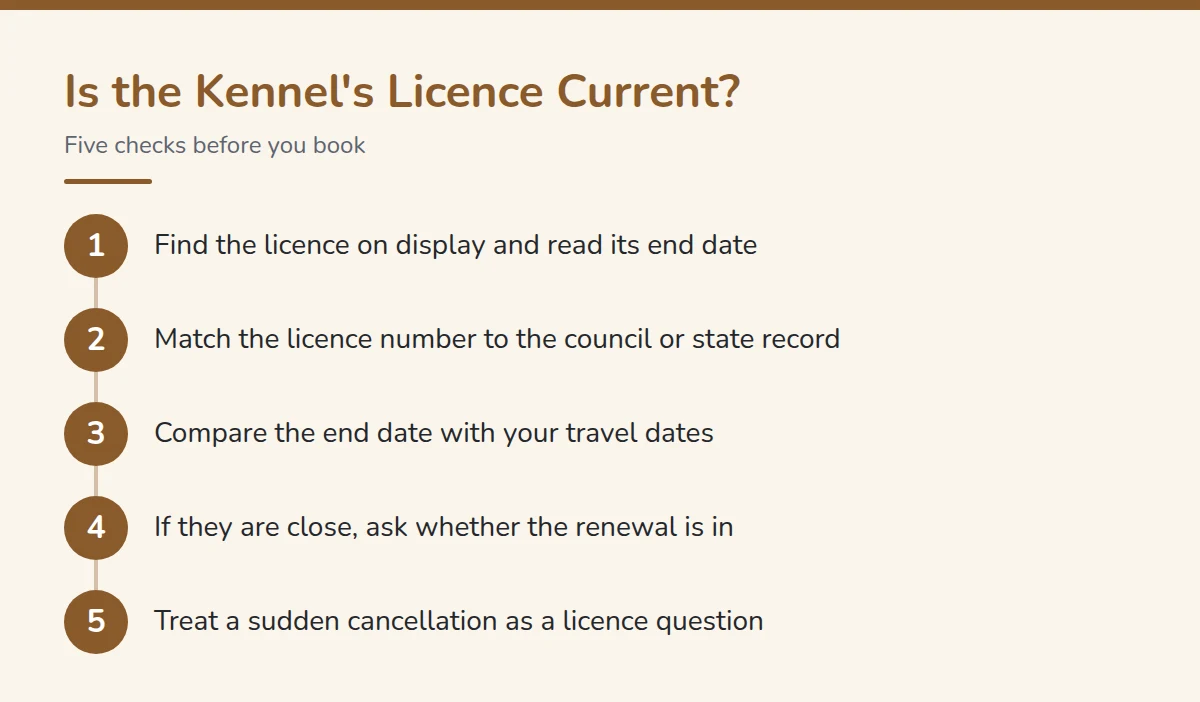
How to Check the Expiry Date Before You Book
In England, three places should show the same licence, and they should agree with each other.
- On the premises. A copy of the licence must be clearly and prominently displayed in a public-facing area such as the entrance, and the licence must show the licensed address. Read the dates on it, and check that the address is the building you are standing in. Our guide to confirming where your dog actually sleeps explains why that second check matters.
- On the website. The name of the licence holder, followed by the licence number, must be clearly and prominently displayed on any website the business uses for boarding. A boarding website with no licence number on it is a question to ask before you pay.
- On the council register. Many councils publish a register of licensed animal businesses. North Norfolk’s lists each one with its licence number, its licensed activities, its star rating and its licence dates, in the form “01/05/2025 to 30/04/2028”. Find the council from the kennel’s postcode, find the business by its address, and read the end date.
Then compare that end date with your travel dates. If the licence expires before or during your stay, ask whether the renewal application went in on time and when the inspection is booked. I would not book a stay that runs past the end date without that answer in writing. Wales and Scotland still license boarding annually under the older 1963 Act, so the same check applies there every year.

In the US, start with a more basic question: does your state license boarding kennels at all? Not every state does, and where it does not, a city or county kennel permit may be the only paperwork that exists. Where there is a state licence, it is often issued by the state department of agriculture, as in Missouri and Pennsylvania.
- Missouri. Ask for the kennel’s licence number and check it with the Missouri Department of Agriculture. Every licence expires on 31 January, so a stay in February or later needs this year’s licence, not last year’s. The state keeps inspection reports on file and makes them available to the public on request.
- Pennsylvania. The Department of Agriculture runs a public kennel search that you can filter by county and kennel type, including boarding kennels. Each listing shows the licence number, its status, the last year a licence was issued and the kennel’s inspection reports. If the last licence year has fallen behind the calendar, ask why before you book.
- Everywhere else. Ask the kennel which body issued its licence or permit, ask for a copy, and read the expiry date yourself. A business with a current licence can usually produce it in seconds.
A wall of badges will not answer the question. Trade association logos and training certificates are not licences, and as our guide to what boarding certifications actually mean explains, even genuine credentials have renewal dates of their own.
What Your Dog Loses When the Licence Lapses
On the day a licence expires, the building and the staff stay the same. What changes is everything that was watching them.
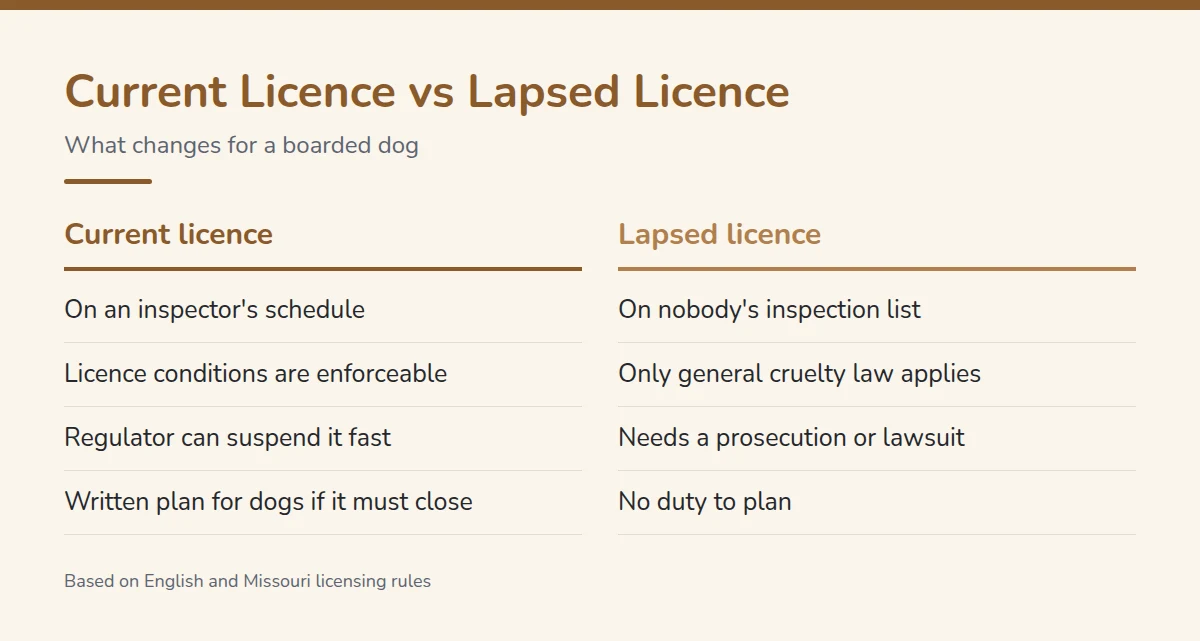
The inspection. A licence is what puts a kennel on an inspector’s calendar. Missouri inspects every licensed facility at least once a year or on complaint, and its program covers breeders, shelters, pet shops, sitters and boarding kennels across the state with eighteen field staff. An English licence comes with an inspection before every grant or renewal, and the statutory guidance pairs every star rating with at least one unannounced visit during the licence term. An unlicensed kennel is on nobody’s list. The Carthage operator went further and turned the inspector away, and the attorney general’s suit asked the court for authority to conduct inspections.
Enforceable standards. Licence conditions are where the specific rules live: space, staffing, records, the emergency plan, vaccination checks and the maximum number of dogs on site. Our guide to licensed capacity and staff ratios shows how much of a kennel’s safety margin sits in those conditions. They bind licence holders. General animal cruelty and neglect laws still apply to anyone caring for your dog, but those laws mostly act after harm has been done, not before it.
A plan for the day the business has to stop. English kennel licence conditions require written procedures for the care of the animals if the licence is suspended or revoked. That plan is a licence condition, so an operator trading without a licence is not bound by it, and the moment it would matter most is the moment a regulator finally steps in while your dog is still inside.
A fast route for complaints. When a licensed kennel goes wrong, the regulator has quick tools. An English council can suspend a licence with immediate effect where that is needed to protect an animal’s welfare. Against an unlicensed business there is nothing to suspend. Missouri’s main route is a court action: the director can ask the attorney general or a county prosecutor to seek an injunction, and the court can add a civil penalty of up to $1,000 for each violation. That works, as Carthage shows, but it moves at the speed of a court, and the dogs boarded there in the meantime stayed in a kennel that had refused its annual inspection.
The paperwork you can still check. Ask to see the kennel’s liability insurance certificate as well as its licence, and read the dates on both. A business that has let one renewal slide is worth checking for others. If a kennel is trading without a licence, do not assume its insurance will respond to a claim the way you expect.
If You Find a Kennel Boarding Without a Licence
A lapsed licence is not, by itself, evidence that your dog is in danger. It does mean nobody is checking. If your dog is booked in, move the booking. If your dog is already there and anything about its care worries you, arrange to collect it.
Then tell the people whose job it is to act:
- In England, contact the animal licensing team at the council for the area where the kennel sits, not the town in its business name.
- In Missouri, report unlicensed or substandard facilities through the Department of Agriculture’s Operation Bark Alert webform or its complaint form. Be aware that complaints, including names and allegations, are public records under the state’s Sunshine Law. The attorney general’s office also takes complaints about animal care facilities.
- Elsewhere in the US, report to the state agency that issues kennel licences, or to local animal control where no state licence exists.
Keep the evidence regulators find useful: booking confirmations, adverts, receipts and any messages in which the business talks about its licence. The Carthage inspectors recorded the advertising on the property and beside the highway for a reason: advertising a service the business is not licensed to provide is evidence in its own right.
The Bottom Line
A kennel licence is a dated document, and the date is the part almost nobody reads. Check the end date against your travel dates, ask whether the renewal is in when the two are close, and treat a sudden cancellation as a question about the licence rather than plain bad luck. A kennel that stops boarding while its licence is sorted out has shown you it takes the rules seriously. A kennel that keeps your booking through the gap has shown you the opposite, and the inspection your dog was relying on is the first thing it gave up.
Further reading (sources)
- Missouri Attorney General’s Office on the lawsuits that include the Carthage boarding kennel case
- Eastern Daily Press for the north Norfolk kennel that closed after its renewal was refused
- North Norfolk District Council with its animal licensing register and processing-time warning
- GOV.UK on the renewal deadline, inspections and refusals in the licensing process guidance
- GOV.UK for the kennel licence conditions on display, websites and contingency procedures
- legislation.gov.uk with regulation 24 of the 2018 licensing regulations, on appeals against a refused renewal
- legislation.gov.uk, section 13 of the Animal Welfare Act 2006, the offence of trading without a licence
- Missouri Department of Agriculture on Animal Care Facilities Act licensing, the 31 January expiry and annual inspections
- Missouri Revisor of Statutes for section 273.329, refusing or revoking a licence and the penalty for operating without one
- Missouri Revisor of Statutes with section 273.347, court action and civil penalties for unlicensed operation
- Pennsylvania Department of Agriculture on its public kennel inspection search