The Daily Report Card at Dog Boarding: What Handlers Should Actually Record and Why Behaviour Beats Biomarkers
Published on October 16, 2026
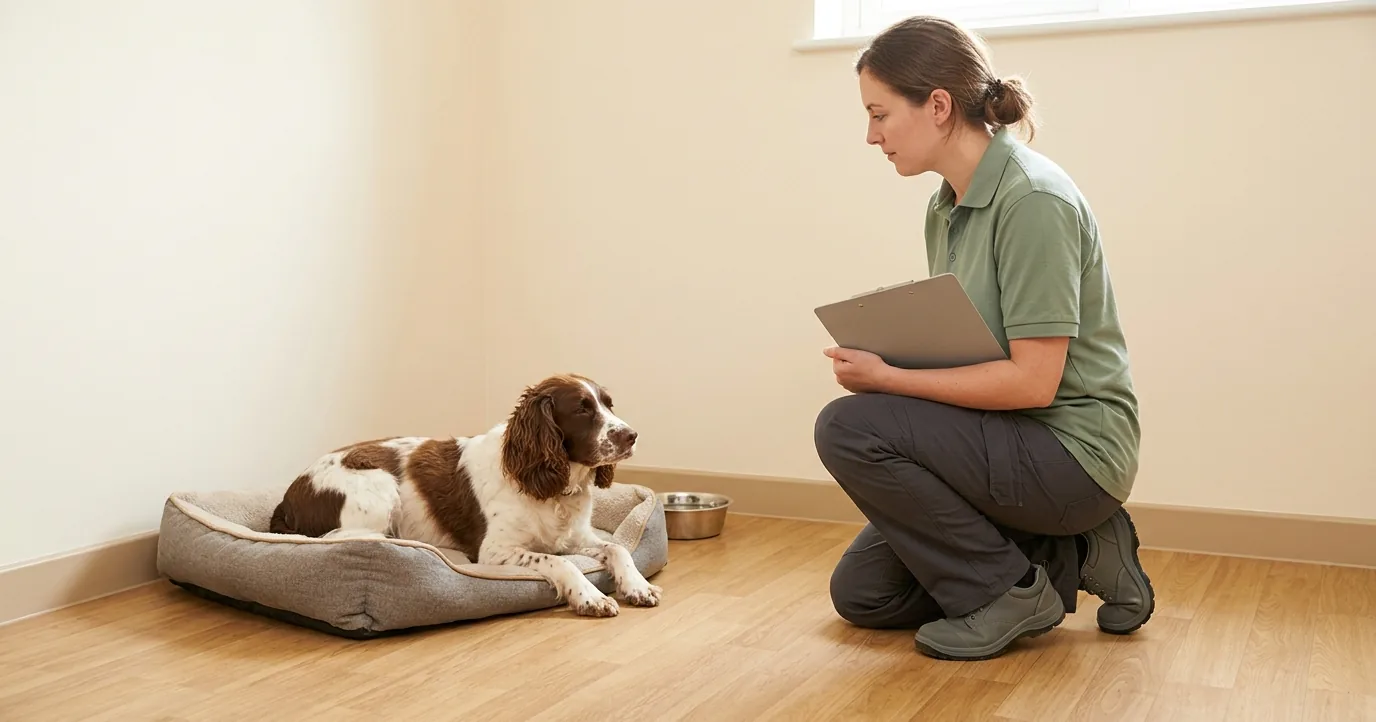
Most boarding updates look alike. A photo of your dog on the play-yard turf, mouth open in what looks like a grin, and a line underneath: “Had a great day! Ate well, played with friends, such a sweetheart.” It lands at the same time every evening, and by the third day you notice it is the same sentence. It is reassuring, and it tells you almost nothing about how your dog is coping.
For most owners, that report is the only evidence of what happens between drop-off and pickup. A 2025 study of 224 shelter dogs from the University of Pennsylvania’s veterinary school suggests what it should contain: what the dogs did in their kennels lined up with what happened to them far more clearly than their stress hormones did. That points to a report built on what a trained handler saw, in amounts and times, rather than a lab number or a flattering photo. Here is what a handler should log each day, why the photo is not the record, how to read a templated update, and what to ask a facility that sells stress scores.
What the Penn Study Found
Lauren Powell and colleagues enrolled 224 dogs at three Pennsylvania shelters between October 2023 and July 2024. Each dog was filmed in its kennel and gave a fecal sample twice: within 48 hours of arrival, and again seven to nine days later. The team coded the videos for behaviour and tested the samples for cortisol, the body’s main stress hormone, and for immunoglobulin A (IgA), an antibody researchers have explored as a stress marker. Then they compared both sets of measures with what eventually happened to each dog.
Behaviour lined up with those outcomes, and the biomarkers mostly did not. Dogs that were later reclaimed by their owners panted more at intake. Dogs that were later euthanized or transferred to another organisation spent less time sitting than dogs that were adopted. Among dogs still in the shelter after a week, the ones later adopted or transferred spent more time standing with their front paws up against the kennel, and more time wagging their tails, than dogs that were euthanized.
The hormone results were murkier. Adopted dogs had higher cortisol than transferred dogs at intake, the reverse of what you might expect, and the gap had closed by the one-week sample. IgA was not related to outcomes at all. The authors concluded that in-kennel behavioural observation may give shelters the most useful information for assessing stress, and that the biomarkers offered no definitive insight.
A shelter is not a boarding kennel, and the study tracked adoptions and euthanasia rather than how the dogs felt. Its lesson still carries over. The most informative record of how a kennelled dog was doing came from watching it, and watching is the one tool every boarding facility already has.
Why a Stress Hormone Reading Says Less Than It Seems
Cortisol sounds like an objective answer to the question owners actually care about. It is less tidy than it looks, for three reasons.
It measures arousal, not misery. When Part and colleagues tested 29 owned dogs at home and in boarding kennels, cortisol and another arousal marker in their urine were higher in the kennels, but the authors called the emotional meaning ambiguous and found no definitive evidence of distress. The hormones, they concluded, track arousal, and they suggested that a dog’s spontaneous behaviour may be the better guide to what that arousal means for an individual. A dog thrilled by group play and a dog frantic in its run can both post a high number, which fits the Penn finding that adopted dogs arrived with higher cortisol than transferred ones.
It describes yesterday. When Schatz and Palme traced cortisol through dogs’ bodies, the breakdown products that fecal tests detect peaked in the stool about a day after the hormone entered the bloodstream, and both the timing and the baseline levels varied from dog to dog. A sample collected on Tuesday morning is largely a report on Monday.
It needs a baseline almost nobody has. Without a reading from the same dog at home on an ordinary day, a single kennel result has nothing to be compared with.
Behaviour has none of those problems. It happens now, it is seen by someone who can act on it, and it can be written down in a sentence.
What a Handler Should Record Each Day
England’s licensing guidance for boarding kennels is one of the few rulebooks that spells out what must be watched and written down. Each dog’s behaviour must be monitored daily, with changes recorded and acted on where they show suffering, stress, fear or aggression. Food and water intake must be monitored and problems recorded, the presence or absence of urine and faeces checked daily, and records kept for three years for inspectors. Colorado requires boarded animals to be observed daily for signs of injury or illness, but its recordkeeping rules centre on vaccinations, veterinary agreements and treatment rather than a daily behaviour log. Plenty of places have no boarding rules at all.
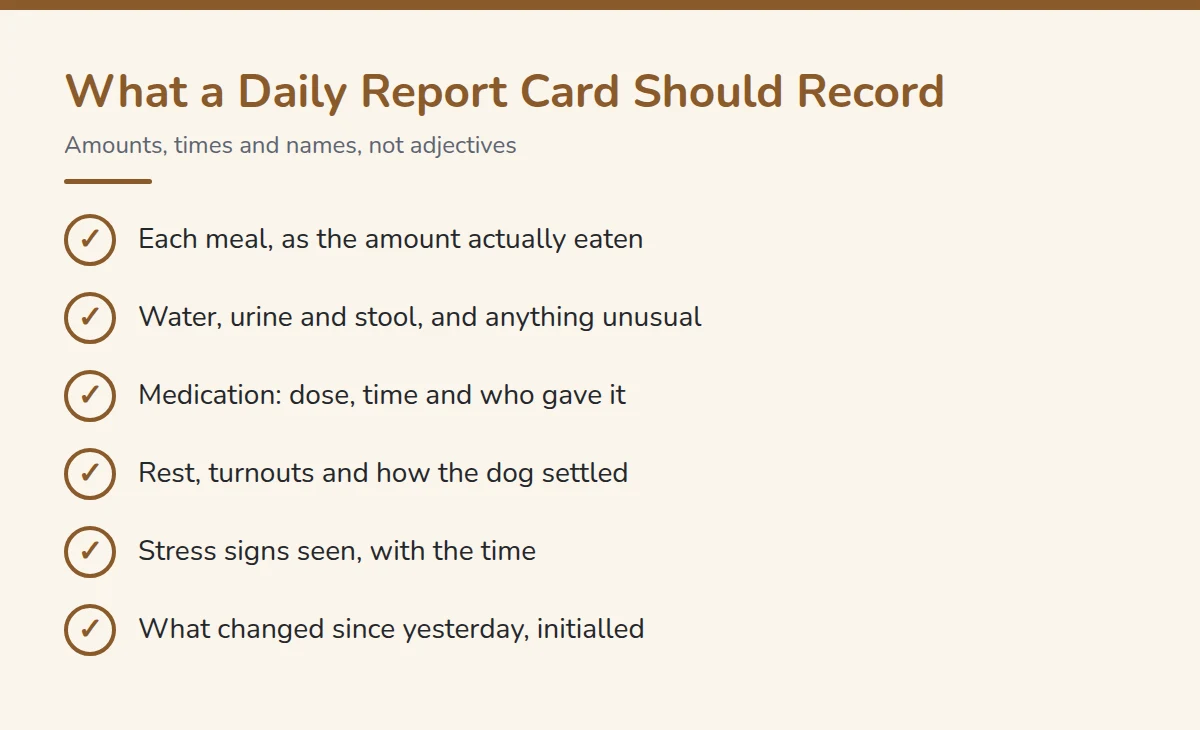
Whatever the local law, a usable daily record for each dog covers the same ground:
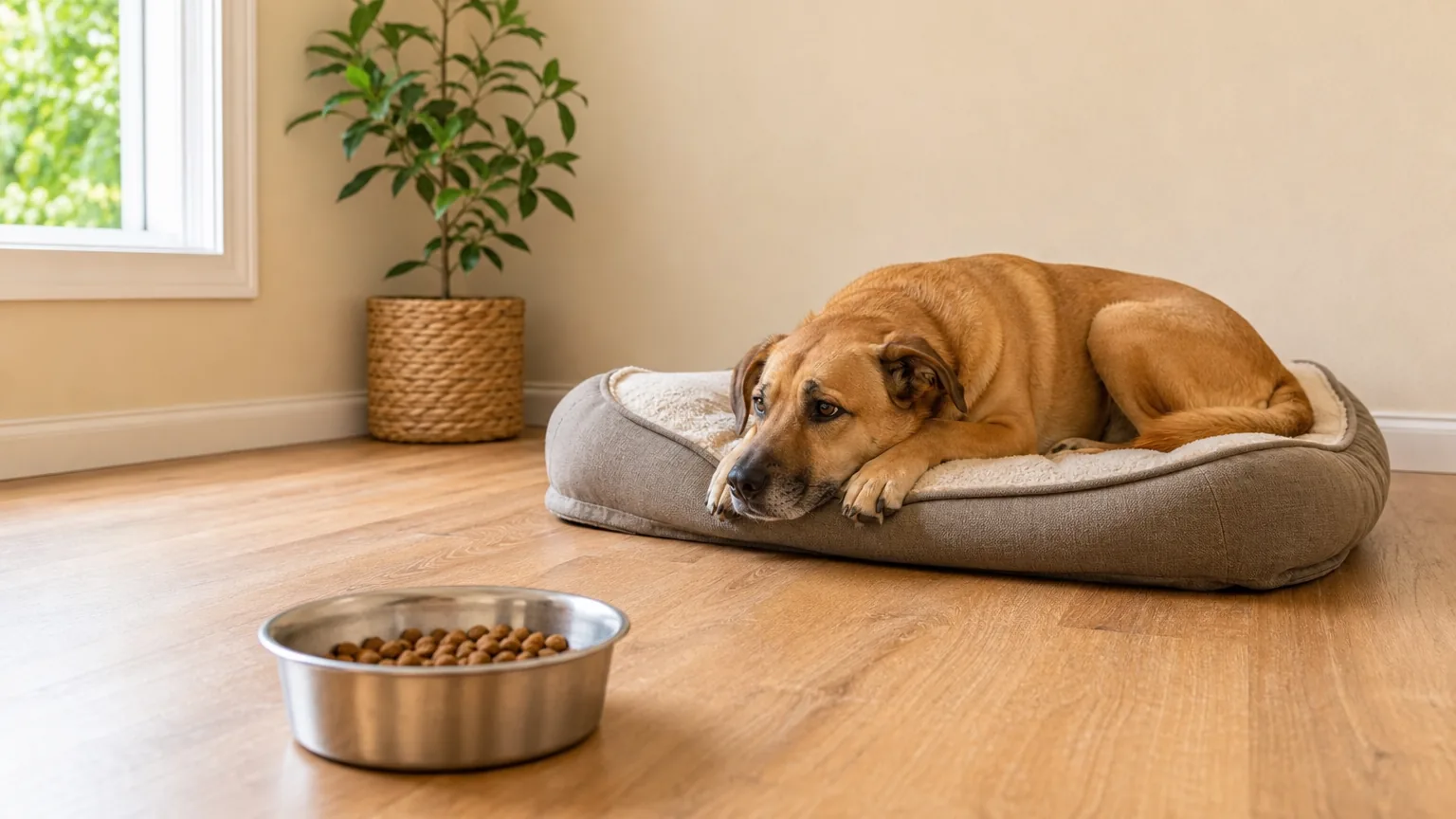
- Each meal, in amounts. What was offered and how much was eaten: half of breakfast, all of dinner, left the topper. “Ate well” is not an amount. England’s guidance requires a dog that stays off its food for more than 24 hours to be monitored, with a vet consulted if there are concerns, and our boarding feeding guide sets out where the lines sit for puppies, toy breeds and diabetic dogs.
- Water. Normal, little or a lot. Under the English rules, a dog that is not drinking, or is drinking far more than usual, is a reason to seek veterinary advice.
- Urine and stool. Whether the dog went, and what the stool looked like. A soft stool on day two is common and worth a line.
- Medication. The drug, the dose, the time it went in and who gave it. Colorado requires a treatment record for any medication given while an animal is in a facility’s care.
- Rest. Whether the dog lay down and slept in its own space, how long it took to settle after turnout, and what the night check found if there is one.
- Exercise. Each turnout, how long it lasted, and whether the dog went out alone or in a group.
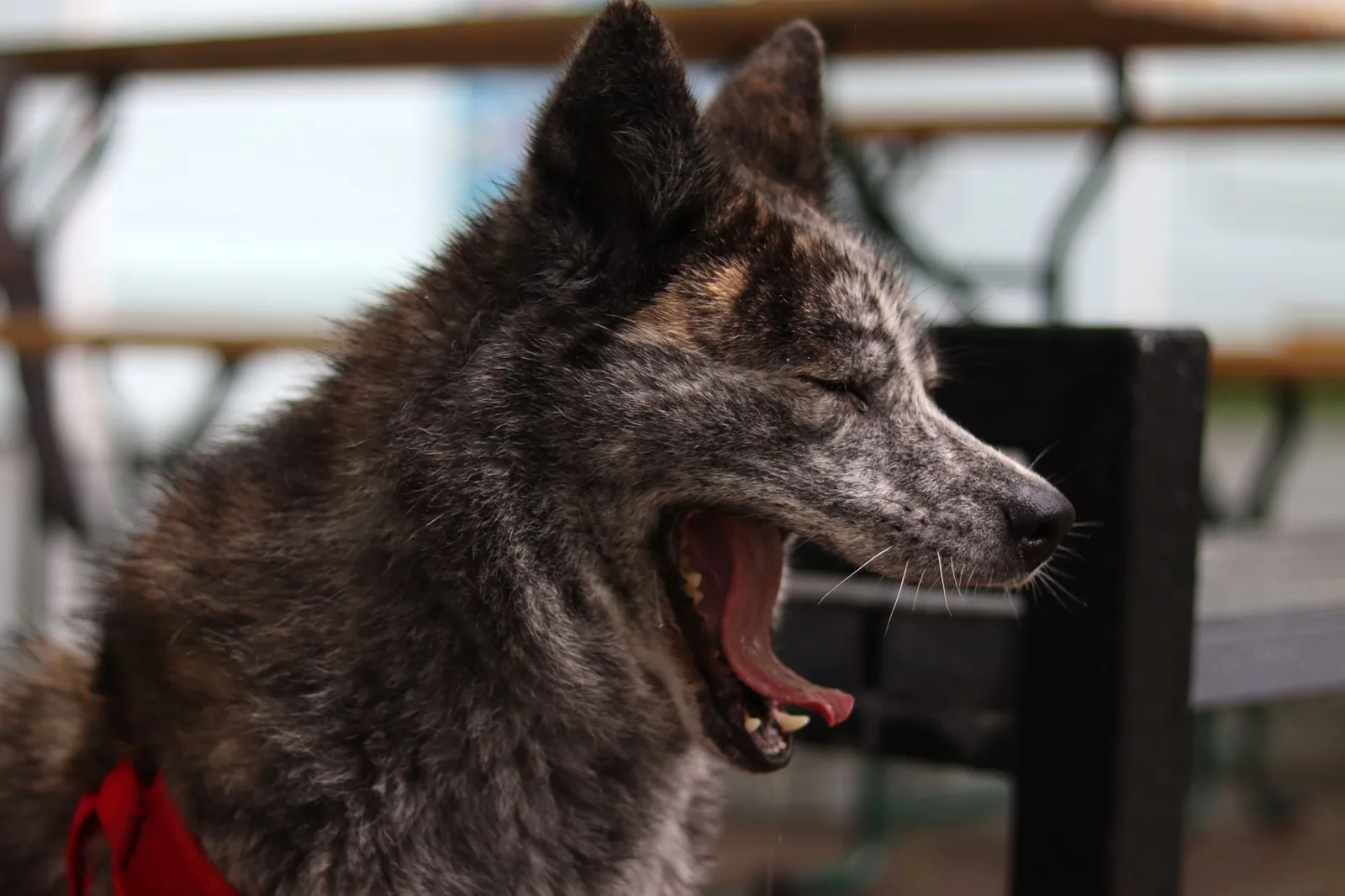
- Stress behaviour, with a time. Pacing, panting in a cool room with no exercise to explain it, lip licking, long yawns, whining, ears pinned back, a tucked tail, paw lifting, spinning, and licking or chewing at itself. These are the signals researchers count. Hecker and colleagues, logging shelter dogs daily for a week, found that lip licking, whining and ears held back separated dogs housed alone from dogs housed in pairs. Beerda and colleagues found that a lowered posture, more self-grooming, paw lifting, vocalising and repetitive behaviour marked chronic stress in beagles moved from group pens into small solitary kennels. Our guide to kennel stress in dogs covers the full vocabulary.
- How the dog meets people. Does it come to the front when a handler approaches, wag and look for contact, or stay pressed against the back wall? In the Penn study, outcomes for dogs still there at one week were largely tied to those human-directed behaviours.
- What changed since yesterday. This is the most useful line on the sheet. A dog that ate everything on day one and half on day three is telling you something no single entry can.
- Who wrote it, and when. Initials and a time turn a note into a record somebody can be asked about.
Not every facility will send all of that to you, and it does not need to. The care sheet should hold it, and the report card should be drawn from it. Our hour-by-hour look at a boarded dog’s day shows where most of those entries get made: the morning walk-through, the feeding and medication rounds, the turnouts and the night check.
Why a Smiling Photo Is Not a Welfare Record
Photos are the part of the update owners look forward to, and they are worth having. They show that your dog is there, that the suite is clean, that the bedding you packed is in use, and that your dog still looks like your dog. What they cannot show is how the day went.
A photo is one frame, picked by a busy staff member from the best part of the day, usually the play yard or treat time. Most of a boarded dog’s day is spent in its own space, and that is where stress tends to show, often between staff visits and as movement rather than a pose: a pace along the front of the run, a yawn that goes on too long, a flick of the tongue across the lips. In one experiment, Albuquerque and colleagues found that dogs licked their mouths more often when looking at faces showing negative emotion than positive ones, and more often at human faces than at dogs’ faces. That is the kind of signal that happens off camera.
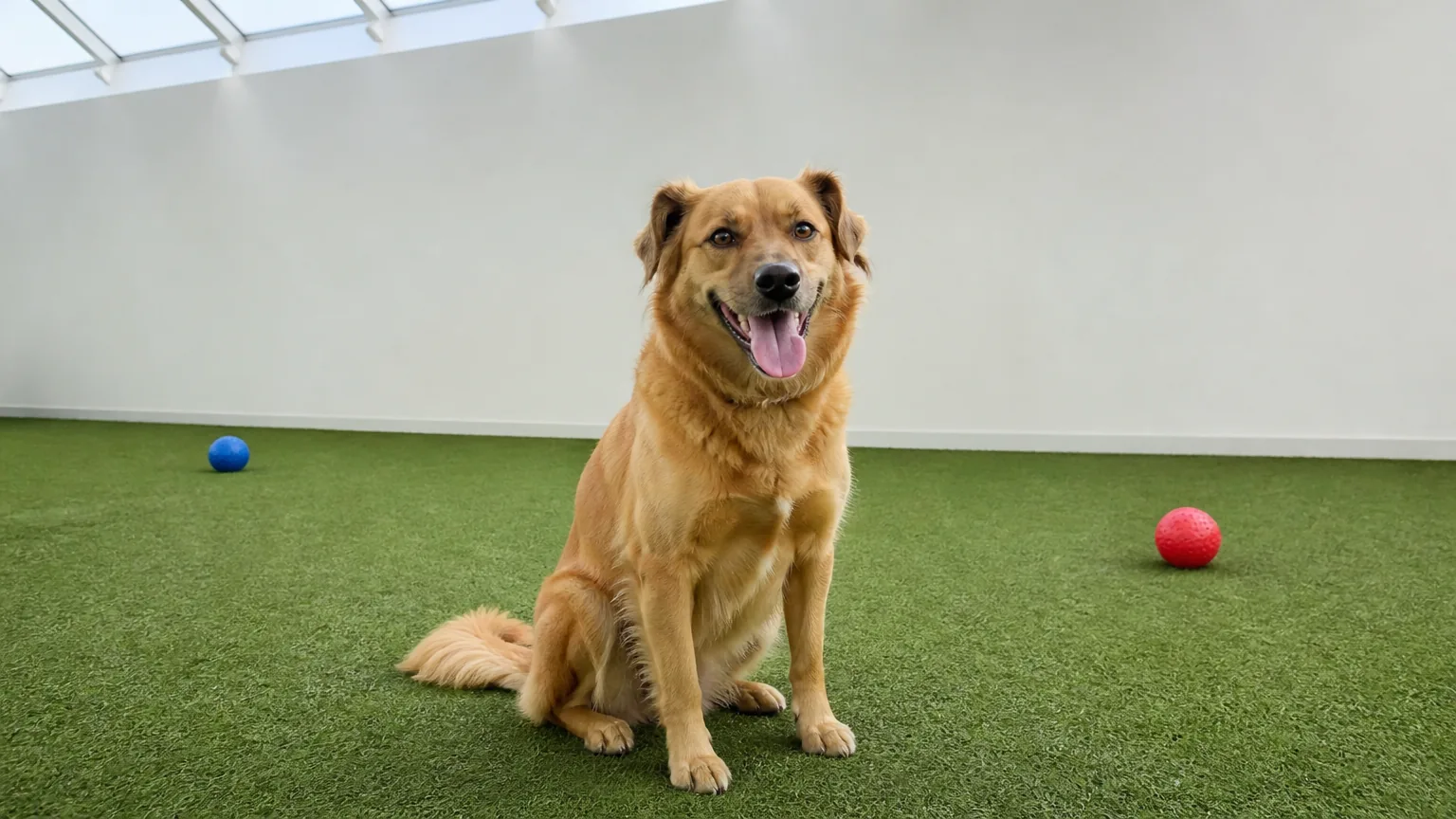
The open-mouthed grin is the hardest picture to read. A relaxed dog, a hot dog and a stressed dog can all show it, and a VCA veterinary guide notes that a dog panting when it has not been exercising may be stressed. Context is what tells you which one you are looking at, and a single photo strips the context away.
There is a problem on the viewer’s side too. Wan and colleagues showed 2,163 adults video clips of dogs that experts had classed as happy or fearful. Between 90 and 93 percent recognised the happy dogs, whatever their experience. Spotting fear depended on it: about 30 percent of people who had never lived with a dog got it right, against more than 70 percent of dog professionals. A happy-looking photo plays to the skill nearly everyone has and asks nothing of the one most owners lack. That second skill is what you pay a trained handler for, and their notes are where it should show.
If photos come with the package, ask for one of your dog resting in its own suite as well as one from play, and a short video now and then, since video catches movement a still cannot. Live webcams have the same limit: they show whatever moment you happen to be watching.
How to Read a Bland or Templated Update
Many kennels now send updates through their booking app, and much of that software comes with a report card template: tick boxes for meals and toilet breaks, a photo slot and a free-text line. Templates are not the problem. A template filled in from real observation is a good record. The trouble is a template filled in from habit, and these are the signs you are reading one:
- Every box is ticked every day. Dogs have off days, and many have an unsettled first day or two. Seven identical days usually means seven identical clicks.
- Adjectives instead of amounts. “Ate great” and “good potty” are opinions. “Ate three-quarters of breakfast” is a fact.
- No times and no names. Nothing anyone could be asked about later.
- Play and nothing else. The update covers turnout and photos, but not rest, stool, water or medication.
- The same sentence on a different day. Or, if you board two dogs, the same sentence for both.
Here is what a useful entry looks like, in the plain shorthand a busy handler might actually write:
Tuesday. Breakfast: ate about half, finished it when offered again at 10. Dinner: all of it. Drinking normally. Stool firm in the morning, a little soft at 4. Paced for about 15 minutes after the morning clean, then settled on her bed. Some lip licking when the dog next door left. Two solo turnouts, 20 minutes each. Came to the front wagging at the evening check. Asleep at the 10 p.m. round. (JT)
Nothing in that entry is alarming, and all of it is useful. If half a breakfast turns into half a dinner tomorrow, someone will notice, and so will you.
When an update is vague, turn it into questions whose answers are numbers or times, the approach that also works on a vague incident call. How much did she eat at each meal? When did he last pass a normal stool? Did she sleep in her suite today? You can also ask to see the care sheet itself rather than the app’s summary. A facility that can produce its notes is one that keeps them, and one with nothing behind the template has told you what you needed to know.
Keep the report card in its lane, too. Day-to-day observations belong in the report. Anything that changes the care plan, such as a vet visit, an injury, two refused meals in a row or a move to isolation, should make your phone ring rather than wait for the evening update.
What to Ask a Facility That Sells Stress Scores or Wellness Testing
Some facilities offer more than a report card: a daily stress score, a “wellness check”, or a health test sold as an add-on. A score can be useful when it is done well. These are the questions that show whether it is.
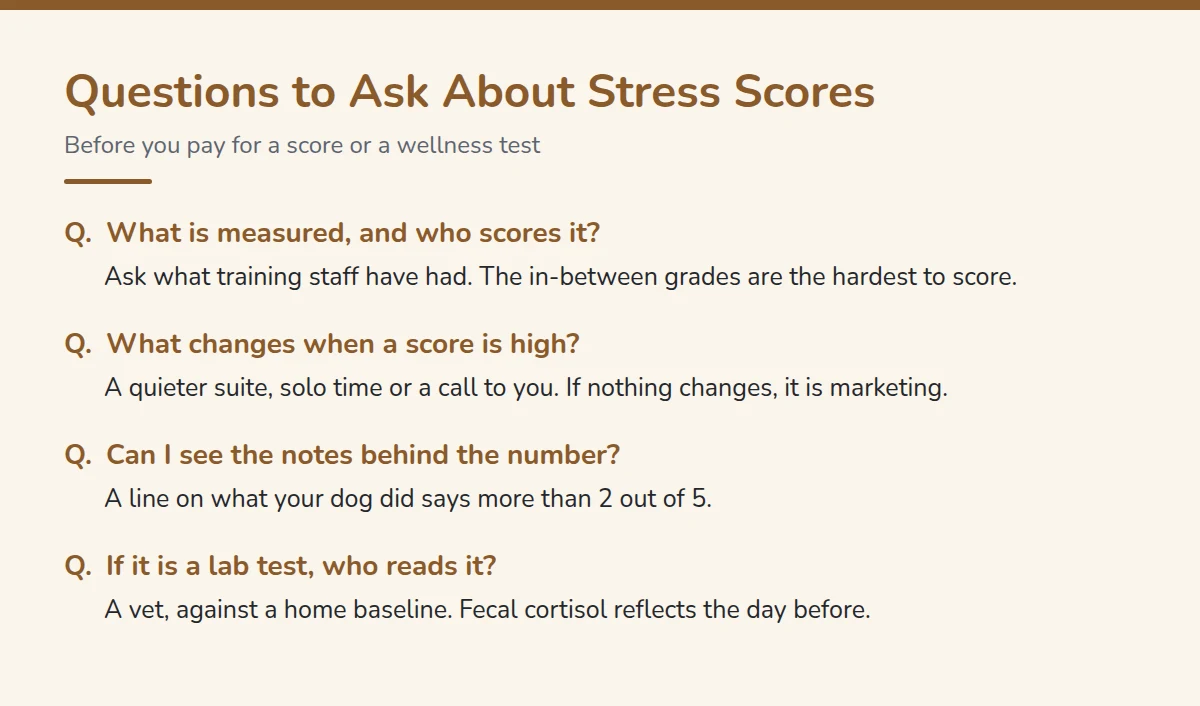
What exactly is measured, and who measures it? A behaviour score is only as good as the person giving it. One widely used scale, Fear Free’s 0 to 5 spectrum of fear, anxiety and stress, was designed for veterinary visits, not a week in a kennel. When Gatehouse and colleagues tested it in 2025, with 79 owners, vets, behaviour experts and trainers scoring videos of dogs in mock examinations, the raters agreed closely overall. But the in-between grades, where the subtle signs sit, were the hardest to place correctly, and owners and behaviour experts differed on some moderate and severe signs. The authors called for design tweaks and proper training for anyone using the scale. Ask what training the staff scoring your dog have had.
What changes when the score is high? The test of any score is whether it changes your dog’s care: a quieter suite, more time alone with a handler, a different feeding plan, a call to you or a vet. England’s guidance already requires dogs showing signs of nerves or stress to be kept in a suitable part of the kennel. A number that is recorded and then changes nothing is marketing.
Can I see the notes behind the number? “Stress: 2 out of 5” tells you less than “paced and whined for 20 minutes after drop-off, settled by noon”. Ask for both.
If it is a lab test, what does it describe, and who reads it? Ask when the sample was taken, since a fecal cortisol result largely reflects the day before, and what it is compared with, since a kennel reading with no home baseline has nothing to be measured against. Ask, too, whether a veterinarian reviews the results. Interpreting hormone and immune markers is a veterinary job, and a result that worries you belongs with your own vet, not the front desk. In the Penn study, neither cortisol nor IgA gave a definitive signal about how the dogs would fare, and a one-off reading at a kennel is unlikely to tell you more.
The Bottom Line
A boarding report card is the closest thing you get to a medical chart for your dog’s stay, so read it like one. Amounts, times, initials and changes from yesterday are the marks of a real record. A happy photo and a cortisol number can both look like proof, and neither shows how your dog is coping between visits. What a trained handler sees at the front of the suite, written down every day, does. If the facility can show you that log, your dog was being watched. If it cannot, the photo was never the evidence it looked like.
Further reading (sources)
- Powell and colleagues on in-kennel behaviour versus fecal cortisol and IgA in 224 shelter dogs
- Part and colleagues for what stress hormones meant in owned dogs moved from home to a boarding kennel
- Schatz and Palme with how long cortisol takes to show up in a dog’s stool
- Hecker and colleagues on daily stress behaviour in shelter dogs housed alone or in pairs
- Beerda and colleagues covering the behaviours that marked chronic stress in kennelled beagles
- Albuquerque and colleagues on mouth licking as a response to negative facial expressions
- Wan, Bolger and Champagne for how experience shapes whether people spot fear in dogs
- Gatehouse and colleagues with a reliability test of the Fear Free stress scale
- VCA Animal Hospitals on stress signals such as panting without exercise and pinned-back ears
- GOV.UK for England’s kennel rules on monitoring behaviour, food, water and toileting
- Legal Information Institute with Colorado’s daily observation rule for boarded animals
- Legal Information Institute on Colorado’s recordkeeping rules, including treatment records