Dog Boarding Certifications Explained: What PACCC, IBPSA, Fear Free, and the Rest of the Badges Actually Mean
Published on September 15, 2026

Scroll to the bottom of almost any boarding kennel’s website and you will find a row of logos. An acronym in a circle. A shield with a paw in it. A ribbon that says “Voted Best Pet Resort.” They sit together in one tidy strip, the same size, the same weight, implying they are the same sort of thing. They are not. That strip usually contains four completely different categories of claim: a credential one human being earned by sitting an exam, an accreditation a building passed by being inspected, a membership somebody bought with a credit card, and an award readers voted for online. Only some of those involve anyone checking anything.
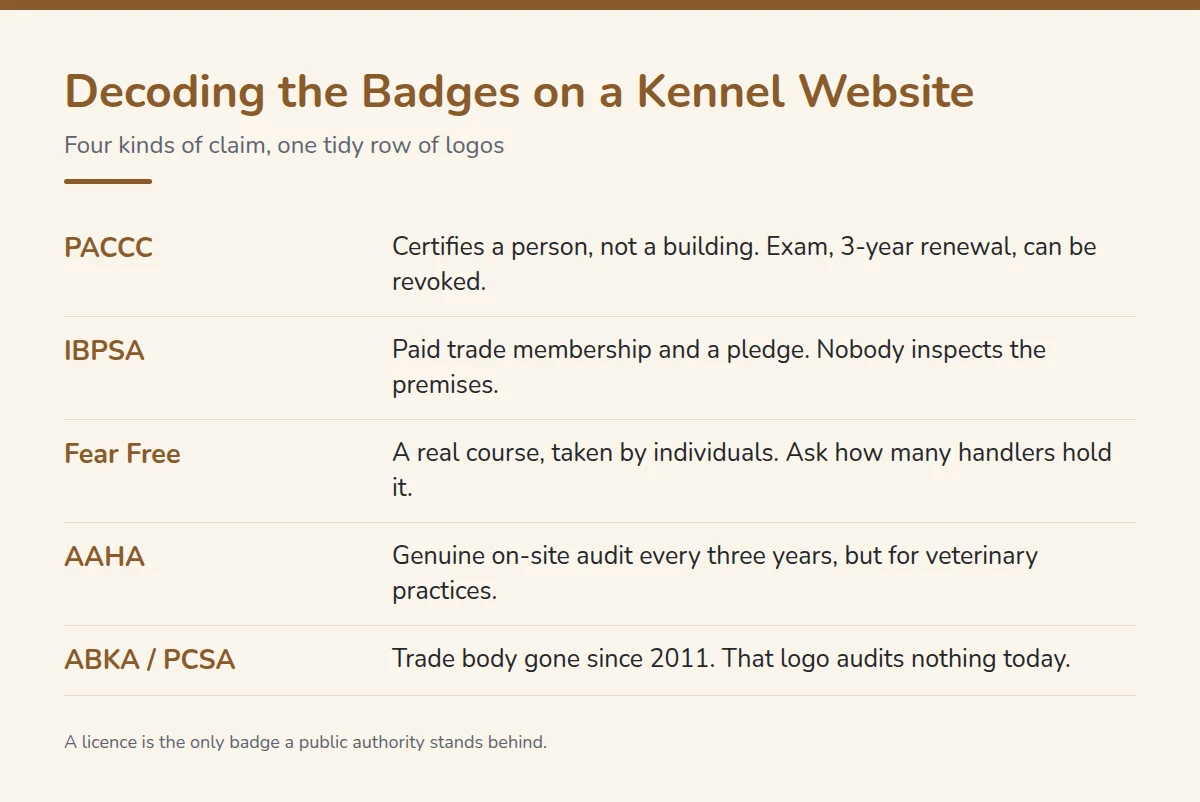
None of this is fraud. Trade bodies are legitimate, awards are fun, and a kennel is entitled to display what it has. The problem is that nobody translates the strip for the person reading it, so an owner comparing two facilities ends up weighing a three-year professional certification against a directory badge that cost $99. Here is how to tell them apart.
The Four Things a Badge Can Be
Before looking at any individual logo, sort it into one of four buckets. Almost every credential in this industry falls into one of them, and the bucket tells you most of what you need to know.
An individual certification belongs to a person, not a place. Someone met an experience requirement, passed an assessment, and has to keep it current. It travels with them when they change jobs.
A facility accreditation belongs to the building and the operation inside it. An assessor comes to the premises, measures things against a published standard, and the accreditation lapses if the standard slips.
A trade-association membership is a subscription. The business pays annual dues and receives education, templates, insurance access, a directory listing, and the right to use the logo. Members typically sign a pledge. Nobody visits.
A marketing badge is a logo with no assessment behind it at all: a local newspaper’s readers’ poll, a “top rated” graphic from a listings site, or a certificate issued by the facility’s own in-house academy.
A kennel with all four is not four times as good as one with one. What matters is which bucket each logo came from.
PACCC: The Closest Thing Boarding Has to a Professional Credential
The Professional Animal Care Certification Council is the name most worth recognising, because it behaves the way a real credential behaves.
PACCC offers three tiers: Certified Professional Animal Care Provider (CPACP) for hands-on staff, Certified Professional Animal Care Manager (CPACM), and Certified Professional Animal Care Operator (CPACO) for owners and operators. Eligibility is gated on experience before anyone sits anything. The operator credential requires five years in the animal care industry with at least one of those years in the operator role. The exam is not a quiz on the organisation’s own website either: it is a 175-question, four-hour paper administered by Professional Testing Corporation, an independent testing vendor, at an approved testing location or proctored virtually.
Three features separate it from a badge you can buy:
- It expires. Certification runs three years, after which the holder needs continuing education credits to renew, 20 hours for CPACP, 30 for CPACM, 36 for CPACO. Miss the window and you re-sit the exam.
- It is publicly verifiable. PACCC publishes a searchable directory of current certificants by name and location. A claimed credential that does not appear in the issuer’s register is not a credential.
- Someone will take your complaint. PACCC has a Code of Ethics with a disciplinary process behind it, and the available sanctions run from written caution and public reprimand up to revocation, which it treats as lifetime with no reinstatement.
Now the catch, and it is the single most misread thing in this whole area: PACCC certifies people, not facilities. There is no such thing as a PACCC-certified kennel. When a website displays the logo, the right question is not “is this place certified” but “who here holds it, at what tier, and are they on site when my dog is?” A CPACO held by an owner who is rarely in the building on weekends tells you less about your dog’s Saturday night than a CPACP held by the person running the overnight shift.

IBPSA: A Trade Association, Not an Inspection
The International Boarding & Pet Services Association comes up constantly, and it is a genuinely useful organisation. It publishes industry guidance, runs safety education and webinars, and gives small operators access to resources they could not build alone. A kennel that invests in that is a kennel taking its trade seriously.
But be clear about what the logo certifies, which is that the dues are paid. IBPSA runs several membership levels with annual fees, and joining involves signing a pledge to provide conscientious care and deal honestly with customers. It does not involve an inspection of your premises, a review of your incident records, or an exam. The member directory is a directory of subscribers, not of vetted businesses.
Read it as a signal of engagement with the profession, roughly the way you would read a restaurant belonging to a hospitality association. It is a mild positive. It is not evidence that anyone has looked at the kennels.
Fear Free: Real Training, Individual Scope
Fear Free is a proper curriculum, and it matters for the dogs most likely to struggle with boarding. The boarding and daycare certification runs through modules on Fear Free fundamentals, reading canine body language, considerate approach and gentle control, enrichment planning, and handling a dog that is coming apart in the moment. Each module requires 80% to pass, the certificant signs the Fear Free pledge, and membership renews annually with further continuing education.
The scope is the thing to understand. The boarding and daycare programme is an individual certification. Fear Free’s practice-level certification, where the whole business is assessed on culture, training, facility, and client education, is built around veterinary hospitals. So when a boarding website says “we are Fear Free,” it almost always means some of the staff have completed the individual course.
That is worth having, and for a dog with real anxiety it may be the most relevant badge on the page. Just convert it into a headcount question: how many of your handlers are certified, is it required for new hires, and is a certified handler on shift overnight? Our guide to boarding anxious or reactive dogs covers what the training should look like in practice, because a certificate on the wall and a low-arousal building are two different achievements.
What Real Facility Accreditation Looks Like
To see the gap, look sideways at veterinary medicine. American Animal Hospital Association accreditation is voluntary, and a practice that wants it is evaluated against more than 900 standards during an on-site visit, repeated every three years. Around 12 to 15 percent of small animal practices in the US and Canada hold it. That is what a facility accreditation is: a stranger in the building, with a checklist, on a cycle, and a majority who do not pass or do not try.
American boarding has no equivalent. It used to have something closer. The American Boarding Kennels Association, founded in 1977 and later renamed the Pet Care Services Association, ran a Voluntary Facilities Accreditation programme that inspected operations against a few hundred standards. The organisation filed for Chapter 7 bankruptcy in September 2011 and its assets went to auction the following spring.
The practical consequence is worth spelling out. If you see an ABKA or PCSA accreditation logo on a kennel website today, it is a badge from a body that has not existed for well over a decade and cannot have inspected anything since. It is usually inertia rather than deception, a logo nobody removed from a footer. But it is not a current assessment of that building, and if a facility is still pointing to it in 2026, that is a fair thing to ask about.
Where genuine facility-level oversight does exist, it is usually statutory rather than voluntary. Most US states license and inspect boarding kennels through their agriculture or animal health department, and England goes further with the star rating system we cover in our guide to UK boarding licences and inspection conditions. A licence is a floor set by government, not a distinction earned from a trade body, but it is the one check in this whole landscape where someone with authority actually walked the runs.

The Middle Ground and the Empty Badges
Some badges sit honestly between education and audit. The AKC’s S.A.F.E. grooming programme is a good example: groomers earn the certificate by completing a safety course and signing a safety oath, renewed every two years, and salons seeking the salon-level designation must also agree to on-site inspection by the AKC to keep it. Pet first aid and CPR certificates are similar. They represent a few real hours of instruction, they are genuinely better than nothing, and they are not a statement about the facility as a whole.
At the bottom of the ladder are badges with no assessment behind them:
- Readers’ choice and “best of” awards. These are popularity votes run by local papers and radio stations, often with the winning business invited to buy a plaque afterwards. They measure who mobilised their customers to click.
- Directory and listings badges. “Top rated,” “featured provider,” and similar graphics are usually tied to a paid listing.
- Self-issued certification. A facility whose staff are “certified” by the facility’s own academy has graded its own homework. The same test applies here as with dog trainers, and our guide to vetting a board-and-train facility lists the independent bodies whose names carry weight.
How to Check Any Badge in Five Minutes
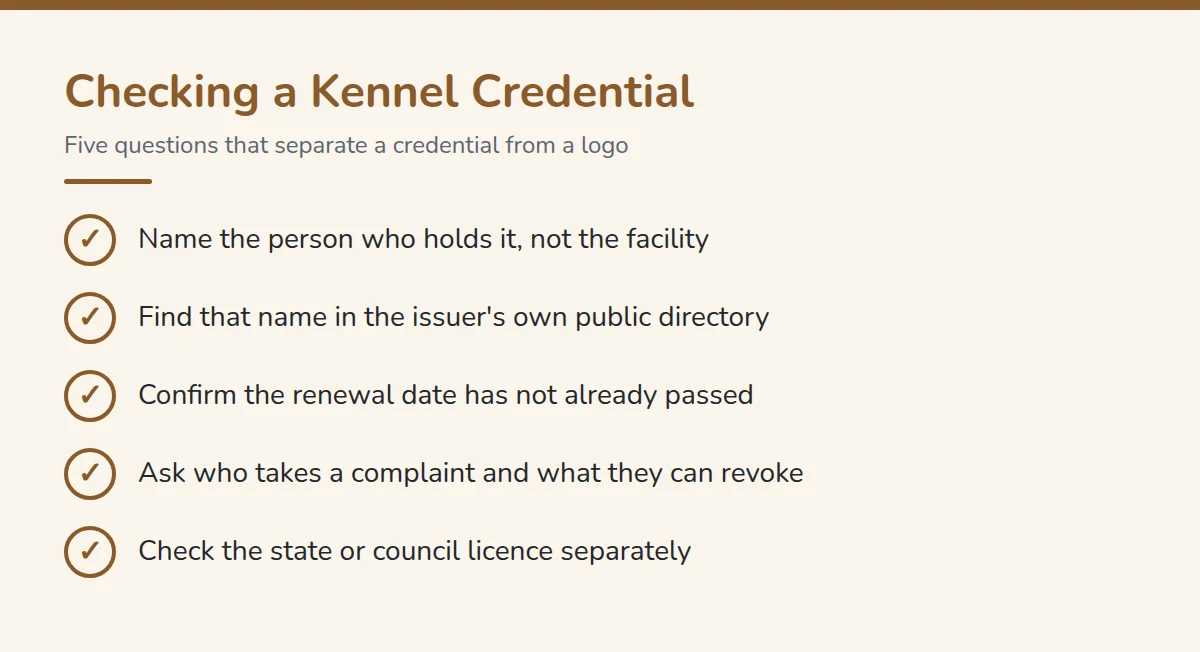
- Name the human. For any individual certification, ask who holds it and at what tier. “The facility is certified” is not an answer to that question.
- Search the issuer’s own directory. PACCC, Fear Free, and the trainer bodies all publish registries. Verify at the source, never from the kennel’s own screenshot.
- Ask when it expires. Real credentials have renewal cycles. A date that has passed is a fact, not an opinion.
- Ask what happens if you complain. This is the sharpest question in the list. A credential with a disciplinary process behind it can be taken away. A membership cannot be, as long as the invoice is paid.
- Separate the licence from the logos. Check the state or council licence independently. It is the only item on the wall that a public authority stands behind.
What No Badge Will Ever Tell You
Even a perfect strip of logos is an input, not an outcome. No certification asks whether the pool has a visible exit ramp and someone watching it, which is why water and pool safety is a separate conversation to have on the tour. None of them tell you the staff-to-dog ratio at 2am, the turnover rate last year, or what happened the last time a dog needed a vet at midnight.
Use credentials as a filter, not a verdict. A facility where the operator holds a current CPACO, several handlers are Fear Free certified, and the state licence is clean has demonstrably invested in something beyond marketing. Then go and look at the building anyway.
The Bottom Line
Sort every logo into person, place, purchase, or popularity contest. Individual certifications like PACCC and Fear Free tell you someone passed an assessment and can lose the credential for cause, which makes them the most informative items on the page, provided you find out who holds them and whether that person is near your dog. Trade memberships like IBPSA signal engagement and nothing more. Accreditation badges from defunct bodies signal only that nobody edited the footer. And the licence, boring as it looks, is the only one backed by an inspector with legal authority. Our guide to choosing the right dog hotel covers what to do with the hour after the badges have told you what little they can.
Further reading (sources)
- PACCC on the five years of experience an operator needs before sitting the exam
- PACCC for the three year renewal cycle and the CEU count at each tier
- Professional Testing Corporation with how the animal care exams are administered and proctored
- Fear Free covering the boarding and daycare modules and the pass mark
- IBPSA on the pledge members sign and what a membership includes
- American Animal Hospital Association for the standards an accredited practice is evaluated against
- American Kennel Club with what the S.A.F.E. grooming oath commits a salon to
- Pet Product News on the boarding trade body’s last rename before it folded