A Day in the Life of a Boarded Dog: What Happens Hour by Hour Between Drop-Off and Pickup
Published on September 17, 2026
Owners who book a boarding stay get to see the lobby, a photo of the play yard and a price list. What they almost never see is the timetable their dog will live on once the door closes. Every kennel runs one. It is set by staff shifts, cleaning and closing time rather than by the dog, and it repeats every day of the stay.
The amenities listed on a kennel’s website usually describe an hour or two of that day. The other twenty-odd hours are made of the gaps between them: the wait for breakfast, the loud stretch while runs are cleaned, the afternoon lull, and the long night after the last person goes home. Those gaps shape how a dog copes far more than a splash pool does. Here is the whole clock, what should happen at each point, and the questions that show you how a facility runs the parts nobody photographs.
Every Kennel Keeps Its Own Clock
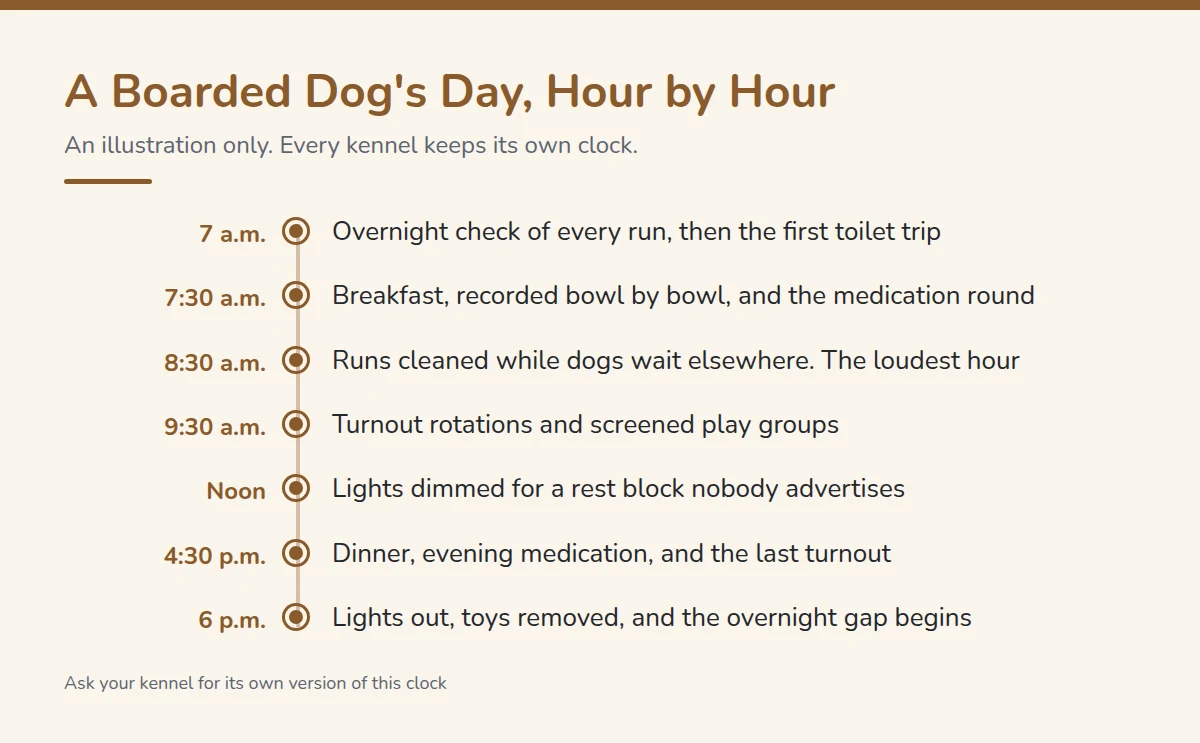
There is no industry timetable, so treat the times below as an illustration. They assume a day shift of roughly 7 a.m. to 6 p.m. Your kennel may open earlier, close later, or have someone sleeping on the premises, and those differences are exactly what you want to find out.
The rules underneath the schedule vary just as much. England’s statutory guidance for boarding kennels requires every occupied kennel to be cleaned daily, each dog to be taken out to toilet at least four times a day unless it has continuous access to a run, and the lights to go off at night. Colorado’s licensing rules require boarded dogs to be observed daily for signs of injury or illness. Both are minimums, and the distance between them is the reason to ask a facility for its actual schedule rather than assume one.
7 a.m.: The First Walk-Through
The first person through the door has one job before anything else: find out how every dog got through the night. That means looking into each run for vomit, diarrhea, blood, shredded bedding, an untouched water bowl, or a dog that does not get up. England’s guidance requires staff to monitor every dog’s urine and stool daily and record anything abnormal, and this walk-through is the first chance of the day to do it.
Then comes the first toilet trip, and for most dogs it is urgent, because they have not been out since the last turnout of the previous evening. A dog that soiled its run overnight should be moved and cleaned up straight away rather than left for the scheduled cleaning block.
7:30 a.m.: Breakfast and the Morning Medication Round
Breakfast is loud. The rattle of bowls is a cue every dog in the building learns fast, and the anticipation sets off barking from one end to the other. A well-run feed is individual and recorded: each dog gets its own portion in its own bowl, someone notes how much was eaten, and the bowls come out once the meal is over. England’s guidance says dogs must be carefully monitored at feeding times and that bowls should be emptied and cleaned afterward, so food is not left sitting until the next meal. That record is what lets staff spot a dog that has skipped two meals in a row. Our boarding feeding guide covers portioning, appetite loss, and why hard play should not follow straight after a meal.
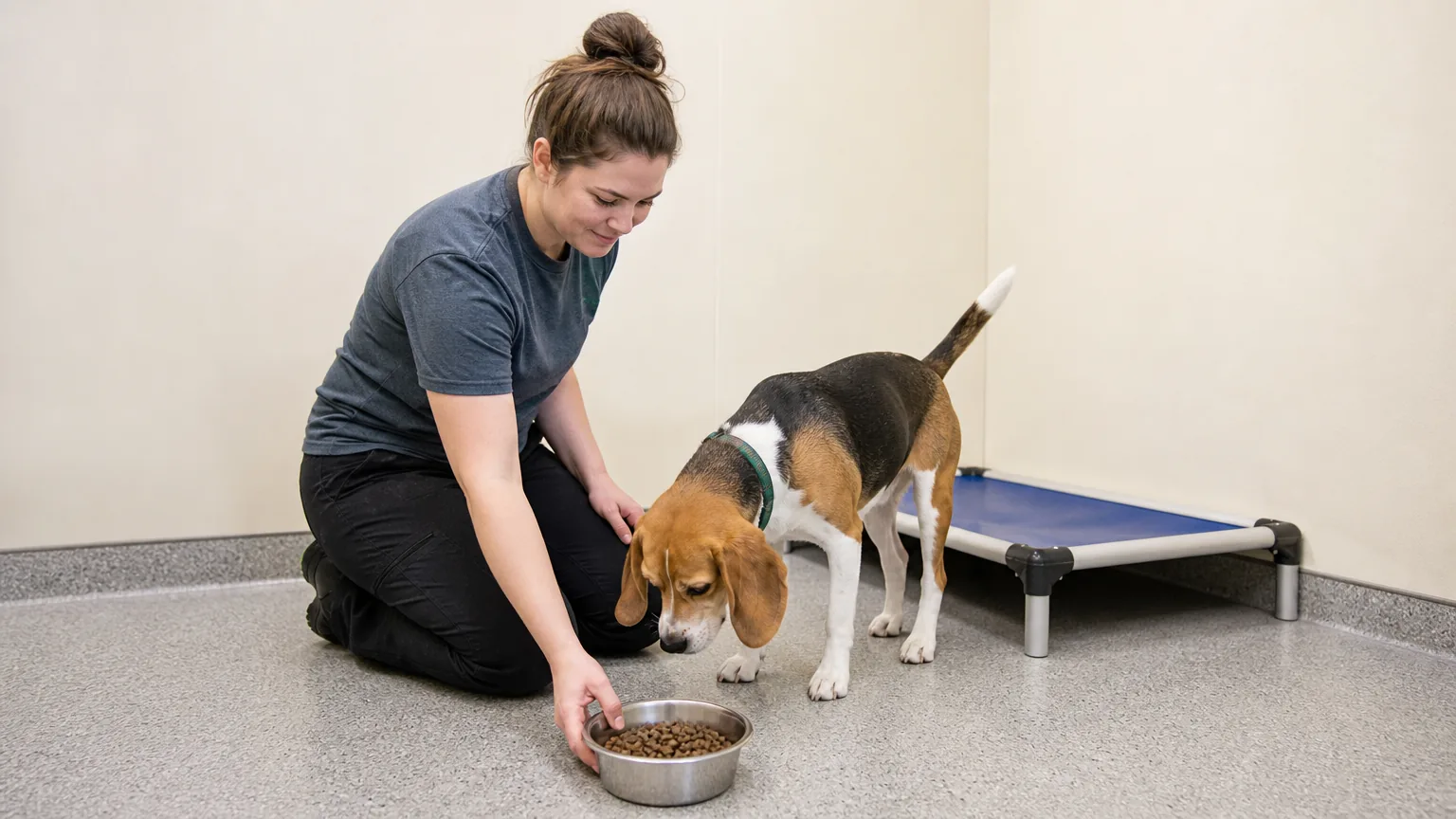
Medication usually rides along with breakfast. The safe version is a round rather than a string of reminders: one named person works through a written medication sheet, gives each dose and initials it. Colorado’s rules let boarding facilities give medication as directed by the owner’s veterinarian, with prescription drugs kept in the original container and labelled with the pet’s name, the drug, the dose, the prescribing vet and the date issued. Send medication that way even where the law does not demand it. A loose pill in a sandwich bag is a pill nobody can check.
8:30 a.m.: Cleaning, the Loudest Hour
Once breakfast is over, the runs get cleaned. England’s guidance requires dogs to be removed from the area while it is cleaned and allows no standing water from cleaning. Colorado requires animals to be protected from water under pressure and from cleaning chemicals. In practice, that means the dog either goes out to a yard while its run is hosed and dried, or waits in one half of a double-sided run while staff clean the other half.
Either way, it is one of the most stressful parts of the day. Researchers at the University of Nebraska Omaha studied it at a local humane society, where morning cleaning began about an hour after the dogs had eaten and each dog waited in the bare back section of its kennel while the front was cleaned. Giving the dogs an enrichment item for that wait cut how often they barked by 31 percent. Calming items produced the most relaxed body postures, with a lavender scent doing best, and a ball brought the lowest barking rate of all, while food enrichment improved neither measure. The authors also note that noise rises significantly during cleaning.
A boarding kennel is not a shelter, but the hoses, squeegees and banging doors are the same. Ask where your dog waits while its run is cleaned, for how long, and whether it goes back onto a dry floor. An answer that includes a chew, a snuffle mat or a handler means the facility has thought about the wait. An answer that stops at a closed door and a hose means it has not.
9:30 a.m. to Noon: Turnout Rotations and Play Groups
Mid-morning is the main exercise block. Dogs rotate through the yards on a schedule, often a grid of run numbers against time slots, some going out alone and some in play groups screened to be together. England requires every dog to be exercised away from its kennel at least once a day, and it does not let dogs from different households share an outdoor area without the owners’ written consent.
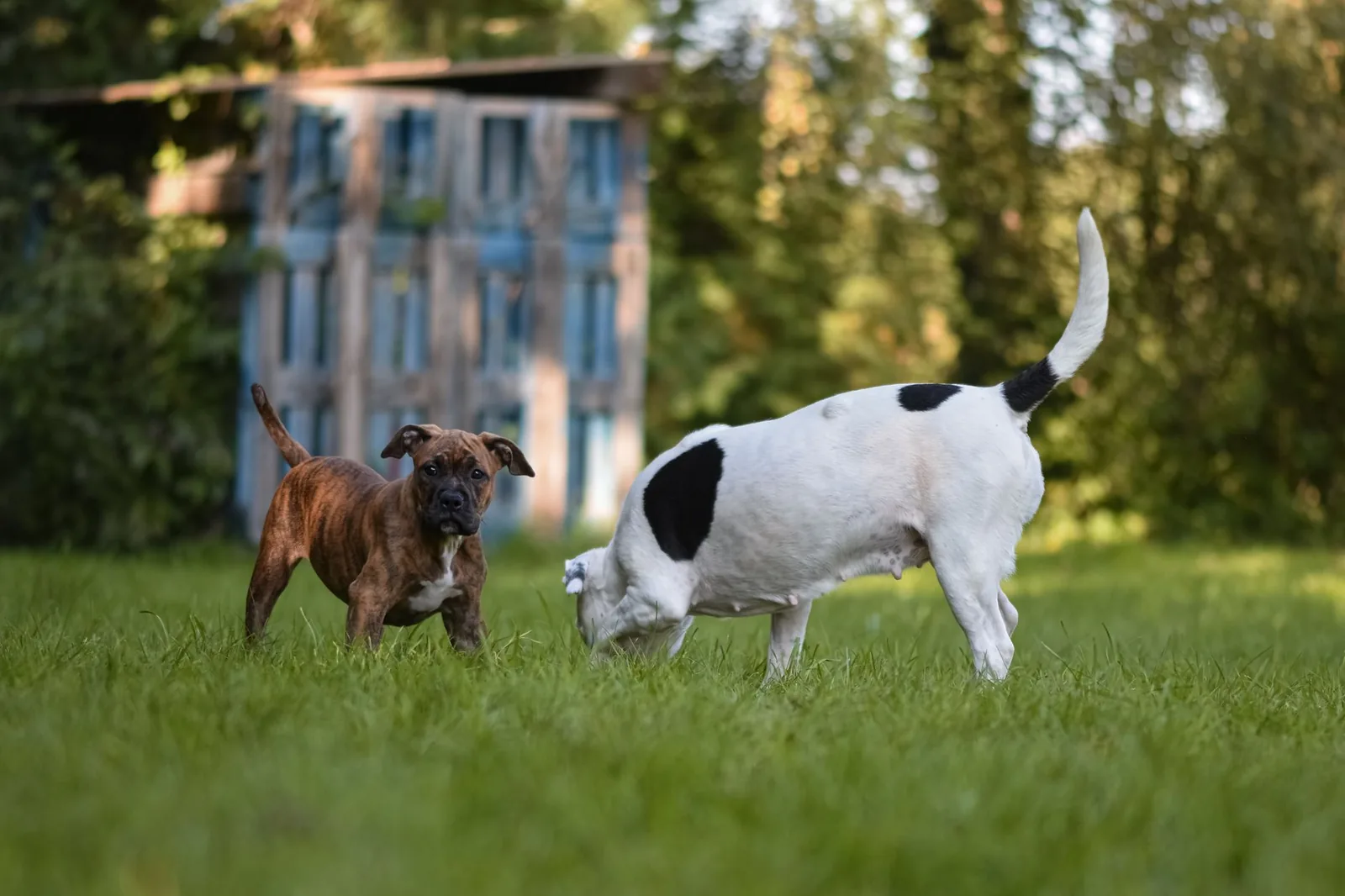
The common mistake is to read this block as the whole day. A package of two twenty-minute play sessions adds up to forty minutes out of the run across the entire day, and a good share of the rotation is spent listening to other dogs go out. Our guide to how much exercise a boarded dog actually gets shows how to turn a package into real minutes and what a hot-weather protocol should include.
Noon to 2 p.m.: The Rest Block Nobody Advertises
The most valuable thing a kennel does all day may be the one it never mentions on its website: bringing the dogs in at midday, dimming the lights and letting the building go quiet for an hour or two.
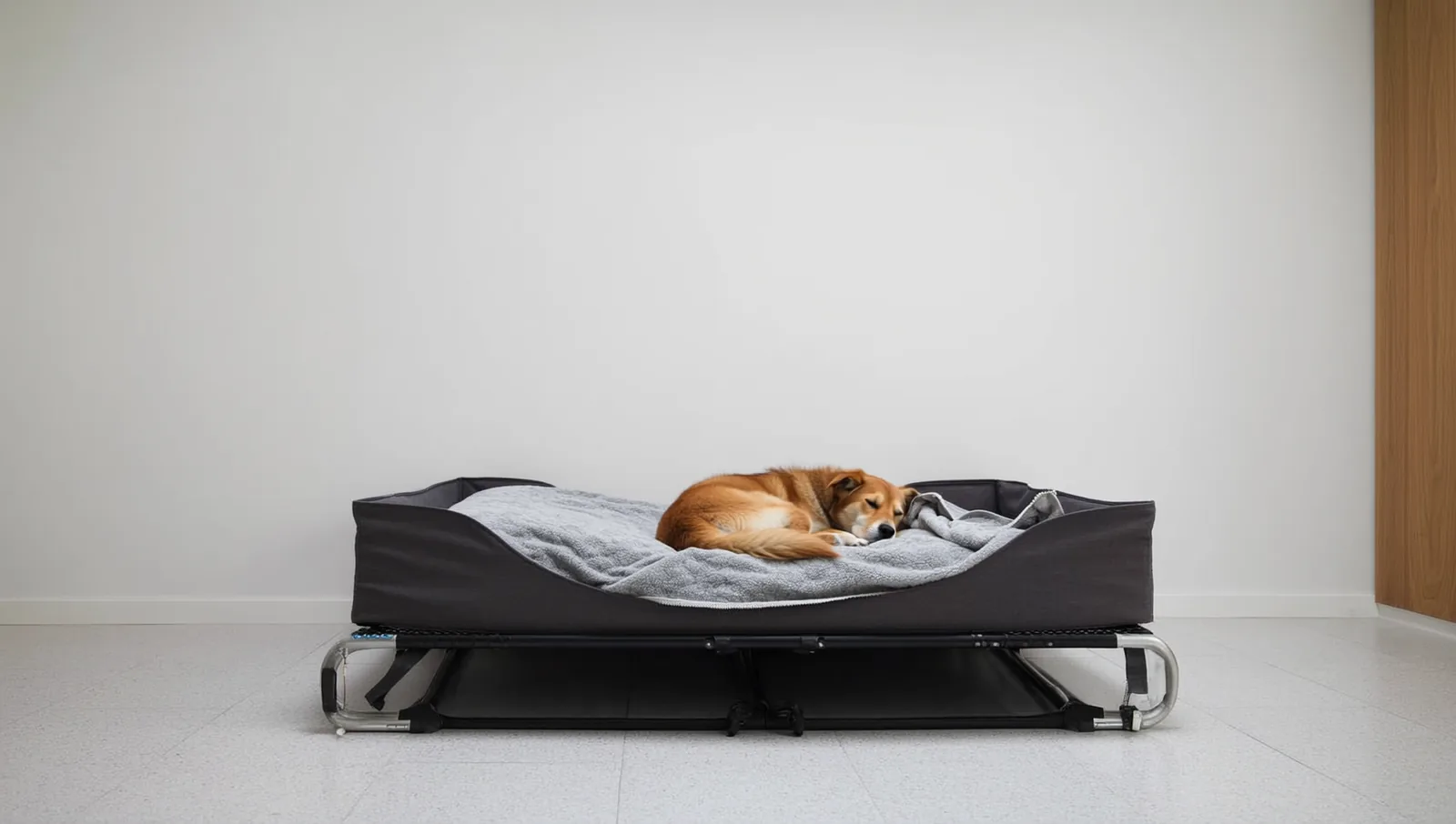
There is a good reason for it. A kennel day is more stimulating than a day at home, even for dogs that seem to enjoy it. When researchers measured 29 privately owned dogs both at home and in boarding kennels, the dogs were generally more active in the kennels and showed higher levels of hormonal markers the authors link to arousal, although the study found no definitive evidence that kennelling distressed them. A room full of aroused dogs does not settle by itself, so rest has to be scheduled.
Noise is what breaks it. In a study that video-recorded 13 kennelled laboratory dogs over eight months, daytime sleep fell as sound levels rose, and noisier days brought bigger stress hormone responses. Much of that noise starts when a person walks into the room, and one barking dog sets off the next. In a pilot study in a daytime boarding ward at North Carolina State University’s veterinary college, everyone passing through was asked to toss each dog a treat, whatever the dog was doing. Barking volume fell, most of all in the afternoon: one afternoon reading with three dogs barking averaged about 95 decibels before the exercise and about 69 decibels during it. The researchers put part of the afternoon improvement down to the ward simply having fewer people in it as the working day wound down.
So ask whether there is a midday rest period, what time it runs, and what happens in the building while it does. Staff breaks, deliveries and tours led down the aisle at 1 p.m. can all undo it. England’s guidance also asks for dogs that are upset by barking to be housed in the quietest part of the kennel, and for every kennel unit to give its dog somewhere to avoid seeing people and other dogs. Our guide to kennel stress covers the rest of what drives it and what brings it down.
2 to 4 p.m.: Second Session, Enrichment, and the Afternoon Rush
The afternoon usually brings a second turnout and whatever enrichment is on the plan: a puzzle feeder, a sniffing game, a brushing session, or a handler sitting quietly in the run for ten minutes. England sets a floor of at least one supervised enrichment opportunity a day, and a kennel aiming for four or five stars needs a written daily plan with at least two sessions of toy or food enrichment on top of exercise. Grooming add-ons such as a bath before going home often land here too.
At kennels with afternoon check-in and pickup windows, this is also when the front door gets busy. Each arrival walked past the runs sets the barking off again, and a dog on its first afternoon hears all of it. A facility that brings new arrivals in by a quieter route, or settles them away from the busiest aisle, is managing a problem most owners never see.
4:30 p.m.: Dinner, Evening Medication, and the Last Turnout
Dinner repeats the breakfast routine, and together the two feeding records are the first real read on a dog’s appetite. The part that deserves closer scrutiny is the evening medication.
A twice-daily medication is usually meant to be given about twelve hours apart. On a day shift that ends at 6 p.m., the evening dose can drift to 4:30 or 5, which can leave nine or ten hours between doses during the day and fourteen or more overnight. For many drugs that makes little difference. For some it matters a great deal. Insulin is the clearest example: the American Animal Hospital Association’s diabetes guidelines dose dogs every 12 hours, with equal-sized meals fed at the time of each injection. Ask your veterinarian how much leeway your dog’s medication has, then ask the kennel exactly what time the evening dose goes in. If the two answers do not fit, the booking needs a different arrangement, not a hopeful note on the care sheet.
Then there is the last turnout, whose timing sets the length of the night. If the final toilet trip is at 5:30 p.m. and the first is at 7 a.m., a dog is holding on for thirteen and a half hours. That is a lot to ask of a puppy, a senior dog, or a dog on medication that makes it drink and urinate more. Ask for both times, and if they are far apart, ask whether a later check can be added.
Lights Out and the Overnight Gap
Closing time has a routine of its own: a final check, water topped up, and in England, toys and enrichment items taken out, because the guidance says they must not be left with dogs when no staff are on the premises. The same guidance limits artificial lighting to a range of 10 to 12 hours a day and requires the lights to go off for a period of darkness overnight.
The first night is the hardest. In a study at a Dutch shelter, van der Laan and colleagues tracked dogs with activity sensors from the night they arrived. Pet dogs normally rest for about 96 to 98 percent of the night, the authors note, but on their first night the shelter dogs rested for about 72 percent of the hours between midnight and 4 a.m., and in those four hours managed an average of just 3.4 rest periods long enough to complete a sleep cycle. The restlessness eased over the following nights but was still above pet dog levels after 12 days. Smaller dogs were more restless than large ones, and dogs with previous kennel experience were calmer, which led the authors to suggest that earlier exposure, such as daycare in kennels, might help. It is a good argument for the trial day or night recommended in our first-time boarding guide.
Season matters too. In the eight-month study of kennelled laboratory dogs mentioned above, night-time sleep dropped as temperatures rose and as daylight hours lengthened, which makes air conditioning and a properly dark room a summer welfare issue rather than a comfort.
Then there is the question of who is in the building. England’s guidance gives 6 p.m. to 8 a.m. as its example of the out-of-hours period, a fourteen-hour stretch. Its minimum standard does not require anyone on site overnight, only a designated key holder who can get there within 30 minutes. To reach four or five stars, a kennel needs a member of staff on site at all times and every dog checked at least once overnight, in person or by CCTV, with a written record. Our guide to staffing ratios by shift goes further into what to ask about the night.
The Questions That Map the Gaps
A well-run kennel has a plain answer to each of these. Hesitation is an answer too.
- “What time does the last member of staff leave, and when does the first arrive?” Unless someone lives or sleeps on site, that is the length of your dog’s unobserved night.
- “When are the first and last toilet trips?” The gap between them is how long your dog holds on overnight.
- “What time is the evening medication actually given?” Compare it with what your vet said about timing.
- “Where does my dog wait while its run is cleaned?” Listen for an enrichment item and a dry floor.
- “Is there a midday rest period, and what happens in the building during it?” Deliveries, tours and staff traffic can quietly cancel it.
- “Who checks the dogs overnight, and is it written down?” Ask to see the night log at pickup, along with the feeding and turnout records.
The Bottom Line
The amenities are the highlights of a boarded dog’s day, but the schedule is the day itself. Before you book, ask for the clock rather than the brochure: when staff arrive and leave, when meals, medication and toilet trips happen, whether the middle of the day includes real rest, and who looks in at night. A kennel that can hand you its daily routine and its overnight log has thought about the hours nobody photographs, and those hours are where your dog spends most of its stay.
Further reading (sources)
- GOV.UK on England’s kennel boarding standards for cleaning, toileting, lighting and night checks
- Legal Information Institute for Colorado’s rules on daily observation and giving medication to boarded pets
- Legal Information Institute with Colorado’s cleaning rules that keep pressure hoses and chemicals off animals
- Dare and Strasser on enrichment items as a buffer during morning kennel cleaning
- Part and colleagues for how owned dogs changed between home and a boarding kennel
- Schork and colleagues covering how noise, daylight and temperature affected kennelled dogs’ sleep
- Zurlinden and colleagues with a quiet kennel exercise that cut barking in a daytime boarding ward
- van der Laan and colleagues on night-time restlessness in dogs’ first two weeks in a shelter
- American Animal Hospital Association for diabetes guidelines that pair twice-daily insulin with meals