Does Your Dog Need to Be Crate Trained Before Boarding? Confinement Comfort, Kennel Runs, and Preparing a Dog That Has Never Been Crated
Published on November 25, 2026
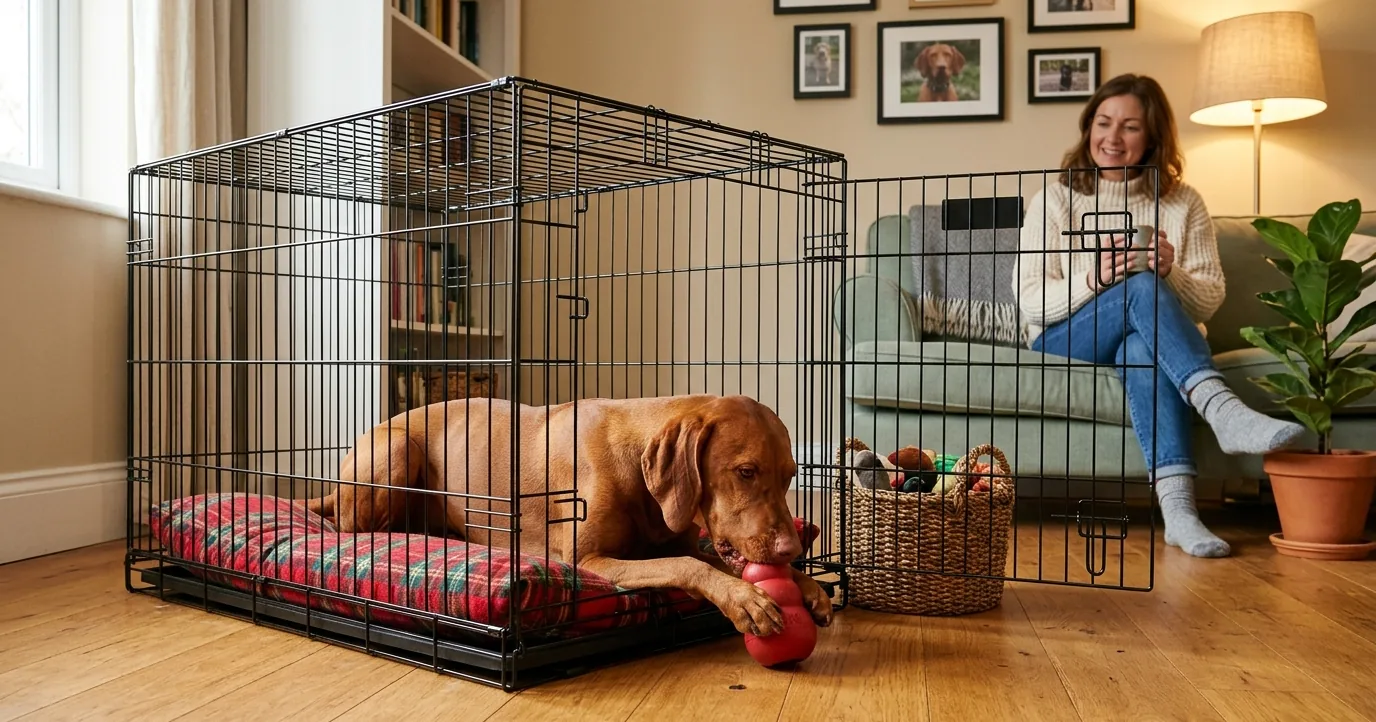
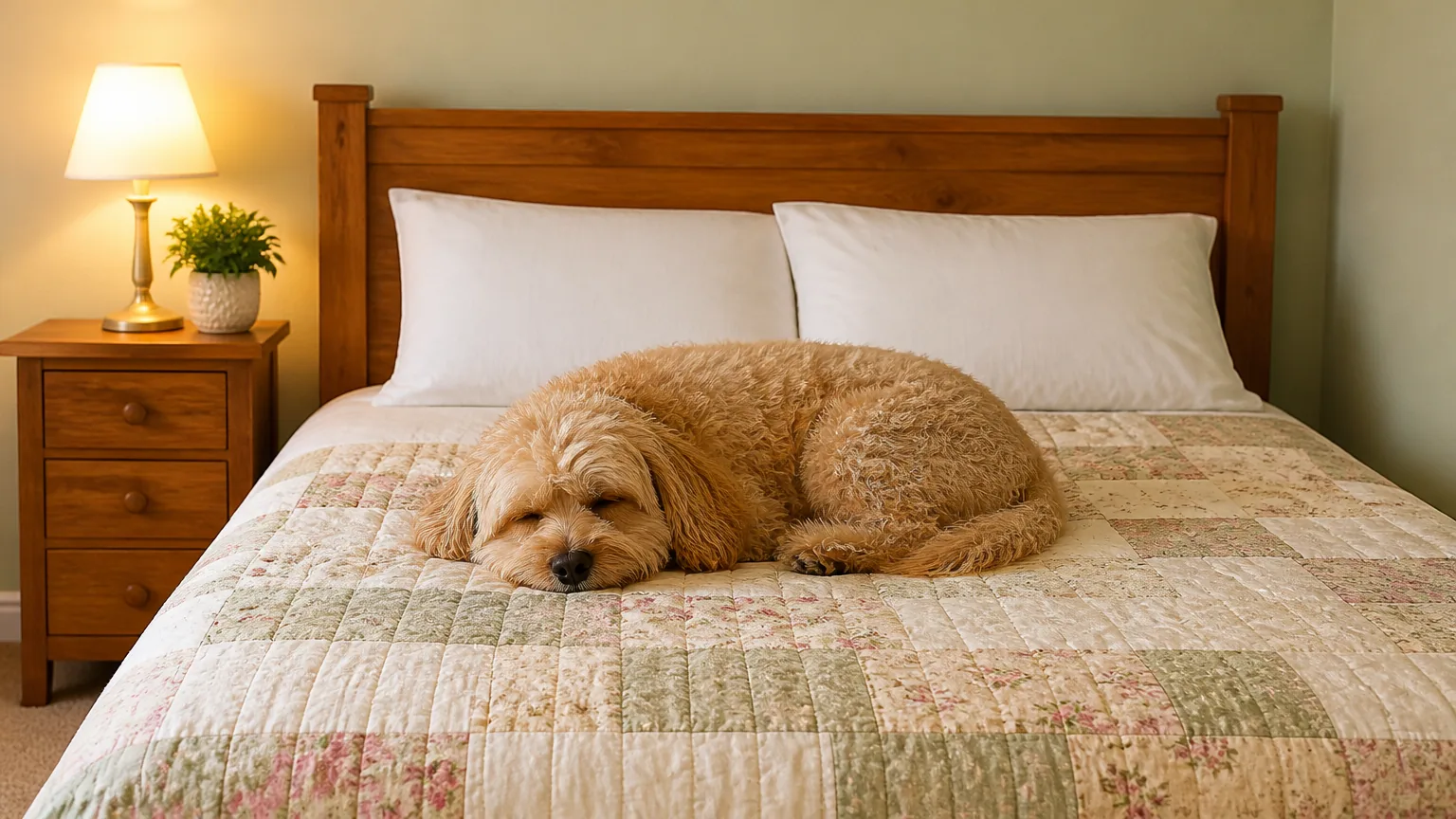
Plenty of dogs have never spent a night behind a closed door. They sleep on the bed, follow their people from room to room, and treat a shut door as a problem to solve. Others were crate trained as puppies and gave the crate up long ago. In Generation Pup, the Dogs Trust study following dogs across the UK and Ireland, two-thirds of 16-week-old puppies had slept in a crate or kennel in the previous week. By 12 months that had fallen to about a third, and the share sleeping on a person’s bed had doubled, to more than a quarter.
So when you book a first boarding stay, it is a fair question: does your dog need to be crate trained first?
Strictly, no. Most boarding kennels house dogs in runs or suites, not crates, and some rules stop staff from crating a dog that is not used to one. But every boarded dog spends the night alone in a space it cannot leave, with unfamiliar footsteps outside and other dogs within earshot. The skill that matters is confinement comfort: settling, sleeping and waiting until morning in a small space behind a closed door. Here is how a kennel run differs from a crate, why dogs with no confinement experience find the first night hardest, a realistic plan for building that comfort over two to four weeks, and when a different kind of care is the better answer.
What Your Dog Will Actually Sleep In
A home crate and a boarding unit are built on opposite principles. The American Kennel Club advises choosing a crate just large enough for a dog to stand up, turn around and lie down comfortably, because in a bigger one a puppy can eliminate at one end and sleep at the other. The crate works as a housetraining tool because dogs generally prefer not to soil their sleeping area.
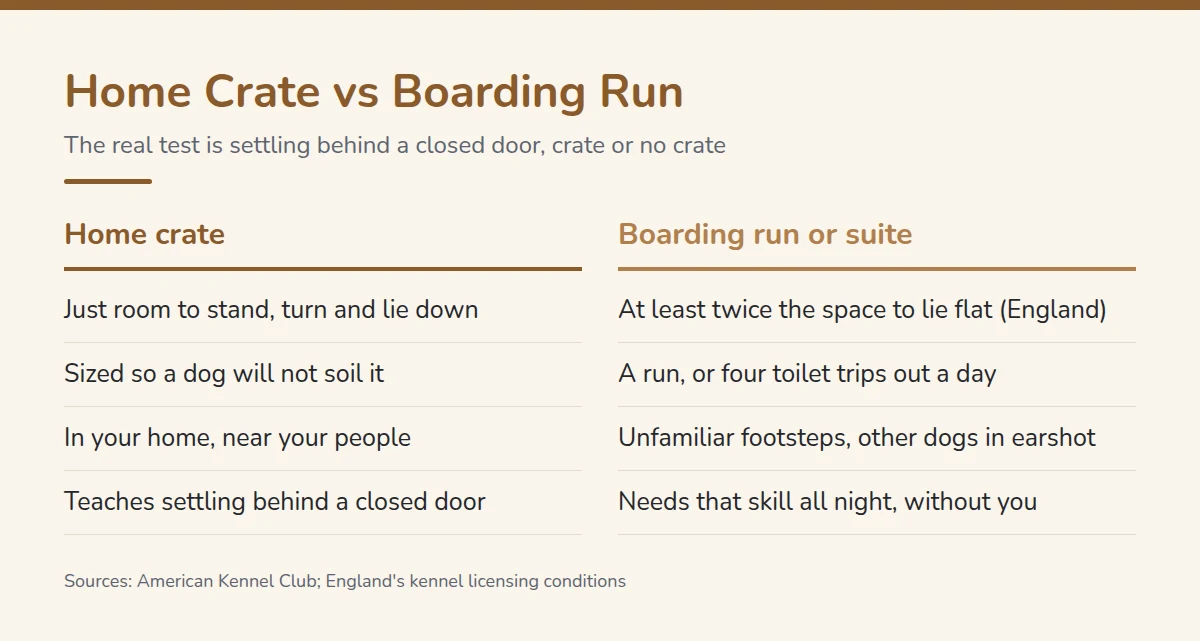
A kennel unit is built with room to do exactly what a crate prevents. England’s licensing conditions for boarding kennels require a sleeping area where the dog can walk, stretch out, wag its tail and turn around without touching the walls, with at least twice the floor area the dog needs to lie flat, and at least 1.9 square metres in kennels built since the rules took effect. The dog must have constant access to its sleeping area, plus either continuous access to a run for toileting or at least four trips a day out of the unit to toilet away from its bed. Colorado sets its minimum enclosure size by a formula based on the dog’s length, and the space required rises by half once a stay runs past five days.
Crates do turn up in boarding, but the rules hem them in:
- Colorado allows a dog to be crated for no more than 14 hours in any 24, with a properly sized enclosure for the rest of the day, and a facility needs the owner’s written consent to house a boarded dog in a crate at all.
- England’s licensed home boarders may not board dogs in outside buildings, cages or runs, and may not keep a dog in a crate unless it is already used to one, a crate is part of its normal routine and the owner has agreed. Even then the limit is three hours in any 24, and a dog that chooses to sleep in its crate overnight must have the door left open.
So “crate trained” is the wrong test for most dogs. A kennel run is bigger than a crate, busier than a bedroom, and closed between turnouts and all night. A suite gives more floor and often a window, and kennels charge a tier more for it, as our guide to what a night of boarding costs shows. Either way, the question is whether your dog can settle in a small space behind a closed door, out of your sight, and stay settled until morning. A dog that can do that in a crate is well prepared for a run. A dog that can do it in a gated kitchen or an exercise pen is most of the way there, crate or no crate.
That does not make crate training wasted effort. The AKC points out that a properly introduced crate helps dogs become comfortable with vet visits, travel and other situations where confinement may be necessary. Trainer Rachel Lane, quoted by the AKC, says it is highly unlikely a dog will never spend time in one: at the vet, with a sitter, at a boarding facility or in a disaster evacuation, a dog is going to end up in a crate at least for a little while, and crate training ahead can make that less stressful.
Why the First Night Is the Hardest
Stress on entering a kennel peaks early. At a county animal shelter, Hennessy and colleagues found that dogs in their first, second or third day had higher cortisol than dogs that had been there for more than nine days. On day one, the dogs’ levels were higher than their own levels on day four or five, and higher than those of pet dogs sampled at home. Boarding is gentler than a shelter, but it is still a change. When Part and colleagues measured 29 pet dogs at home and again in a boarding kennel, cortisol and a second arousal marker were higher in the kennel, although the team found no definitive evidence that the dogs were distressed rather than simply aroused.
Practice beforehand changes the curve. University of Bristol researchers followed 31 young Labrador Retrievers as they moved from the homes where they had been raised into kennels at a training establishment, after first habituating half of them to confinement in a kennel. Cortisol rose in every dog on arrival, but the rise was significantly higher in the dogs that had not been habituated, and in that group it was still above its home baseline 12 weeks later. Past stays alone do not guarantee an easy one, though. Part’s team found no effect of previous kennelling experience. Deliberate practice in the weeks before the move is what the Bristol study tested, and it helped.
For a dog that has never been confined, the first night tends to look like this:
- Barking and whining at the front of the run. The AKC notes that whining or barking which starts within minutes of a dog being shut in is likely stress or anxiety, while barking after the dog has been settled for a while is more often boredom, hunger or a need to toilet. The Bristol team saw whining and time at the front of the kennel fall over the following days, but warned that the drop could equally reflect dogs learning what gets human attention. A dog that has gone quiet by night three has not necessarily relaxed.
- Refusing to settle. Pacing, shaking, drooling, scratching at the door and long bouts of howling or barking are on the AKC’s list of signs that confinement is causing stress or panic.
- Soiling. A run has room to toilet at one end and sleep at the other, which is precisely what a crate is sized to prevent. Urinating and defecating are also common signs of separation and confinement distress.
- Chewing and scratching at the barrier. The ASPCA warns that dogs with separation anxiety may dig and chew at doors and windows, and injure themselves doing it: broken teeth, cut and scraped paws, damaged nails.
Our guide to kennel stress covers how good facilities lower these responses across a whole stay. The rest of this article is about what you can do before the stay begins.
Confinement Anxiety or Separation Anxiety? Find Out First
Two problems look alike at the kennel gate. Separation anxiety is distress at being left alone or apart from particular people. Confinement anxiety is distress at being shut in, whoever is nearby. In a 2024 case report in the Canadian Veterinary Journal, Anneliese Heinrich and Christine Calder, of two veterinary behaviour practices, diagnosed both in a young golden retriever and poodle cross that barked and scratched near her crate door even with her owners in the room. Confinement anxiety, they note, can be mistaken for separation anxiety when a dog is only ever confined while home alone.
A simple check at home tells you which way your dog leans. Shut your dog in a pen or behind a gate while you sit in view on the other side. On another day, leave it loose in the house while you step out for a few minutes, with a phone or camera recording. Heinrich and Calder’s clients ran a version of this, swapping the crate for an exercise pen to see whether confinement was the core problem.
Stop and rethink if you see what the ASPCA lists as signs that crate confinement is not the best option for a dog: heavy panting, excessive salivation, frantic escape attempts, and persistent howling or barking. Its suggested alternative is a room behind a baby gate. The AKC goes further. Dogs with separation anxiety often panic in a crate and can hurt themselves trying to escape, it says, so use a larger, puppy-proofed area such as an exercise pen and work with a trainer or behaviourist. Humane World for Animals is blunt: a crate will not fix separation anxiety. If your dog falls apart in a pen at home, do not expect a kennel run to go better. Talk to your vet, and read our guide to boarding anxious or reactive dogs before you book.
A Two-to-Four-Week Plan for the Dog That Has Never Been Crated
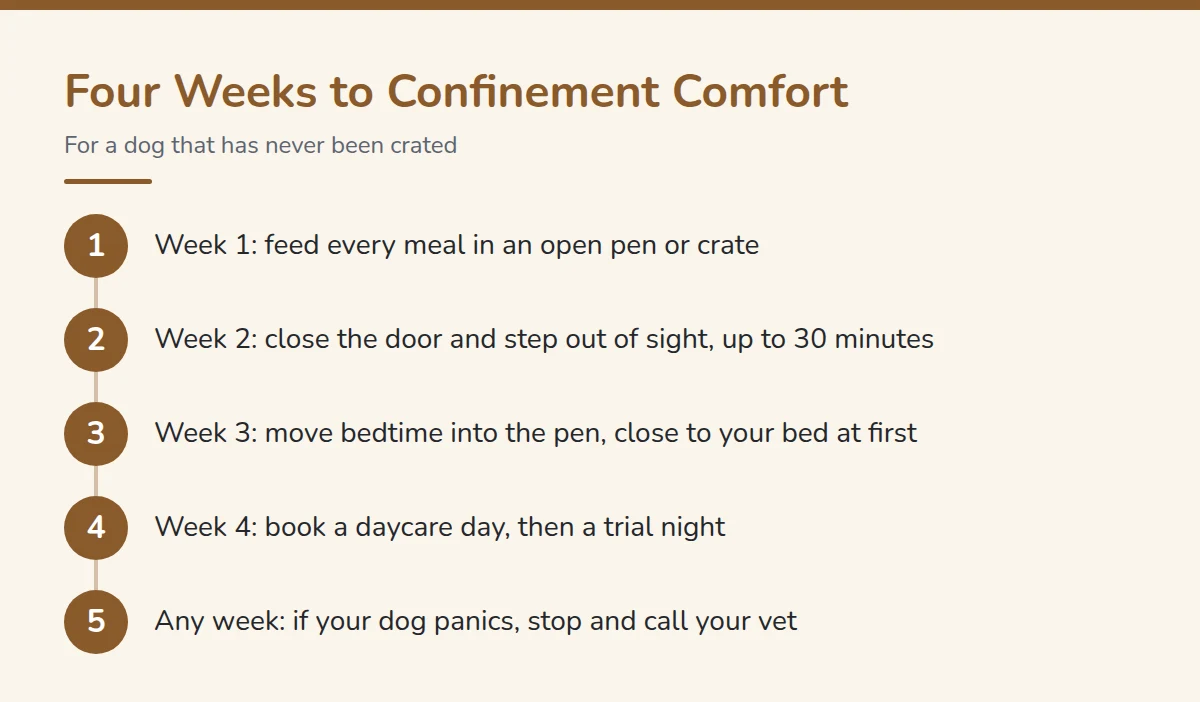
Humane World for Animals says crate training can take days or weeks, depending on a dog’s age, temperament and past experiences, and should move in small steps with the crate always linked to something pleasant. For an adult dog that has never been confined, budget two to four weeks before the stay. Some dogs move faster. A dog still panicking after a month is telling you something.
Use a crate, an exercise pen or a gated room. A pen is closer in size to a kennel run, and the AKC recommends one over a crate for dogs that show signs of anxiety.
Week one: make the space the best spot in the house. Set it up in a room where the family spends time, with the door open. Toss treats inside, and while your dog stays in, keep rewarding: Lane suggests a treat every five to ten seconds. Then feed every meal inside, a little further back each time. Once your dog eats comfortably in the space, close the door during the meal and open it as soon as the bowl is empty, leaving it closed a few minutes longer at each meal until your dog stays in calmly for about ten minutes after eating. With a puppy, or any dog that still has accidents, hold off on soft bedding until it is reliably clean in the space, because the AKC notes that many puppies prefer to toilet on soft, porous surfaces.
Week two: add the closed door and distance. With your dog inside, sit quietly nearby for five to ten minutes, step into another room for a few minutes, come back, sit again, then let your dog out. Repeat several times a day, stretching the time and the distance. A frozen, food-stuffed chew toy every time the door closes builds the right association. Aim for about 30 minutes of calm with you mostly out of sight.
Week three: move bedtime. Once your dog manages those 30 minutes, start nights in the crate or pen. Humane World advises keeping it in or near your bedroom at first, older dogs included, so the crate does not come to mean social isolation. Once your dog sleeps through the night there, move it gradually further from your bed, because at the kennel you will not be in the room. For a dog that has always slept beside you, this is the big week. Start short absences from the house too: keep departures matter-of-fact and returns low-key, and keep using the space at times when you are home, so it never comes to mean being left.
Week four: rehearse the real thing. Book a day of daycare and then a one-night trial stay at the kennel you plan to use. Our first-time boarding guide explains how that on-ramp works and what to pack.
Throughout, meet your dog’s toilet and exercise needs before each spell in the crate or pen, as the AKC advises. Never punish whining or barking, and never force your dog in or leave it to cry it out. If whining starts within minutes of the door closing, the AKC and Humane World agree you have moved too fast, so go back a step. Heinrich and Calder’s patient had been punished for vocalising in her crate early in her treatment, and they warn that punishment may have made both of her anxieties worse.
What to Tell the Kennel
Put it on the booking form, then repeat it at drop-off:
- Where your dog sleeps now, in plain words. “Sleeps on our bed and has never been crated” tells staff more than a blank box.
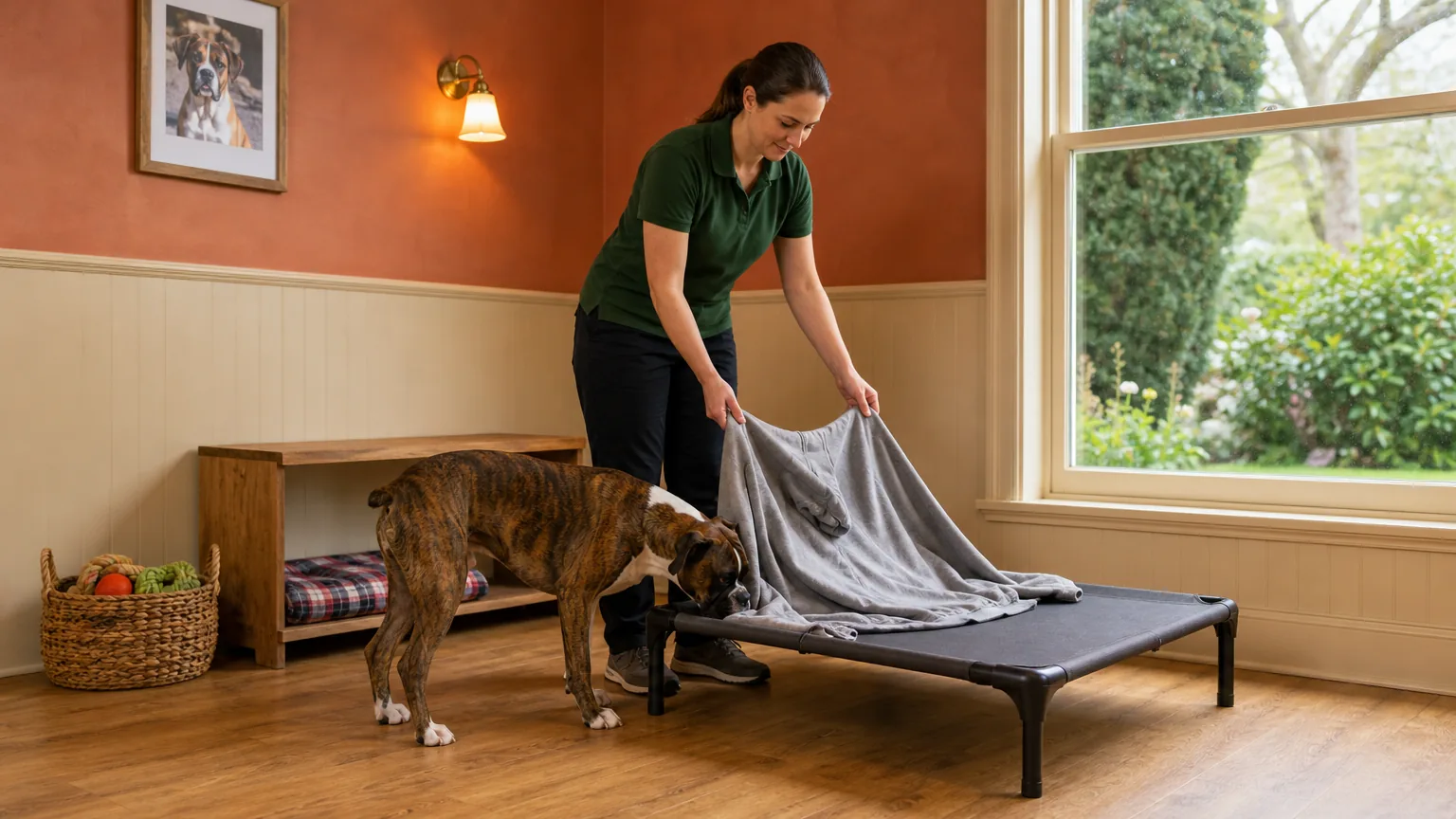
- How the practice went. How long your dog settles in a pen or crate, whether it has slept a full night in one, and what helps: a chew toy, a covered crate, a particular blanket.
- Whether a crate is allowed. Colorado requires your written consent before a boarded dog is crated, and England’s home boarders may not crate a dog that is not already used to one. If your dog has never been crated, write “no crate.”
- Any history of escaping or of chewing through, or getting hurt on, a crate, gate or door.
- Toileting. How your dog asks to go out, what surface it uses, and how long it normally waits overnight.
Then ask:
- Will my dog be in a run, a suite or a crate, and where in the building? England requires every kennel unit to include somewhere the dog can get out of sight of people and other dogs, such as a bed with high sides, a crate or a screen. Ask where that is in your dog’s unit.
- Can I bring bedding or a T-shirt that smells of home?
- What do staff do about a dog that barks at the gate? In a North Carolina State University pilot study in a daytime boarding ward, everyone walking past the kennels simply tossed each dog a treat, whatever it was doing. Peak noise fell, fewer dogs barked over time, and those that did barked less. A facility with a plan like that has thought about first-night dogs.
- Who checks on the dogs overnight, and when?
- Can my two dogs share? If you have two dogs that already sleep together, England’s rules let dogs from the same household share a kennel unit with the owner’s written authorisation. Kennels elsewhere commonly allow it too, often at a reduced rate for the second dog.
When a Kennel Run Is the Wrong Answer
Some dogs should not go into a run, however well the stay is planned:
- A dog that panics when confined even with you in the room, or falls apart when left alone, and has not improved with gradual practice.
- A dog that has injured itself on a crate, gate or door.
- An older dog with sore joints. The AKC’s Lane points out that long spells in a crate can be physically uncomfortable for senior dogs and suggests a larger area where they can move between comfortable spots.
- A dog still distressed after four weeks of careful practice.
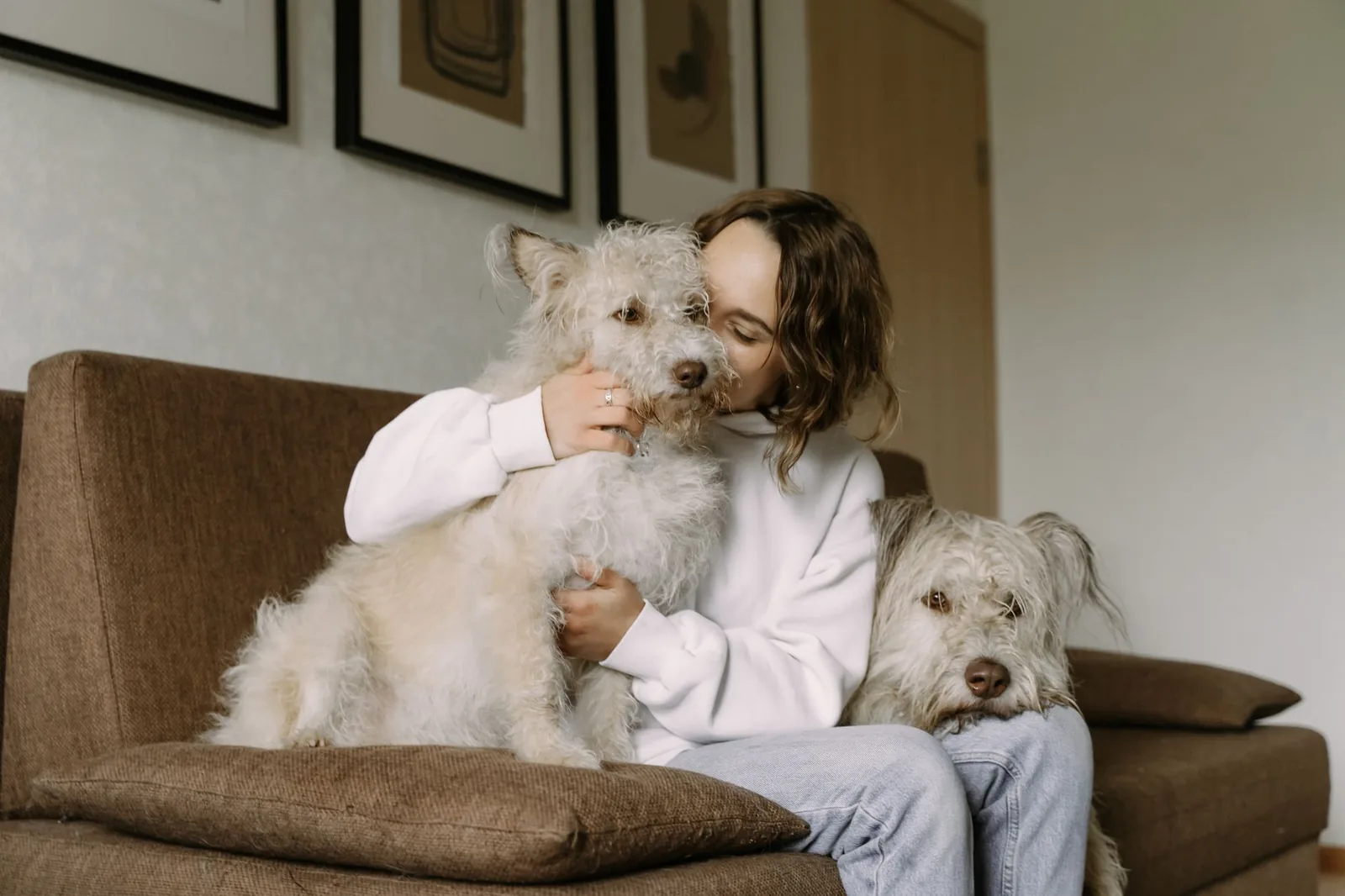
There are good alternatives. A sitter who stays in your home avoids confinement and a new building altogether. A licensed home boarder in England must house dogs inside the home, not in outside buildings, cages or runs. Sometimes the dog can come with you, and our guide to taking the dog or boarding the dog weighs that choice. For severe distress, see your vet well before the trip. Anxiety medication is a veterinary decision, and it can take adjusting: Heinrich and Calder’s patient went through several medications, two of which caused side effects, before one worked alongside behaviour modification.
The Bottom Line
Your dog does not need to love a crate to board well. It needs to settle alone in a small space behind a closed door, sleep there through the night, and wait until morning to go out. A dog that has always slept on your bed can learn that, given a few weeks of small steps. Start early, tell the kennel the truth about where your dog sleeps, and choose another kind of care if practice shows your dog cannot be shut in without panic.
Further reading (sources)
- American Kennel Club on crate sizing and why dogs avoid soiling where they sleep
- American Kennel Club for crate training, warning signs of panic, and when to use a pen instead
- Humane World for Animals with its step-by-step crate training method and timeline
- ASPCA on separation anxiety, escape injuries and when not to crate
- GOV.UK for England’s kennel unit sizes, toileting and hiding-place conditions
- GOV.UK with the home boarding rules on crates, cages and runs
- Colorado Code of Regulations on enclosure sizes and the 14-hour crate limit
- Colorado Code of Regulations for the written consent required to crate a boarded dog
- Kinsman and colleagues with where Generation Pup dogs slept at 16 weeks and 12 months
- Hennessy and colleagues on cortisol in shelter dogs over their first days
- Part and colleagues for pet dogs measured at home and in a boarding kennel
- Rooney, Gaines and Bradshaw with how prior kennel habituation softened the stress of moving in
- Heinrich and Calder on a dog with both confinement and separation anxiety
- Zurlinden and colleagues for the quiet kennel exercise that cut barking