Who Regulates Dog Boarding in Canada? Provincial Gaps, Municipal Kennel Licences, and How to Check a Kennel Before You Book
Published on November 2, 2026
In December 2021, a Toronto couple booked their rescue dog, Hank, into a boarding kennel in Brock Township, about 80 kilometres north of the city, for two weeks while they were in Florida. Hank got off the fenced property and was hit and killed by a car on a nearby road. The couple had picked the kennel after reading about it on a Toronto blog and seeing it on local television. They liked its cage-free, home-style pitch and never visited, because a van collected Hank from their door. Days later, the township’s clerk told Global News that the business was licensed to care for animals between 8 a.m. and 6 p.m. and was not permitted to board them outside those hours. It was charged under the township’s bylaws.
In June 2024, a Hamilton couple’s two-year-old dog, Cartelo, died overnight at a home-based boarding business they had found through a pet-care app. The city then confirmed it had issued penalties at that address between 2021 and 2023 for operating without a licence, keeping more than four animals on unlicensed premises and failing to keep animals clean and sanitary. Its zoning manager added that a kennel was not a permitted use at the address at all. That November, the province laid 96 charges under its animal welfare law in relation to the deaths of five dogs and two dozen more found in distress. The charges had not been tested in court when they were reported.
In both cases, the facts that mattered were on file at a township or city office before the dog arrived. Neither family knew to look there, and nobody tells Canadian owners to. England publishes council registers of licensed kennels, complete with star ratings and inspection conditions. Canada has no national kennel licence, no national register and no single inspector. Here is who checks what, and how to do the checking yourself.
Canada Has No National Kennel Licence
Animal welfare law in Canada is mostly provincial, and business licensing and zoning are mostly municipal. The federal government’s part is the Criminal Code, which makes it an offence for anyone with custody or control of a domestic animal to abandon it in distress, or to wilfully neglect or fail to provide suitable and adequate food, water, shelter and care for it. The maximum sentence is two years in prison. That covers every boarding operator in the country, but it is a criminal prosecution after the harm is done, not a standard anyone inspects a kennel against.
The closest thing to a national standard is A Code of Practice for Canadian Kennel Operations, published by the Canadian Veterinary Medical Association (CVMA) and now in its third edition, from 2018. It was written mainly for breeding kennels, though the CVMA says parts of it can be applied to boarding and daycare facilities. The association is plain about its limits. As a non-governing body, it says, its guidelines “are not enforceable under the law”, though a province or a veterinary regulator can adopt them by writing them into its own regulations. Two provinces have done that, as you will see below. Ontario has not.
The code is still worth knowing, because its requirements make good tour questions. Enclosures are cleaned of feces and urine at least twice a day. An emergency action plan is kept on hand, covering evacuation procedures, emergency contacts and prompt access to enough transport crates and vehicles, and someone on every shift is responsible for carrying out an evacuation. Fire drills happen once a year. A kennel that follows the code can answer all of that on the spot.
Ontario: Standards of Care, but No Kennel Licence
Ontario’s Provincial Animal Welfare Services Act, known as the PAWS Act, came into force on 1 January 2020, replacing the old OSPCA Act. It requires everyone who owns an animal, or has custody or care of one, to meet the province’s standards of care. Those cover adequate and appropriate food, water, medical attention and care; ventilation, light and protection from the elements, including harmful temperatures; sanitary conditions; and space to move naturally and exercise. A boarding operator has custody of your dog, so the standards apply for the whole stay.
What Ontario does not have is a licence for boarding kennels, or any standard written for them. The province’s additional standards of care cover dogs kept or tethered outdoors, marine mammals, and wildlife and primates in captivity. Nothing in the PAWS Act or its standards sets a staff ratio, an overnight check or a vaccination requirement for a boarding kennel.
Provincial inspectors can enter a place where animals are kept for a commercial purpose and check it against the standards without a warrant, between 9 a.m. and 5 p.m. on a business day or whenever the place is open to the public. There is one large exception. They cannot enter a dwelling that way without the occupier’s consent or a warrant, and a home boarder’s guests live in a dwelling.
In practice, the system runs on reports. Ontario’s Animal Welfare Services, part of the Ministry of the Solicitor General, has more than 100 inspectors for the whole province. In 2025 its call centre took 45,239 calls and its inspectors carried out 28,384 inspections and investigations. Its Specialized Compliance Unit made 183 proactive inspections of commercial facilities, a category that takes in zoos and aquariums as well as pet-related businesses. When a case reaches court, the penalties are heavy: an individual convicted of causing or permitting an animal’s distress faces a fine of up to $130,000, up to two years in jail, or both, for a first offence. But all of that happens after the harm. Before it, the only paperwork an Ontario kennel is likely to hold is municipal.
The Kennel Licence That Does Exist Is Municipal
Ontario’s municipalities license businesses and control land use, and many townships run their own kennel licensing bylaws. What the word “licence” means changes at every township line.
In Thames Centre, east of London, anyone keeping four or more dogs, whether as pets, for show, for breeding or as boarders, needs a kennel licence. It is renewed every year, and applying means a form, a map or drawing showing the kennel’s location and size, and a $160 fee.
In the Township of Guelph/Eramosa, a kennel has to sit on a farm in an agricultural or extractive industrial zone, as a use secondary to the farming, set back 150 metres from every property line and with at least one employee living on the property. A new application needs floor plans, a scaled site plan, confirmation from the planning department, proof of $2 million in commercial general liability insurance for a boarding kennel, and a criminal record search for animal cruelty convictions. A boarding kennel can hold no more than 50 dogs, depending on the floor area of its housing, the licence lasts a year, and the township says its municipal law enforcement officers inspect every kennel throughout the year.
Both of those are kennel licences. Being told that a kennel is licensed tells you very little until you know which municipality issued the licence and what it checked.
A licence also has a scope. The Brock Township kennel was licensed, for daytime care. It was not permitted to keep dogs overnight, and an overnight stay was exactly what Hank’s family had booked. Ask what the licence covers: overnight boarding or daycare only, which hours, how many dogs, and until what date.
Zoning is a separate question from licensing. Hamilton’s zoning manager said a kennel was not a permitted use at all at the address where Cartelo died. Rural approvals can be precise as well: a county in central Alberta approved a kennel this year capped at 12 dogs, the owners’ own two included, and our guide to what a kennel’s location tells you covers how permits like that shape a stay. Municipalities can also set a higher bar than the province. Where a municipal animal welfare bylaw and the PAWS Act conflict, the provision that gives animals greater protection prevails.
Other Provinces Draw the Line Differently
Cross a provincial border and the answer changes. Three provinces show the range.
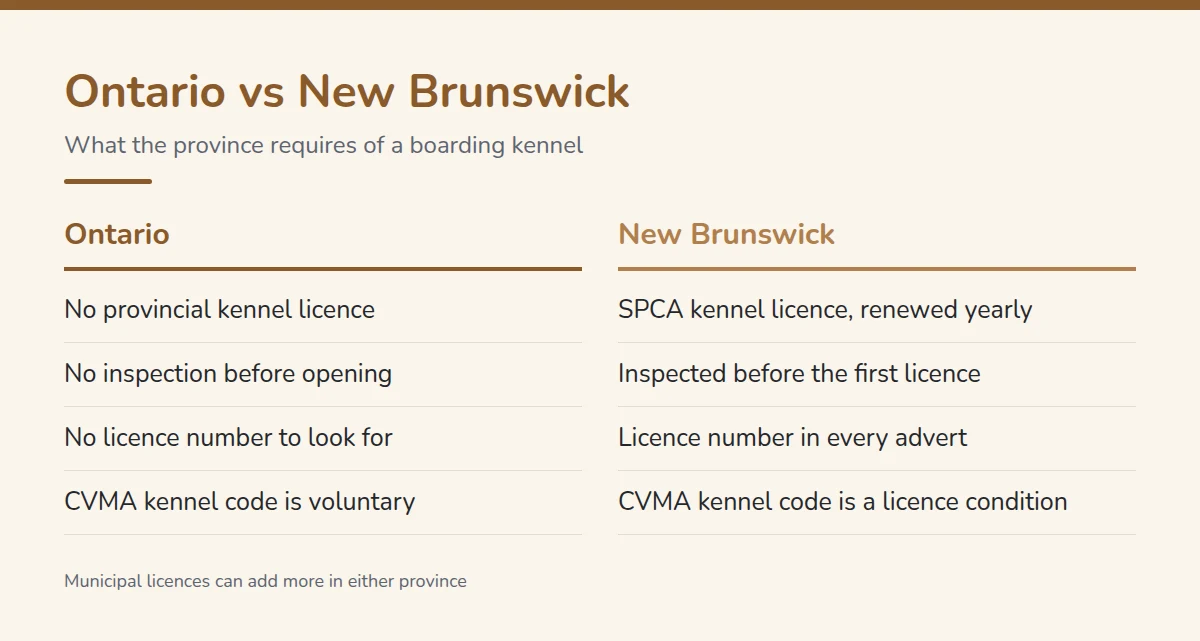
New Brunswick comes closest to the English model. Any premises where dogs are bred or boarded for payment needs a kennel licence from the New Brunswick SPCA. An animal protection officer has to inspect before a first licence is issued, and may inspect again before each renewal. The licence costs $250, lasts a year and must be posted on the premises, and every advertisement has to carry the kennel’s name and licence number. The SPCA keeps a registry of licensed establishments, and licence holders must comply with the CVMA kennel code. A New Brunswick kennel advertising without a licence number is worth a call to the SPCA before you book.
Quebec licenses by headcount. Anyone who owns or has custody of 15 or more cats or dogs needs a permit from the provincial agriculture ministry, MAPAQ, and the ministry’s guidance names boarding kennels among the places that count. Inspectors assess the premises before the permit is issued and then on a regular basis, and the permit runs for 12 months. A small boarder who never has 15 animals in at once sits outside the permit system altogether.
British Columbia has no kennel licence, but commercial dog boarding is a “regulated activity” under the province’s cruelty law. BC SPCA agents, who must be appointed as special provincial constables, can enter premises where a regulated activity is carried on to check compliance without a warrant, during ordinary business hours, as long as the premises are not a dwelling house. The province also recognizes the CVMA kennel code as the reasonable and generally accepted practice for running a kennel. Following generally accepted practice is a defence to a distress charge, so in BC the code is the benchmark a kennel will be measured against.
Elsewhere, ask the provincial animal protection agency whether boarding needs a provincial licence. As Quebec’s 15-animal line shows, the answer can differ for a large kennel and a home boarder in the same province.
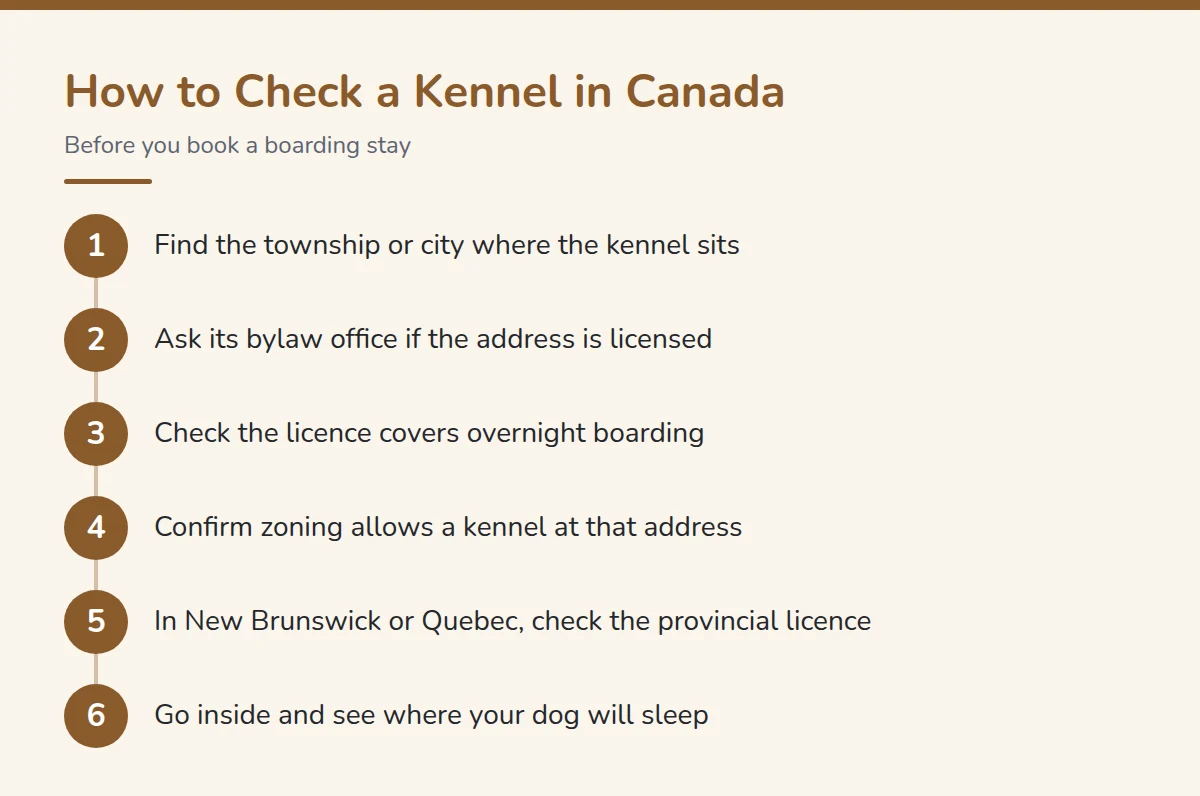
How to Check a Kennel Before You Book
- Find the municipality the kennel actually sits in. In Ontario that is usually the township, town or city rather than the county or region, and it may not be the town in the kennel’s mailing address or business name.
- Ask its bylaw or licensing office three questions. Does this address hold a kennel licence? What does it cover: overnight boarding or daytime care, how many dogs, and until when? Have any orders or penalties been issued here? Hamilton shared its penalty history with reporters, so ask the same question yourself. Ask the kennel for its copy too, and check the expiry date against your travel dates.
- Confirm the zoning. Ask the planning department whether a kennel is a permitted use at that address. A home boarder on a residential street can be breaking the zoning rules before anyone gets to the question of a licence.
- Check the provincial layer where there is one. In New Brunswick, look for the licence number in the advert. In Quebec, a kennel holding 15 or more dogs at a time needs a MAPAQ permit. In Ontario and British Columbia there is no provincial boarding licence to look up, so ask whether the kennel follows the CVMA kennel code and test the answer with the questions above.
- Go inside, to the room where your dog will sleep. Hank’s family never visited the property, because the kennel’s van came to them. After Cartelo died, his owner’s advice to other families was blunt: “Go inside. Don’t take no for an answer.” A tour that stops at the front desk has not shown you the part of the stay that matters most.
- Keep the booking on the record. If you find a sitter or boarder through an app, book and pay through the app. Cartelo’s stay was not booked or paid for through the platform, and the company said that limited the information it had for its own investigation.
Who to Call When Something Goes Wrong
Each agency handles a different piece, so match the call to the problem.
- An animal in distress or being neglected, in Ontario: the Ontario Animal Protection Call Centre at 1-833-9-ANIMAL (1-833-926-4625), which answers 24 hours a day. Give the full address and as much detail as you can. The call centre cannot give you updates on an investigation, so keep your own notes.
- A life in immediate danger, or cruelty happening now: call 911.
- An unlicensed kennel, too many dogs, a zoning breach or a barking complaint: the municipality’s bylaw or animal services office.
- Outside Ontario: the provincial enforcement body. That is the BC SPCA in British Columbia, the New Brunswick SPCA in New Brunswick and MAPAQ in Quebec.
- Vet bills or the loss of your dog: a civil claim, usually in small claims court. A regulator can lay charges, but it will not recover your costs.
Whatever you report, the evidence is the same. Photograph your dog at pickup, get a vet examination with written findings the same day, and keep every message, receipt and advert, along with whatever the kennel told you about its licence. If a dog dies in care, ask your vet about a post-mortem examination straight away. Our guide to the signs your dog was mistreated at boarding covers what to document and how to escalate it.
The Bottom Line
Canada regulates dog boarding in layers, and the layer that matters most before a booking, the municipal licence, is the one nobody tells owners about. A federal Criminal Code offence and a provincial cruelty law stand behind every stay, but both act after the harm. Before you book, ask the township or city four things: is the kennel licensed, does the licence cover overnight boarding, is a kennel allowed at that address, and is anything on file. In New Brunswick and Quebec, add the provincial licence or permit. Everywhere, go inside. And if no kennel within reach clears those checks, it is worth asking whether your dog should come on the trip instead.
Further reading (sources)
- Global News on the Brock Township kennel charged for boarding overnight on a daytime licence
- Global News for the Hamilton boarder’s licensing, zoning and penalty history
- CP24 with the provincial animal welfare charges laid in the Hamilton case
- Justice Laws Website on the Criminal Code offence of neglecting an animal in your custody
- Canadian Veterinary Medical Association for its national code of practice for kennel operations
- CanLII with Ontario’s PAWS Act, from inspection powers to penalties
- Government of Ontario on the provincial standards of care and the 1-833-9-ANIMAL line
- Government of Ontario for the latest count of animal welfare calls, inspections and charges
- Municipality of Thames Centre on who needs a kennel licence and what applying involves
- Township of Guelph/Eramosa with its zoning, insurance and inspection rules for boarding kennels
- New Brunswick Acts and Regulations for the regulation that licenses boarding kennels through the SPCA
- LégisQuébec on the permit rule for keepers of 15 or more cats or dogs
- Gouvernement du Québec with the agriculture ministry’s permit guidance, which lists boarding kennels (in French)
- BC Laws for the regulation that makes commercial boarding a regulated activity
- BC Laws on the cruelty law’s inspection powers and accepted-practice defence