What a Kennel's Location Tells You About Your Dog's Stay: Site, Neighbours, Noise Limits, and Traffic Risk
Published on October 7, 2026
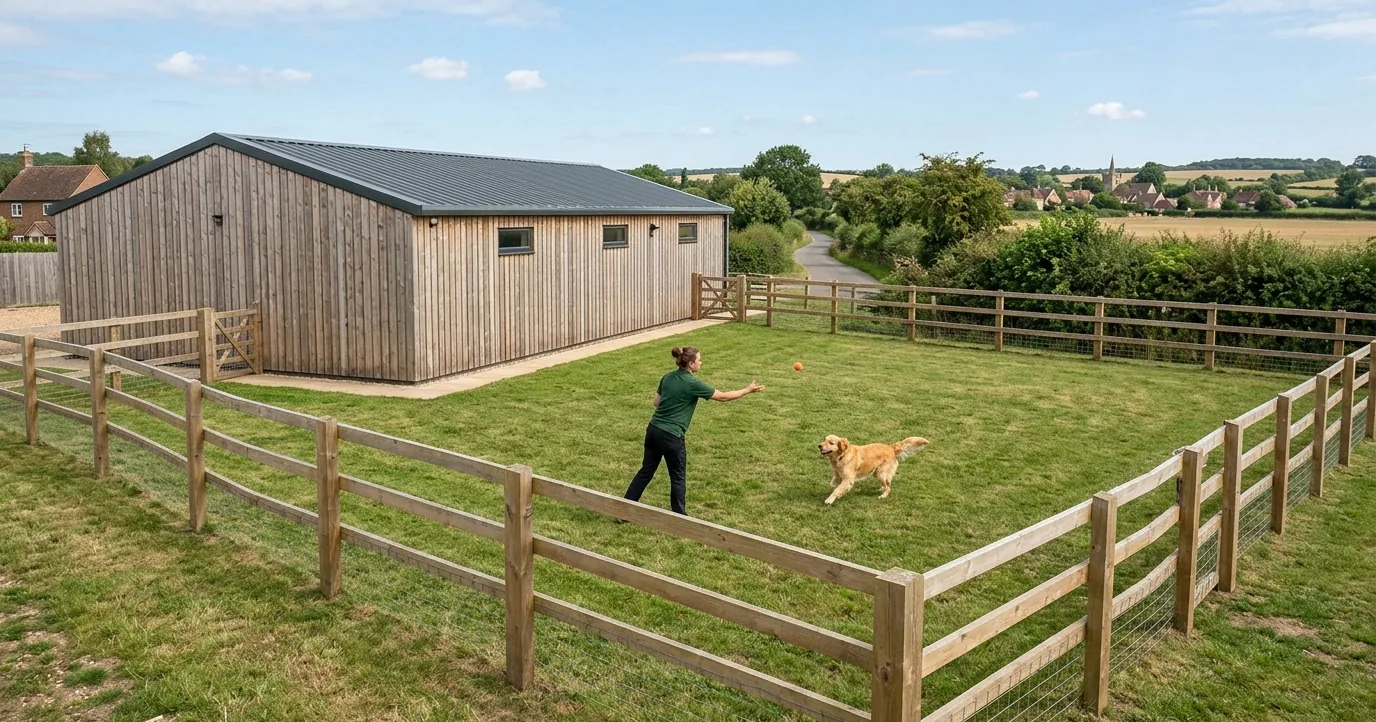
In August 2026, Peterborough City Council approved a small boarding kennel at a house on Park Lane, beside the grounds of a school. The local highway authority had objected that the site lacked enough parking and turning space, and the case officer approved it anyway, satisfied that about three vehicles could fit. The decision report explains why the site worked. This was “a small-scale boarding facility limited to six dogs,” and vehicle activity would mostly be “occasional pre-arranged drop-offs and collections rather than continuous customer visits throughout the day.” The officer also went round the compass: open grassland to the north, the school and its grounds to the east, roads to the south and west and, “unlike many residential kennel proposals,” no ring of neighbouring gardens.
Read that again as a dog owner. How many dogs share a site, when the cars come and go, who lives close enough to hear the barking and what lies beyond the fence are planning questions. They are also the things that decide how long your dog spends outdoors, how pickup goes in the busiest week of the year and what happens if a gate is left open. Owners choosing between two nearby kennels compare prices, suites and reviews. Few compare the sites. This guide reads a kennel’s location the way an inspector would and translates each finding into your dog’s day.
Noise Limits Become Turnout Limits
Barking is what neighbours worry about, so noise is what many of the conditions on a kennel’s permission are written to control. The simplest way to control it is to keep dogs indoors.
In July 2026 the town council in Leeds, Utah, approved a home-based daycare and boarding business under conditions that read like a timetable for the dogs. No more than five boarded dogs at once. Every dog indoors overnight, outdoor play only between 7 a.m. and 6 p.m., and quiet time from 6 p.m. to 7 a.m. apart from necessary toilet breaks. No more than five dogs outside together, never unattended, and no sustained barking, howling or yelping audible beyond the property line for more than ten consecutive minutes.
Rural sites get the same treatment. A boarding and daycare kennel approved this year on a ten-acre agricultural parcel in Mountain View County, Alberta, may hold no more than 12 dogs, the owners’ own two included. The dogs are housed indoors from 10 p.m. to 5 a.m., outdoor exercise is supervised at all times, and the permit forbids letting them “bark or howl excessively or otherwise disturb any persons.” In South Dakota, Minnehaha County approved an overnight kennel for up to 24 dogs in May, over neighbours’ objections about barking and traffic and after its planning commission had cut the plan from three buildings to one. The applicant’s answer to the noise was to keep the dogs and their runs inside a heavily insulated building.
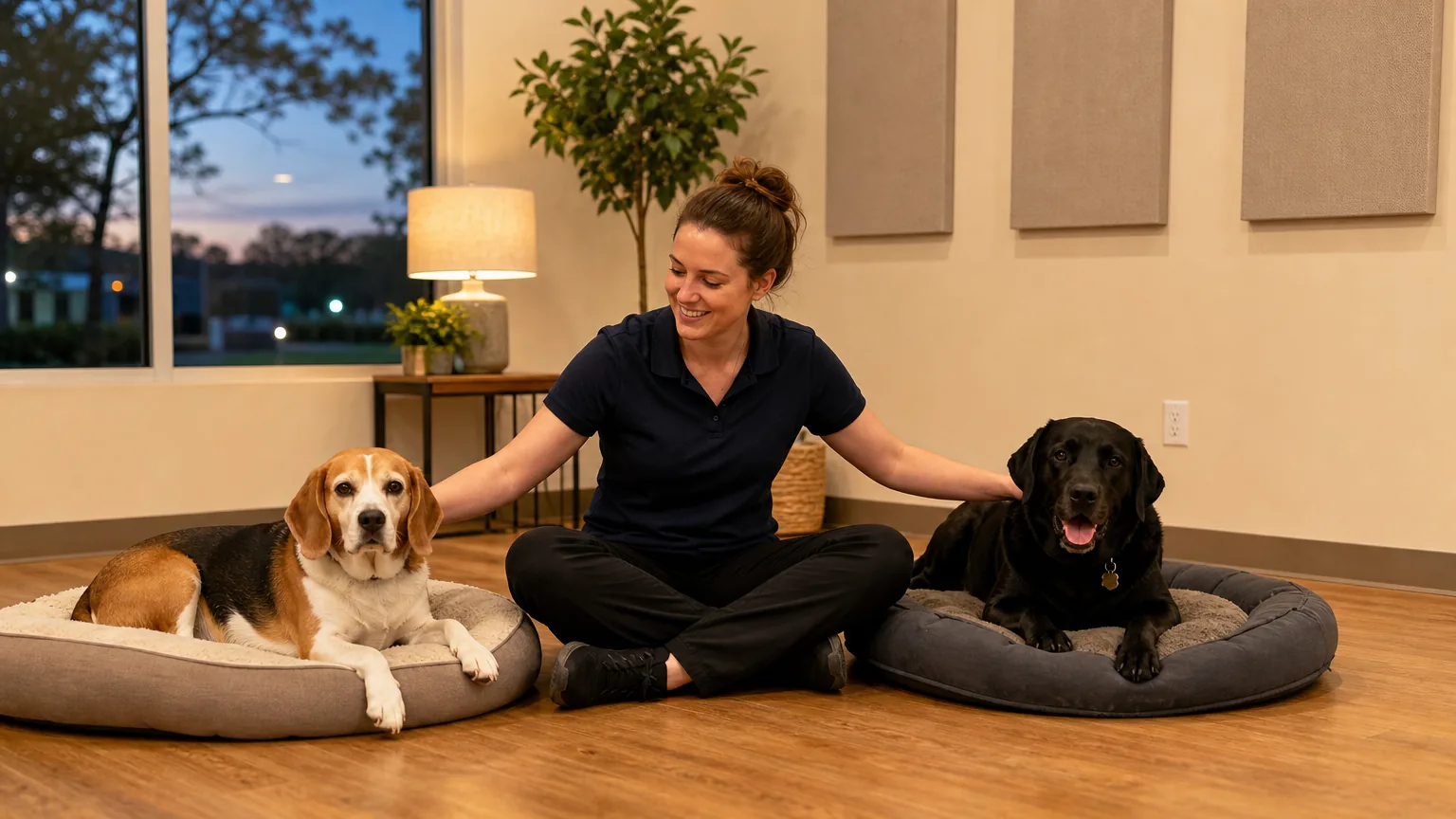
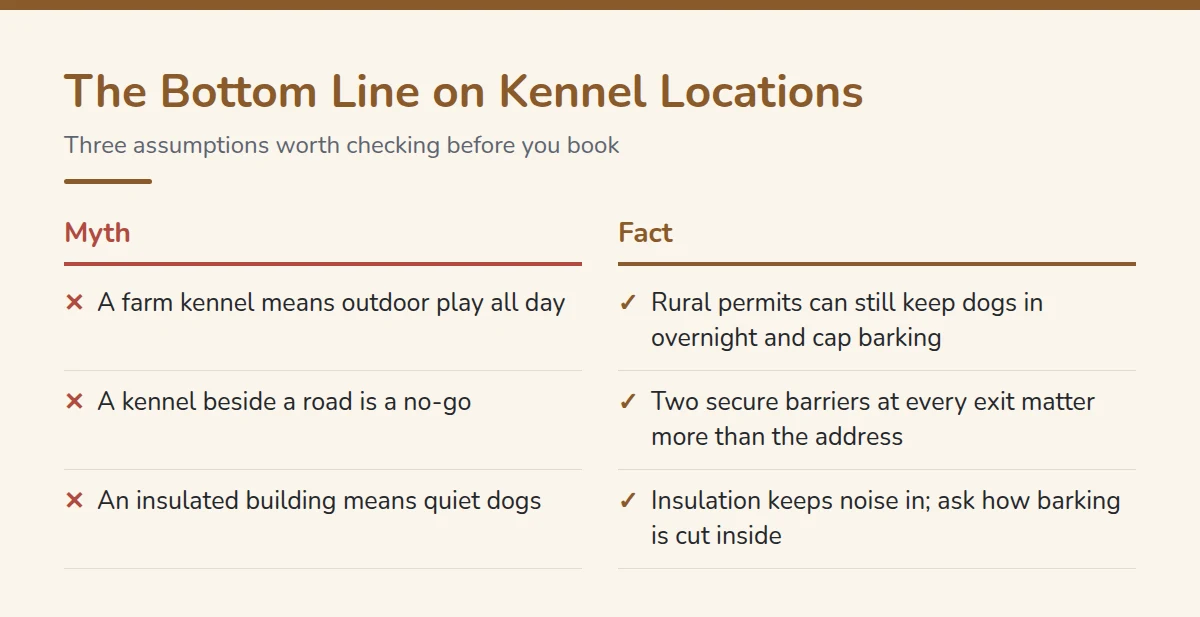
None of this is bad for dogs in itself. Supervised play in set sessions is how good kennels operate anyway, and quiet nights help dogs rest. It does mean the turnout described on the website is partly set by the permit, not just by staff judgement. Ask whether the site has conditions on dog numbers, outdoor hours or noise, then compare them with what your dog needs. A young, high-energy dog at a site where everyone comes in at 6 p.m. needs its long session in the afternoon. A dog that barks along the fence line may be brought in early to protect the permit. Our guide to how much exercise a boarded dog actually gets shows how to turn the answers into a plan.
There is a catch for the dogs. Insulation stops the noise leaving the building. It does nothing to make the inside quieter. Veterinary researchers at North Carolina State University call excessive barking “a major source of noise pollution in dog kennels” that harms welfare, and in their small pilot study, asking everyone who walked through a boarding ward to toss each dog a treat, whatever it was doing, reduced the barking. England’s licensing standards require kennels to avoid excessive noise and to house dogs upset by barking in the quietest part of the building, and a written plan to reduce noise for the dogs themselves is one of the optional standards that count toward a four or five star rating. On a site that keeps dogs in to protect the neighbours, ask what the operator does about the noise the dogs have to live with.
Neighbours Decide How Long a Kennel Lasts
A kennel’s permission is only as secure as its relationship with the people next door. The Leeds permit spells out the mechanism. Evidence of a violation can come from town officials, animal control officers, police, written logs or audio recordings, and two verified violations within twelve months can lead to review, modification, suspension or revocation of the permit. The permit does not pass to a new owner of the property either. Minnehaha County has no noise ordinance, but its planner said neighbours could still file complaints if problems arose. Of the estimated 10 to 12 kennels operating across the county, the planner said, “We have no active complaints,” a useful reminder that most kennels and their neighbours get along fine.
Dense streets are where the friction is sharpest. In June 2026 a planning inspector upheld Westminster Council’s refusal to let a pet grooming business on Great Portland Street in central London add overnight boarding on its basement and ground floors. The applicant’s noise survey had not traced how barking would travel through the structure of the building to the flats above, where residents sleep, so it had “not been demonstrated that no harm would arise” to their living conditions. The daytime business was not in question. Overnight stays were refused.
For an owner, this matters in two ways. A kennel in a running dispute is likely to tighten up first, with fewer dogs, shorter turnout and an earlier lock-in. And a booking made months ahead for a holiday week depends on whatever the permit allows by then. Ask how long the business has operated at this address, whether its permission is permanent or due for review, and whether it is dealing with any complaints. A confident operator answers in a sentence. In England, a site’s planning history is usually searchable on the council’s online planning register. In the US, conditional use permits go through public hearings, and the agendas and minutes are usually posted online. Our guide to licensed capacity and staff ratios explains how these permissions sit alongside welfare licences.
Roads Raise the Stakes of Every Gate
Dogs get out of good kennels as well as bad ones. Where the kennel sits decides what happens next: a dog loose in a fenced paddock is a nuisance, and a dog loose beside a fast road is in danger within seconds.
England’s minimum standard for licensed kennels requires “at least 2 secure physical barriers (for example, a door or gate) between a dog and any entrance or exit to the property,” and kennels and runs must open onto secure corridors or areas so dogs cannot escape from the premises. The rule exists because single barriers fail. In Pennsylvania in 2019, a dog got out of a boarding kennel overnight, with no staff on site, and was hit and killed by a car. Its owner said a door had pulled far enough away from the building for a larger dog to get through, and state dog wardens filed charges after finding violations that included failure to contain the dogs safely. Pennsylvania did not require overnight staff at the time, and the kennel faced a maintenance violation and fines of up to $300.
Sites without a fenced yard carry a different version of the risk. In June 2026, two days into a board-and-train program in Fredericksburg, Virginia, a dog was taken out for a toilet break outside the trainer’s townhome. In the trainer’s account, a quiet car passed on an adjacent road, the dog snatched the leash away and bolted, and a driver reversed over it in a nearby parking lot. The owner had warned in advance that the dog chased cars. Cheaper home-based care often runs from ordinary houses on ordinary streets, as our guide to trading down safely on boarding costs discusses, and where there is no secure yard, every toilet break is a walk beside traffic.
What to check on a site near a road:
- Count the barriers. Walk the route from the room your dog will sleep in to the road and count every door and gate. Fewer than two is a fail.
- Look at the road side of the property. Fencing there should be at least as strong as anywhere else, and no play-yard gate should open toward it.
- Watch the arrival area. The car park is where dogs are least contained: excited, on a lead, among moving cars. A good layout brings dogs from the car to the building without crossing traffic.
- Ask about street walks. If dogs are walked off the property, ask what equipment is used and whether a dog known to chase cars is walked at all.
Our guide to latches, gates and fencing gaps has the detailed hardware questions.
Parking, Pickup Windows and the Holiday Crush
Parking is the objection highway authorities raise, and it matters for more than convenience. The Peterborough kennel was approved because six dogs meant a handful of pre-arranged arrivals rather than a stream of cars. In Leeds, every drop-off and pickup happens on the property in one of three windows (7 to 9 a.m., noon to 1 p.m. and 4 to 6 p.m.), with no more than two customer vehicles there at once. The Minnehaha County kennel’s conditions also include designated drop-off and pickup times.
Two things follow. First, a pickup window may be a condition of the permit rather than a house preference, so a delayed flight can mean an extra night if the operator is not allowed to hand dogs over outside those hours. Ask what happens if you are late. Second, the busiest weeks concentrate everything. A kennel that is full over Christmas or the Fourth of July sends most of its guests home within the same day or two, and a car park built for a trickle of arrivals fills with reversing cars and dogs that have just seen their families.
Good operators handle that with timed slots, staff bringing dogs out one at a time, and a rule that leads go on before car doors open. Do your part. At drop-off, leave your dog in the car until you are called and clip the lead on before you open the door. At pickup, get your dog into the car before you stop to chat, and save the big reunion for somewhere a dog cannot bolt into traffic.
Farms and Rural Sites: Space, Quiet and Different Hazards
Rural kennels have real advantages: fewer neighbours to disturb, more room for outdoor areas, and nights quiet enough for dogs to sleep. The trade is a different set of hazards, and most of them sit beyond the fence.
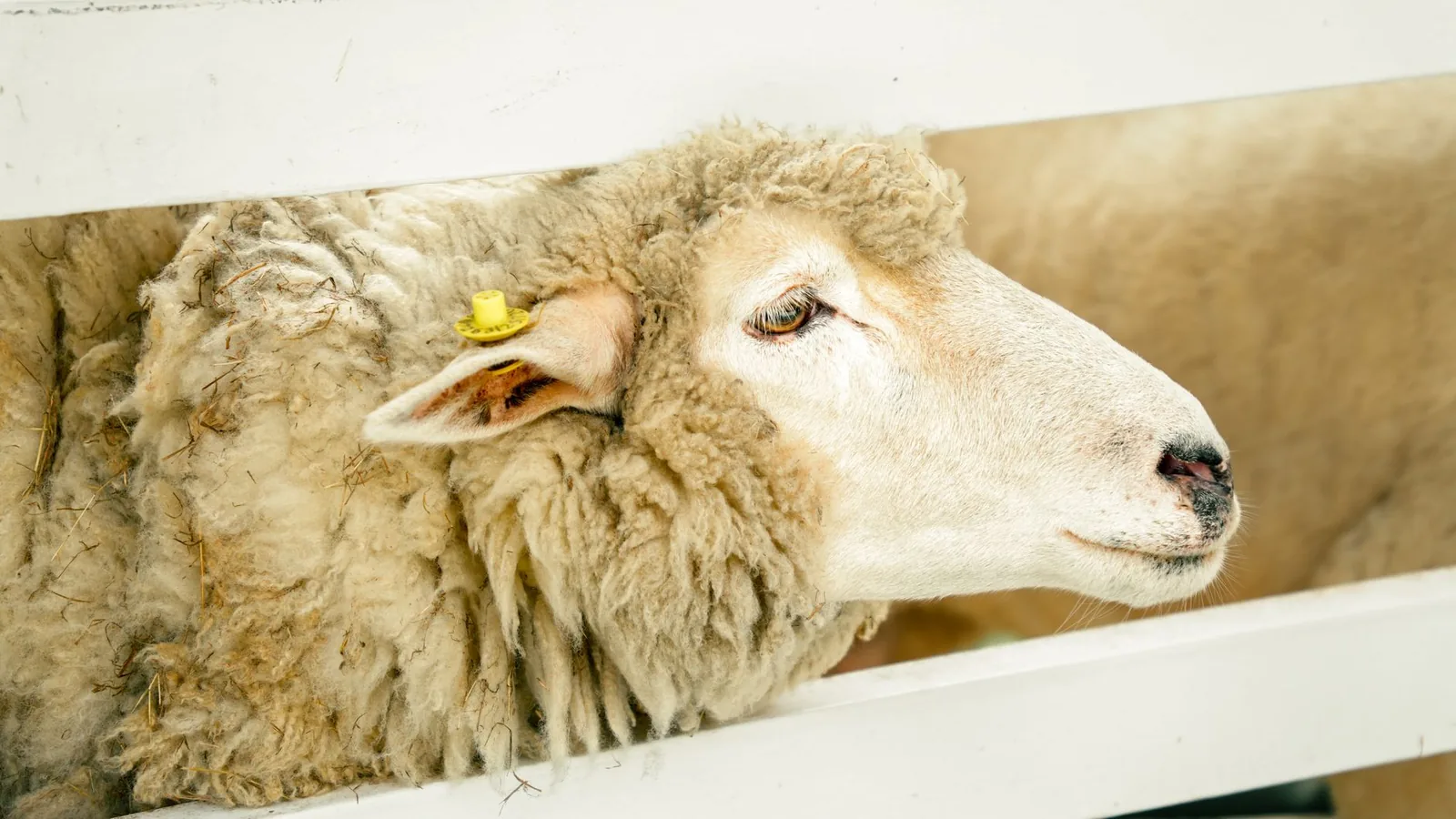
Livestock come first. A loose dog among sheep or cattle is in danger from the farmer as well as the traffic. In England and Wales, someone sued for killing or injuring a dog has a defence if they were protecting livestock they were entitled to protect and the dog was worrying the animals, or about to, with “no other reasonable means of ending or preventing the worrying.” Texas law lets anyone who witnesses a dog attacking livestock, or about to, kill it, and that person is not liable to the dog’s owner, keeper or whoever had control of it. When the Alberta applicants contacted 11 nearby landowners, no letters of objection came back, but one neighbour asked whether proper fencing would keep the dogs contained. The answer was six-foot wire fencing around the exercise area. Ask what is in the next field and what stands between it and your dog.
Then there is distance. Rural roads are often fast, unlit and without pavements, so the gate questions above still apply. Emergency care may be a long drive away. England’s kennel standards require the kennel’s registered vet to be “within a reasonable travel distance,” but the practice a kennel registers with is not always the one answering the phone at 2 a.m., so ask which clinic takes out-of-hours emergencies and how long the drive is. Farms also bring their own ingestion hazards, from rodent bait to fertiliser stores, which our guide to poisoning hazards on kennel grounds covers in detail.
How to Read a Site Before You Book
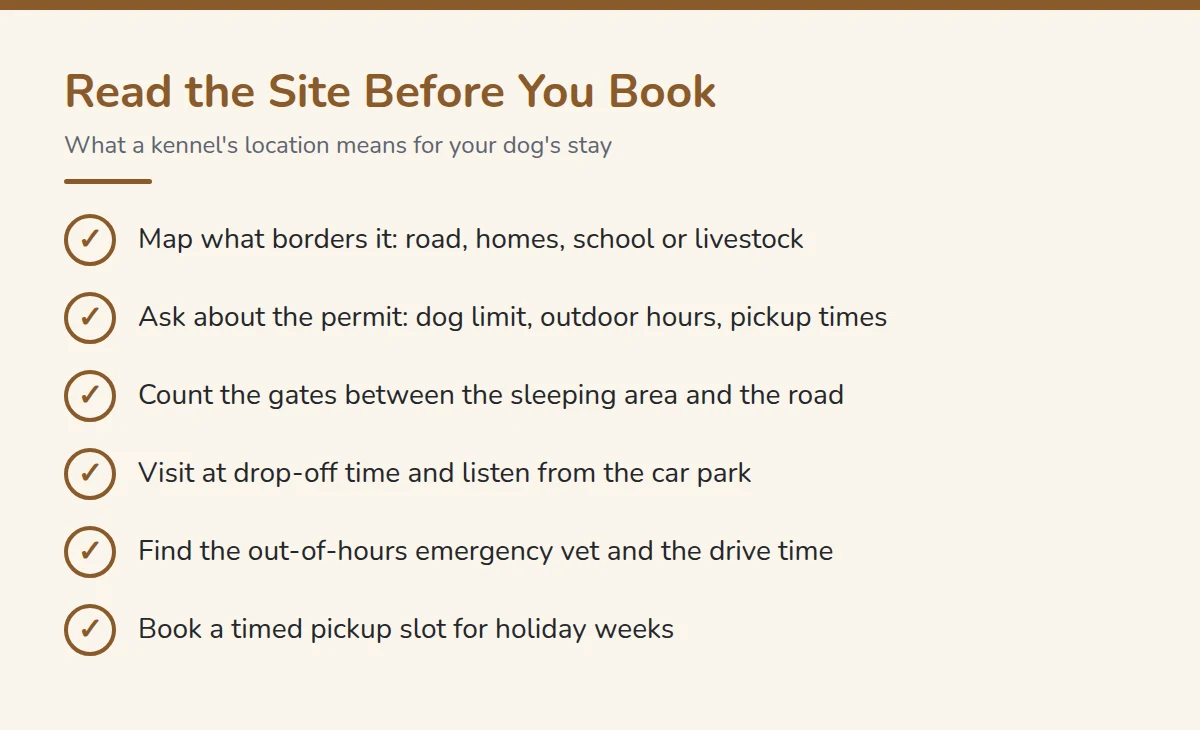
- Look at the satellite view. Note what sits on each side: road, houses, school, livestock or open land.
- Ask about the permission. Dog numbers, outdoor hours, quiet hours, pickup windows and any review date.
- Visit at a busy time. Go at drop-off or turnout, not in a quiet mid-afternoon slot, and listen from the car park.
- Count the barriers between the sleeping area and the road.
- Find the emergency vet. Ask which clinic handles out-of-hours emergencies and how far away it is.
- Plan the holiday pickup. Ask how collections are scheduled in peak weeks and what happens if you are late.
Choosing Between Two Nearby Kennels
Location is not a verdict on its own. A kennel on a main road with two secure barriers at every exit, timed collections and a solid fence on the road side can be safer than a farm with a single gate and sheep next door. A house with strict outdoor hours can suit an older dog and frustrate a young one. Match the site to the dog in front of you. A fence runner or car chaser needs distance from traffic and layered gates. A dog that barks at everything may spend more of the day indoors on a site with tight noise limits. A dog that hates noise may do best where the permit keeps everyone quiet after six.
Further reading (sources)
- BBC News on the Peterborough six-dog kennel approved over parking objections
- Town of Leeds, Utah for the council minutes setting play hours, barking limits and pickup windows for a home boarder
- The Albertan with a rural Alberta kennel capped at 12 dogs and kept indoors overnight
- Sioux Falls Live on a South Dakota kennel approved with insulated indoor runs and set pickup times
- Fitzrovia News covering the appeal that refused overnight boarding beneath London flats
- GOV.UK for England’s kennel standards on escape barriers, noise and vet access
- Zurlinden and colleagues on cutting kennel barking with a treat-tossing routine
- FOX43 with charges against a Pennsylvania kennel after a dog got out overnight and was killed by a car
- WTVR CBS 6 on a board-and-train dog killed by a car during a toilet break
- legislation.gov.uk for the Animals Act defence for killing a dog that is worrying livestock
- Texas Legislature covering the state statute on dogs that attack livestock