What Dogs Eat That They Shouldn't at Boarding: Play-Yard Plants, Mulch, Bait Stations, and the Staff Room Fridge
Published on September 19, 2026
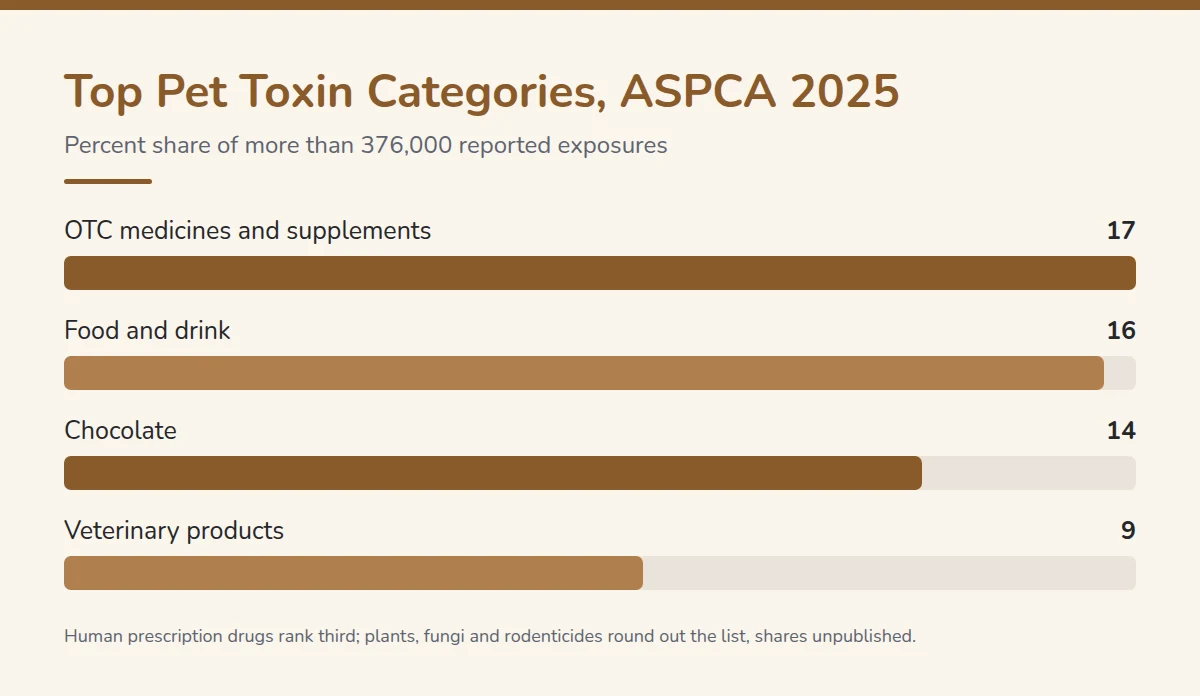
In 2025 the ASPCA Animal Poison Control Center took calls about more than 376,000 items that pets had been exposed to. The categories at the top of that list read like an inventory of an ordinary staff room. Over-the-counter medicines and supplements came first at 16.9 percent of exposures, food and drink second at 16.4 percent, human prescription medicines third, and chocolate fourth at 13.6 percent. Veterinary products were fifth at 9.1 percent, plants and fungi sixth, rodenticides seventh.
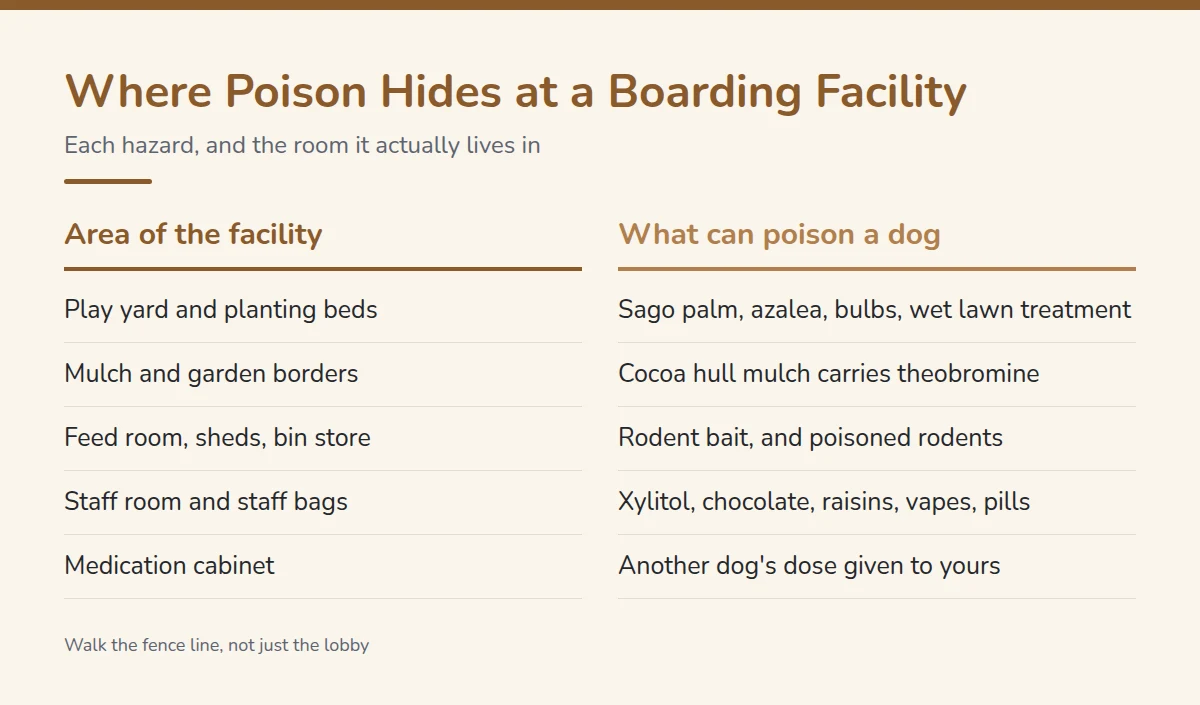
Now picture where your dog sleeps while you are away. A boarding facility holds every one of those categories on site, in larger quantities than a house, spread across more rooms, and handled by a rotating shift of people rather than one owner who knows exactly what is in the cupboard. Then it adds hazards a home does not have: a landscaped play yard your dog spends hours in, a feed room full of kibble sacks that attracts rodents and therefore bait, and a medication cabinet holding pills for twenty dogs who all look broadly alike at seven in the morning.
Most boarding safety writing treats poisoning as a footnote. The physical hazards get the attention, and they should, but swallowing deserves its own category. Here is where it lives on a typical property, what an owner can actually see on a tour, and what happens if the call comes mid-stay.
The Play Yard Is Landscaping First and a Dog Run Second
Almost every play yard was planted by somebody thinking about how it would photograph, not about what a bored Labrador does to a shrub at four in the afternoon. The beds around the fence line, the screening hedge along the neighbour’s boundary, the pots by the entrance: all of it was chosen for looks, and nobody checked it against a toxicity list.
Sago palm is the one worth knowing by name. It is sold as an ornamental across the southern United States and as a houseplant everywhere else, every part of it is toxic, the seeds most of all, and the Pet Poison Helpline reports that as little as one seed can kill a dog, with roughly half of poisoned dogs dying even with treatment. Azalea and rhododendron, oleander, yew, and tulip or daffodil bulbs all belong on the same mental list. The ASPCA maintains a searchable database of more than a thousand toxic and non-toxic plants filtered by species, with a printable dog list you can carry on a tour.
Two seasonal hazards ride along with the planting. Mushrooms come up in damp turf and shaded corners after rain, identification is genuinely difficult, and the sensible rule is that any unidentified mushroom in a dog yard is treated as toxic until a vet says otherwise. And lawn products matter less for what they are than for when they were applied: many insecticides and fertilisers are only considered safe once fully dry, which makes the re-entry interval the thing to ask about rather than the brand name.
What to actually do on the tour: walk the fence line rather than looking at the yard from the gate. Ask who maintains the planting, whether anyone has checked the species against a toxic plant list, and what the schedule is for lawn treatment and how long dogs are kept off afterwards. A facility that treats the yard as animal housing rather than as grounds will have an answer.
Mulch Underfoot, and the Cocoa Problem
Mulch is the surface owners never think to ask about. Cocoa bean mulch is the specific worry, because it is made from the hulls left over from chocolate production and it carries the same theobromine and caffeine that make chocolate dangerous. It also smells like chocolate, which is the entire problem.
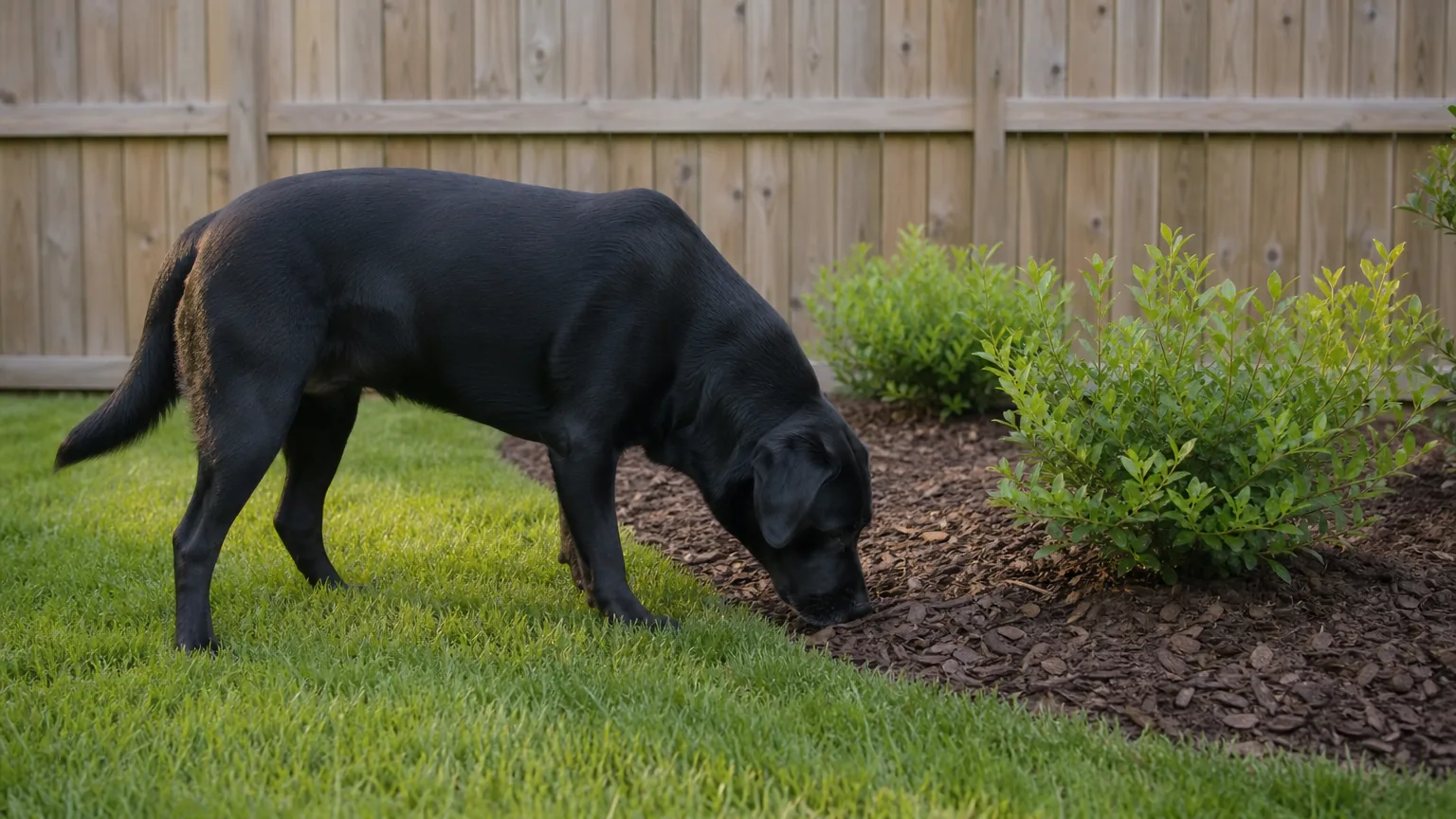
The National Capital Poison Center is honest about the limits of the advice here: it is impossible to say how much cocoa mulch is poisonous, because it depends on the theobromine concentration in that particular batch, the size of the dog, and how much it ate. Their summary of reported cases is a useful picture of what exposure looks like in practice. About half of affected dogs vomited, a third developed tremors, and around one in six showed a fast heart rate or hyperactivity. A third showed no clinical signs at all, which is exactly why the absence of symptoms is not reassurance.
Ordinary bark and wood mulch carries a duller risk: dogs that swallow it can obstruct, and the dogs that eat mulch tend to be the same dogs that eat socks. Ask what the yard surface and the bed mulch are, ask specifically whether any cocoa mulch is used anywhere on the property including the front landscaping, and if your dog is a known eater of things, say so at booking and ask for turnout on grass, gravel, or turf instead.
Bait Stations Are Where the Feed Room Meets the Pest Contract
A kennel stores food in bulk, which attracts rodents, which means most facilities have a pest control contract and bait on site. This is not a scandal. It is normal operations, and a rodent problem in a feed room is its own health risk. What matters is where the bait sits and what is in it.
The EPA limits which products reach the consumer shelf. Consumer-sized rodenticides are restricted to first-generation anticoagulants (chlorophacinone and diphacinone) and the non-anticoagulant bromethalin. The more potent second-generation anticoagulants (brodifacoum, bromadiolone, difenacoum and difethialone) are registered only for commercial and structural pest control markets, which is to say that the bait a professional applicator brings to a kennel may be stronger than anything an owner could buy. EPA rules require tamper-resistant bait stations for professional and agricultural products wherever children under six, pets or non-target wildlife have access, and for all outdoor above-ground applications.
Tamper-resistant is the correct word, and it is not the same as dog-proof. A station is engineered against a toddler’s hands, not against a determined 80-pound dog with an afternoon to spare. Stations also get knocked over, moved by staff mowing around them, and left unlatched after a refill.
The active ingredient decides how the emergency goes. Anticoagulants have an antidote in vitamin K1, but the bleeding they cause appears days after the dog ate the bait, which means a dog can be collected at pickup looking perfectly well. Bromethalin is worse in one specific respect: the Merck Veterinary Manual notes there is no antidote for bromethalin poisoning, it causes cerebral oedema, and neurological signs appear anywhere from four hours to several days after exposure depending on the dose. There is also relay toxicosis to consider, where a dog is poisoned by eating a rodent that ate the bait rather than by finding the station at all.
Ask whether there is a pest control contract and who holds it, what product is in use, and where the stations are placed. A facility using a professional service can produce a service record with the active ingredient on it, and that record is the thing an emergency vet will want. Ask that no station sits in, or shares a fence line with, any area dogs use.
The Staff Room Fridge
This is the hazard nobody puts on a tour, because it lives behind the door marked private. Staff bring food to work. Some of that food is dangerous, and a kennel is full of dogs whose entire job that afternoon is finding something interesting.
Xylitol deserves the top of the list, and it is the one with a kennel-specific twist. The FDA explains that dogs absorb xylitol rapidly, which triggers a powerful insulin release and a dangerous drop in blood sugar, with signs appearing 10 to 60 minutes after ingestion and serious effects sometimes delayed 12 to 24 hours. It turns up in sugar-free gum, mints, chewable vitamins, cough syrup, toothpaste, and peanut butter. That last one matters here more than anywhere else, because peanut butter is the standard filler for enrichment toys in boarding facilities. If the jar came from somebody’s kitchen at home rather than from a checked facility supply, nobody has read the label.
Grapes and raisins are the second entry, and the science has moved. Tartaric acid is now the proposed toxic principle, and its concentration varies with the grape cultivar, growing conditions and ripeness, which explains why two dogs eating the same amount can have completely different outcomes. The Merck Veterinary Manual puts the rough threshold at more than one grape or raisin per 10 pounds of body weight, with vomiting or diarrhoea in the first 6 to 12 hours and kidney failure developing over 24 to 72 hours. Raisins hide in trail mix, granola bars and oatmeal cookies, which is precisely what somebody eats standing up on a short break.
Then the rest of the break room: chocolate, onions and garlic, macadamia nuts, yeast dough and alcohol, all of which Humane World for Animals lists among the foods that can poison a pet. Nicotine belongs here too, and vape pods are the modern version of the problem, since a pod is a concentrated dose in a chewable plastic case. And a handbag on a hook at nose height contains the two categories that top the ASPCA list every single year.
The questions are simple and a good operator will not find them strange. Is the break room behind a door that dogs never pass through? Are staff bags stored in lockers or on a high shelf rather than on the floor? Is there a written rule about food in the kennel areas? And where does the peanut butter for enrichment come from?
The One Nobody Talks About: Another Dog’s Medication
Boarding facilities give medication as a matter of routine. Morning and evening medication rounds are a fixed part of the kennel day, and on any given morning one person may be dosing a dozen dogs from a dozen different containers.
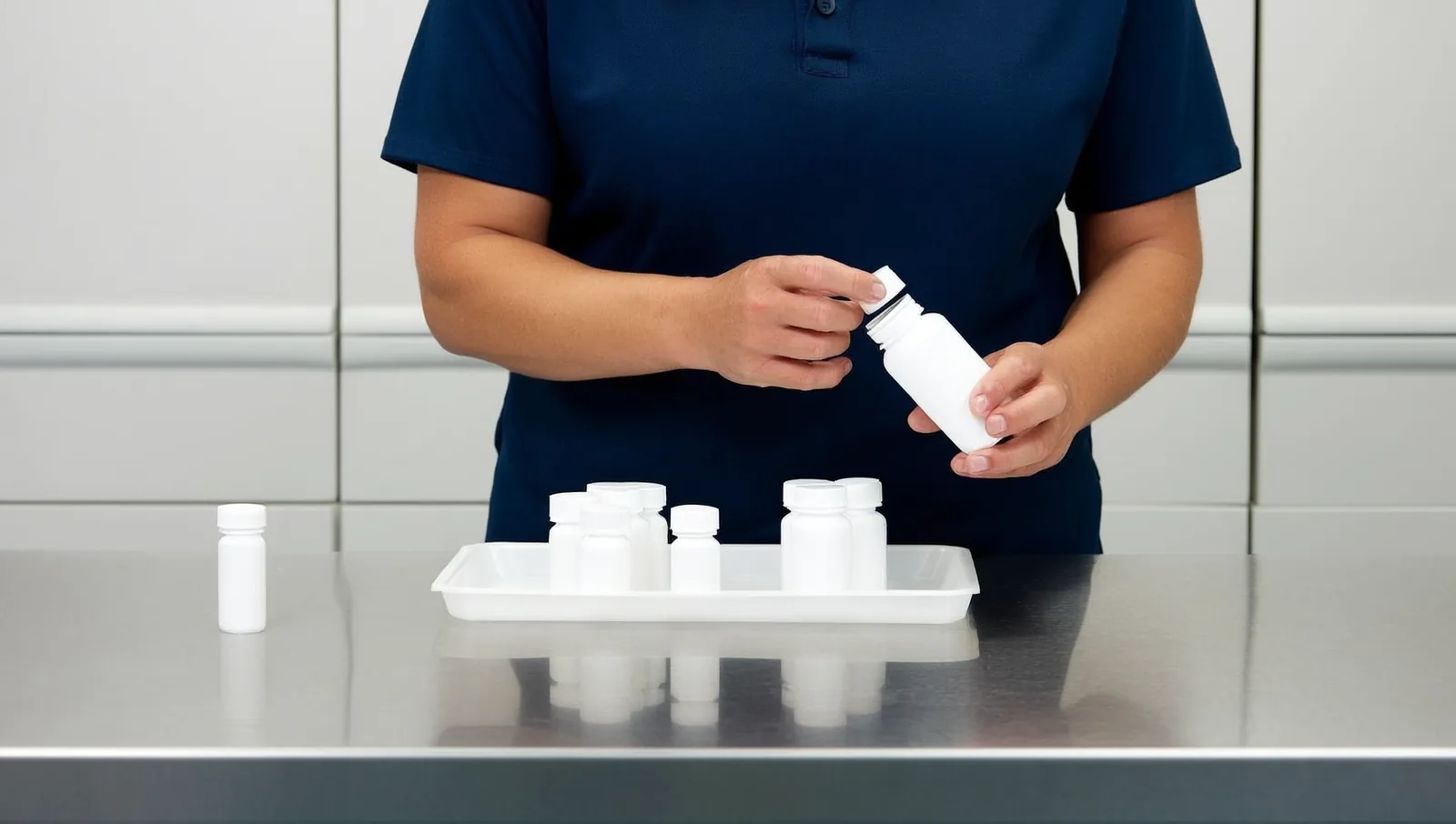
The veterinary research on medication errors is sobering, and it comes from clinics rather than kennels. Petrou and colleagues searched UK first-opinion electronic health records and, of the medication errors they identified, found that 51.4 percent occurred during the drug administered phase, with dosing errors making up 68.1 percent of those. Just under 30 percent of the errors caused mild harm to the patient, 2.8 percent moderate harm. A separate literature review by Pinho, Nasr-Esfahani and Pang found that medication errors were among the most commonly reported medical errors in veterinary medicine, that self-reporting systems almost certainly understate the true rate, and that the predisposing factors include distraction, fatigue, workload, thin supervision, dose calculations by body weight, and giving several medications within a short window.
Read that list of predisposing factors again and notice that it describes a kennel medication round exactly. Then notice what a kennel does not have. There is no veterinarian on site, staff may be unlicensed and hourly, and there is rarely a second person available to check a dose before it goes down a dog’s throat.
The FDA’s own guidance on medication errors names the usual culprits: similar-sounding and similar-looking drug names, crowded or low-contrast labels, illegible handwriting, verbal instructions, and improper storage. Its advice to owners includes two lines that translate directly to boarding: keep drugs in their original labelled containers, and never give one animal’s medication to another without veterinary approval.
What you can control at drop-off:
- Send every drug in its original pharmacy container. Not a weekly pill organiser, not a labelled sandwich bag, not a repurposed bottle.
- Write your dog’s name on every container yourself, in large letters, even though the pharmacy label already has it.
- Hand over one typed instruction sheet per dog covering drug, strength, dose, timing and whether it goes with food. Do not rely on a conversation at the counter during a busy Friday check-in.
- Ask whether doses are initialled at the moment they are given or written up at the end of a shift, and ask to see the log at pickup.
- Ask where medications are stored and whether each dog’s drugs are physically separated rather than kept loose in one shared box.
If your dog takes several medications, or takes anything with a narrow safety margin, that is a reason to be choosier about the facility rather than a reason to hide it. Our guide to what older dogs need that standard kennels miss covers the same ground for seniors on long-term prescriptions.
If the Call Comes Mid-Stay
Two 24-hour animal poison control services cover North America: the ASPCA Animal Poison Control Center on (888) 426-4435 and the Pet Poison Helpline on (855) 764-7661. Both charge a per-incident consultation fee, and the Pet Poison Helpline publishes its as $89 with follow-up calls included. Paying it buys something specific: a case number, and a toxicologist your treating vet can talk to directly about dose and timing.
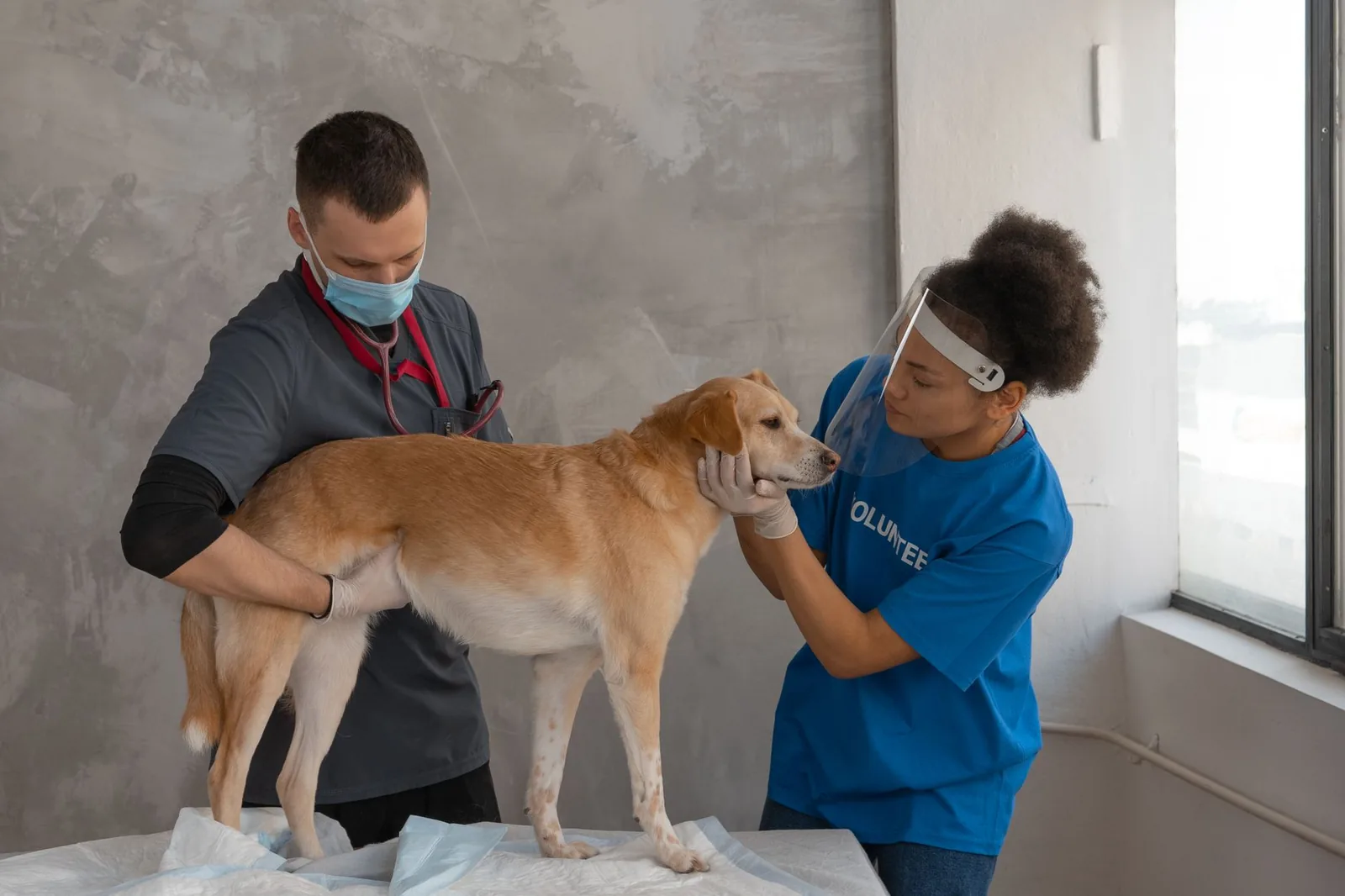
Whoever is standing in front of your dog needs five things ready before dialling: what was eaten, roughly how much, when, the dog’s current weight, and the product packaging if it still exists. The packaging is the one most often thrown away and the one that matters most, because the active ingredient changes the treatment entirely.
One firm rule: do not let anyone induce vomiting on the strength of a phone instruction from a kennel. Some ingestions do more damage coming back up than going down, and that call belongs to a veterinarian who knows what was swallowed.
The money question is worth settling before you ever need it. Most boarding contracts contain an emergency care clause naming a vet and setting a spending limit, and owners sign it at drop-off without reading the number. If that cap is $250 and the workup is $1,500, somebody has to reach you from an airport before treatment continues. Read the cap, raise it in writing if it is low, and leave two contact numbers plus a person with authority to decide if you are unreachable. These clauses also generally put the cost on the owner unless negligence is established, and whether a facility was negligent is a legal question rather than something a kennel manager decides on the phone. Keep the records either way. If the bill is the immediate problem, Humane World for Animals maintains a guide to payment plans and assistance for unexpected vet bills, including a searchable directory of clinics and funds. All of this sits alongside the wider questions about a facility’s emergency plan that you should be asking before you book.
Whether a particular ingestion needs treatment is a decision for a veterinarian, not for this article and not for the person who called you.
The Bottom Line
Ingestion risk at a kennel is not exotic. It is a plant somebody liked the look of, a bag of mulch bought on price, a bait station moved by a mower, a jar of peanut butter from a staff member’s kitchen, and a medication round run by a tired person at seven in the morning. Every one of those has a boring control behind it, and a facility that has thought about any of them has usually thought about the rest. Ask the questions on a tour, walk the fence line yourself, and put your dog’s medication instructions in writing. Then add it to everything else you weigh when choosing the right dog hotel.
Further reading (sources)
- ASPCA Animal Poison Control on the categories behind 376,000 pet exposure calls in 2025
- ASPCA Animal Poison Control for the searchable toxic and non-toxic plant database
- US Environmental Protection Agency with which rodenticides reach consumers and when bait stations are required
- National Capital Poison Center on why cocoa bean mulch poisons dogs and what exposure looks like
- Merck Veterinary Manual for why bromethalin has no antidote
- Merck Veterinary Manual on tartaric acid and the grape dose that puts a dog at risk
- US Food and Drug Administration with how fast xylitol crashes a dog’s blood sugar
- US Food and Drug Administration for what causes veterinary medication errors and how to prevent them
- Petrou and colleagues on medication errors found in first-opinion veterinary health records
- Pinho, Nasr-Esfahani and Pang with a review of medication errors across veterinary practice
- Pet Poison Helpline on why a single sago palm seed can kill a dog
- Humane World for Animals for the household foods that poison pets
- Humane World for Animals with payment options when a vet bill arrives unplanned