How Many Dogs Is Too Many? Licensed Capacity, Peak Occupancy, and Staff-to-Dog Ratios at Boarding Kennels
Published on September 16, 2026
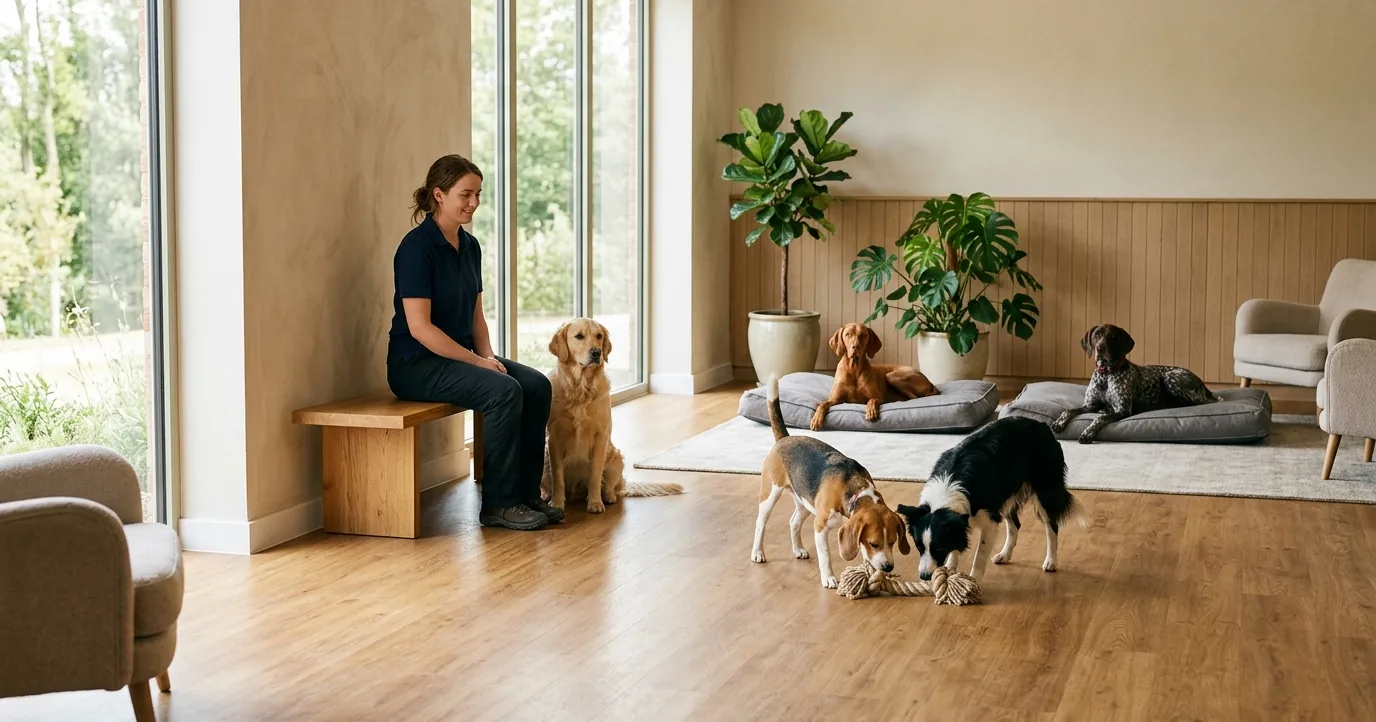
In 2026, a county in central Alberta approved a new boarding and daycare kennel allowed a maximum of 12 dogs on site at any one time, and that figure includes the two dogs the applicants already own. In Peterborough, England, a council officer approved a small boarding kennel on the basis that it was limited to six dogs. And in Roanoke, Virginia, court documents described an estimated 70 dogs in a warehouse, housed in kennels or in play groups of 15 or more, on a July day when staff were dripping with sweat and no drinking water was visible. A man was later charged with animal cruelty and with failure of a boarding establishment to provide proper care. The business has said the accounts circulating about it were false or misleading.
Most kennels have a number like the first two somewhere in their paperwork, and almost no owner asks what it is. The licensed or permitted maximum is the most useful single figure a boarding business holds. It is still only half the answer, because a dog count means little without the count of people caring for those dogs. Here is where capacity limits come from, what gets left out of them, the staff-to-dog ratios that actually exist in writing, and how to tell when a building holds more dogs than hands.
Where the Number on the Permit Comes From
A kennel’s maximum usually comes from one of two gatekeepers, and they are asking different questions.
Planning and zoning decide whether a dog business can operate on a site at all, and the limits they set are about neighbours, noise, traffic and land use. The Peterborough decision is typical. The officer described the proposal as “a small-scale boarding facility limited to six dogs” that “does not represent a large commercial kennel operation”, and approved it despite a highway authority objection over parking. The Alberta permit’s conditions deal with barking, waste disposal and a ban on breeding. None of that is a welfare calculation, although a low planning cap does protect dogs by default.
Welfare licensing is the number meant to reflect care. England’s statutory guidance requires a boarding licence to state how many dogs are permitted, judged against the facilities and staffing on the premises, and it treats undeclared numbers as a breach, “especially if not reflected in increased staffing levels”. Massachusetts moved the same way in 2024. Under its kennel safety law, known as Ollie’s Law, every kennel licence must state the maximum number of animals, set by the licensing authority and the animal control officer after an inspection. For commercial boarding kennels, that figure has to ensure “the property can support the number of animals while ensuring their health and safety”. Our guide to UK boarding licences and star ratings explains how to find the English version on a council register.
Where no welfare licence applies, a zoning permit may be the only number anyone ever wrote down, and permits lapse without announcement. In July 2026, Los Angeles County animal care and planning officials executed an inspection warrant at a private property linked to an animal rescue, where a kennel operation was reported to hold more than 100 dogs. Its kennel permits had reportedly expired in 2023. The owner said the visit came down to paperwork and site diagrams. Whatever that inspection concludes, the county had to obtain a warrant to get onto the property and check.
What Counts Toward the Maximum
A capacity figure is only as honest as the dogs it includes, and three groups routinely fall through the gaps.
The operator’s own dogs. England’s day care guidance is blunt about this: pet and retired dogs on site count, and “if an applicant has 3 pet dogs on site, they must be included in the figure”. The kennel boarding guidance asks inspectors to weigh pets and retired dogs looked after by the same staff. The Alberta permit’s 12 already includes two personal dogs. A kennel quoting 20 boarding places while also caring for six of its own dogs is feeding, cleaning and supervising 26.
Puppies. When a Wisconsin county committee approved a 30-dog overnight boarding kennel in 2026, the total already included the managers’ own eight dogs and four puppies. One member pointed out that puppies are often not counted toward “maximum capacity” until they reach a certain age, and the committee capped litters at four a year as a condition of approval. Massachusetts, for its part, leaves dogs under three months out of the count when setting kennel licence fees.
Daycare on top of boarding. A building permitted for 40 overnight dogs that also takes 25 daycare dogs is running at 65 during working hours. Ask whether the maximum covers both, and which one the staffing is built around.
Then there is peak occupancy. A kennel inside its licensed number can still be stretched thin, because the weeks it runs full tend to be the ones owners most want to book: school holidays, Christmas and long weekends. England’s guidance ties dog numbers to staffing for a reason, and the same logic applies inside the limit: a full house should come with a bigger roster than a half-empty one. A rota built for a quiet week in March does not stretch to a sold-out August unless someone plans it that way.
The Staff-to-Dog Ratios That Exist in Writing
Few rulebooks put a number on staffing, which makes the handful that do useful benchmarks even where your kennel is not bound by them.
- England, kennel boarding. At minimum standards, each member of staff “should have 25 dogs or less to care for”. To reach the higher standards, a business needs at least one full-time member of staff for every 15 dogs kept.
- England, day care and home boarding. The minimum is 10 dogs or fewer per member of staff, with a higher standard of at least one full-time member of staff per 8 dogs.
- Colorado, group play. Dogs from different households may share a common area only with their owners’ written consent and under constant and direct supervision: at least one supervisor for every 15 dogs, and no more than 60 dogs in any one area. The rule also spells out what does not count as supervision: watching on a video camera or through a window, or a staff member busy with other tasks, including grooming other pets.
- Massachusetts. Ollie’s Law requires the state’s agriculture department to write regulations for commercial boarding kennels, and names staff-to-animal ratios, group sizes and supervision among the subjects they may cover.
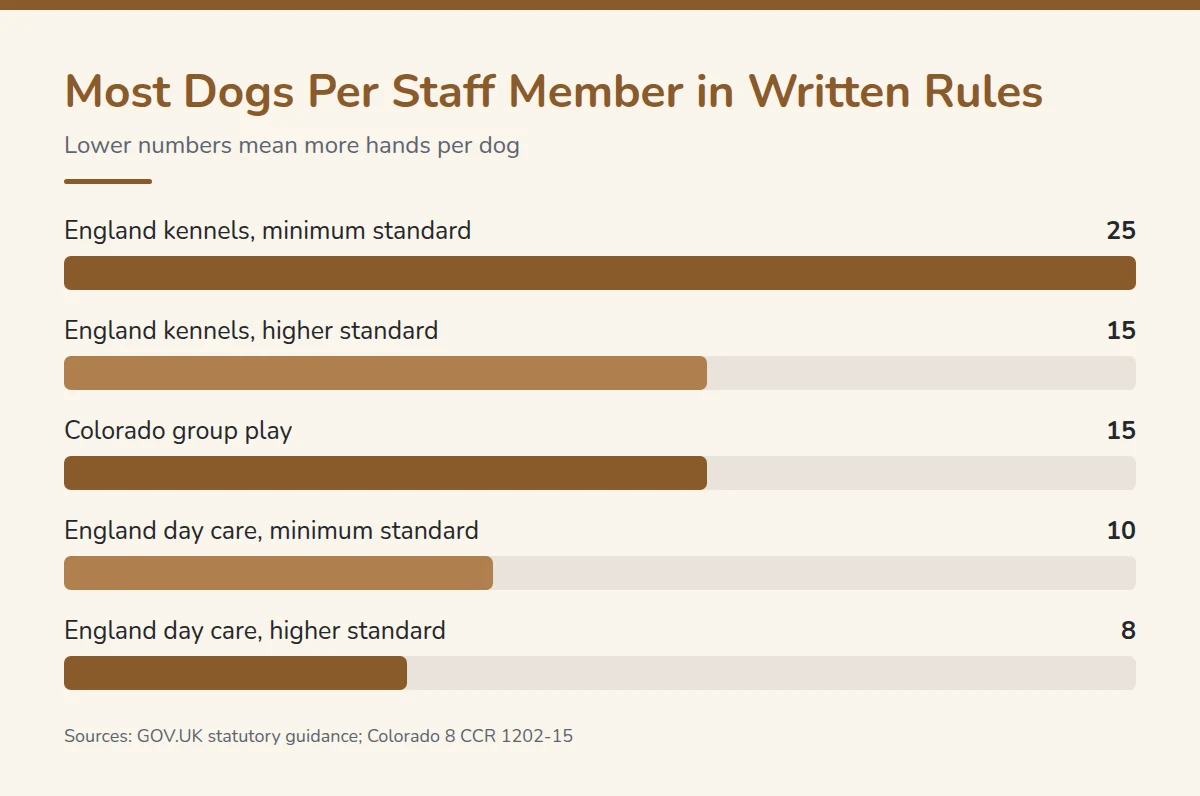
The spread between 8 and 25 is not inconsistency. It reflects what the dogs are doing. A handler in a play yard is managing loose dogs interacting with each other, where a scuffle develops in seconds, so group settings get the tightest ratios. Dogs in individual runs can be cared for in rotation, which is why the kennel figure is looser. A single ratio quoted for a whole facility tells you very little until you know which job it describes.
Ratios by Shift: Play, Chores, and the Overnight Gap
Group play. Written rules cluster between 8 and 15 loose dogs per person, and that person should be doing nothing else. I treat 15 as a ceiling for a settled group of adult dogs of similar size, not a target, and I expect fewer when a group mixes sizes, includes young dogs or new arrivals, or is out on a hot afternoon. England’s day care guidance adds a detail worth checking on any tour: there must be an area where any dog can avoid seeing other dogs and people if it chooses. Our guide to how much exercise a boarded dog actually gets covers the play schedule questions in more depth.

Cleaning and feeding. Chores are where staff time quietly disappears. The Association of Shelter Veterinarians notes that a standard estimate of 15 minutes per animal per day may roughly cover cleaning and feeding in some facilities, while leaving out enrichment and additional care, and it recommends timing real tasks and multiplying by the number of animals to set staffing. Run that arithmetic on a kennel. One person responsible for 25 dogs needs more than six hours a day just to clean and feed them, before a single walk, medication round or phone call. At 15 dogs, the same chores take under four hours, which leaves time to actually look at each dog. It is a shelter estimate, and a rough one, but a boarding kennel mops the same runs and fills the same bowls.
Overnight. This is the shift where the ratio often drops to zero people on site. England’s minimum standard allows that, provided a designated key holder can reach the premises within 30 minutes in normal conditions. The higher standards go further: a member of staff on site at all times, and every dog checked at least once overnight, in person or by CCTV, with a written record. The Alberta applicants answered the same question by living on the property. Our guide to overnight fire risk at boarding kennels explains why the empty hours are the dangerous ones.
Headcount is necessary, but it is not sufficient. In May 2026, four employees of a boarding and training kennel in North Carolina were charged after two dogs died there, and investigators found no food in either dog’s digestive tract. A rescue owner in western North Carolina put the staffing lesson plainly, asking how “one of four people did not at some point stop what was going on”. Staff numbers only protect a dog when that dog is a named person’s responsibility on every shift, and someone checks that the feeding log matches what is actually in the bowls.
How Overcrowding Shows Up
Shelter veterinarians have a name for the limit: capacity for care, meaning the number of animals an organisation can humanely look after given its space, staff hours and skills. Their guidelines call operating beyond it “an unacceptable practice”, because once a population outgrows the care available, living conditions worsen and health suffers. Crowding also spreads disease, and the strep zoo outbreak at a San Diego shelter hit a campus running at 178 percent of capacity.
On a tour or at pickup, overcrowding rarely looks dramatic. It looks like small mismatches between the number of dogs and everything else.

- Resources that do not add up. England’s kennel guidance requires food, water, toys and resting areas in numbers equal to or greater than the dogs in each unit. Count the water bowls and beds in a play room against the dogs using it.
- Doubled-up housing. Dogs from different households sharing a run sized for one, or crates appearing in corridors and offices during a busy week.
- A supervisor with another job. Someone mopping, answering the phone or grooming while nominally watching a yard. Colorado’s rule would not count that person at all.
- No room to disengage. Dogs in constant body contact because the space cannot absorb the group, with no quiet corner to retreat to.
- Noise and smell ahead of the cleaning. Strong ammonia by mid-morning, and staff raising their voices to be heard over the barking.
- A headcount nobody can give you. The ASPCA lists not knowing how many animals are in someone’s care as a sign of animal hoarding, which it describes as housing more animals than a person can adequately care for. For rescue groups it adds refusing visitors access to where animals are kept, not disclosing numbers, and continuing to take animals in despite the condition of those already there.
The boarding versions of those warning signs are a kennel that will not show you where dogs sleep, cannot say how many dogs are booked tonight, and finds a space for you a day after telling you it was full.
The Questions That Get You the Real Numbers
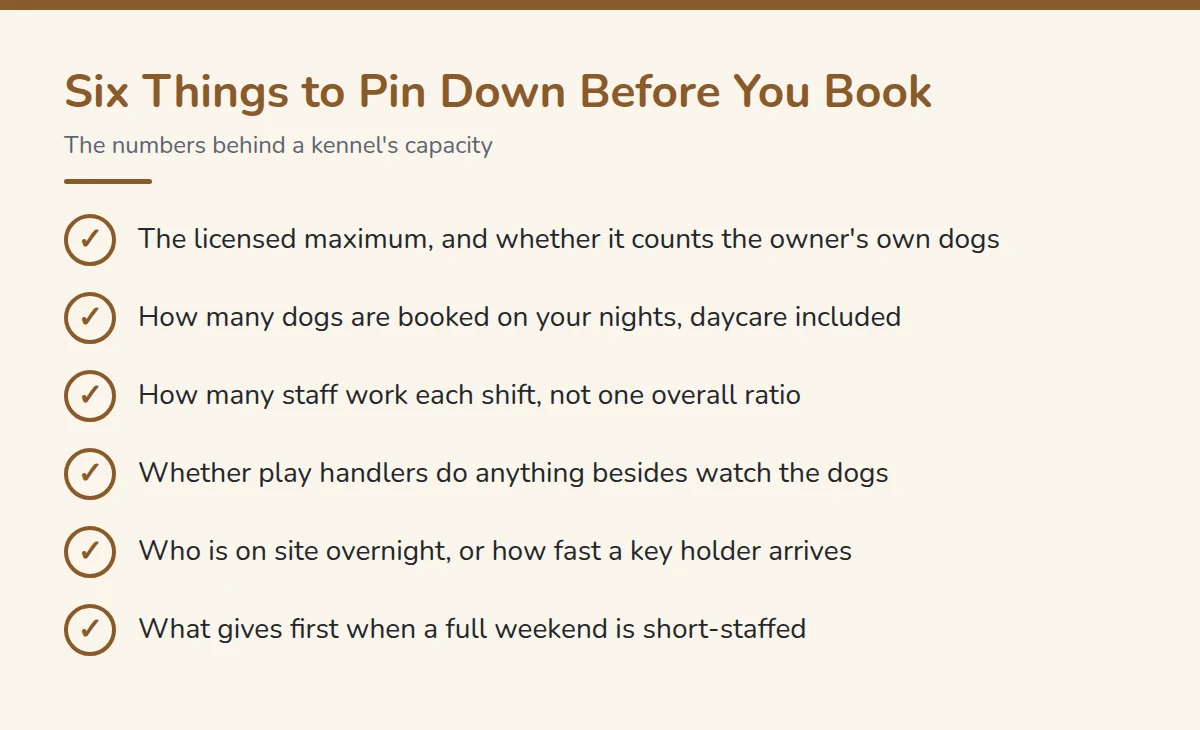
- “What is your licensed or permitted maximum, and does it include your own dogs?” An operator who holds a licence knows this figure without looking it up.
- “How many dogs are booked on the nights I need, including daycare?” You are asking how close to the ceiling the building will be while your dog is in it.
- “How many people work each shift: morning chores, group play, evening, and overnight?” A single ratio for the whole facility hides the shift that matters.
- “In group play, how many dogs does one handler watch, and does that person do anything else?” Listen for a number at or under 15 and a clear no.
- “Who is on the premises overnight, and if nobody, how fast can your key holder get here?” Thirty minutes is the English minimum. Someone sleeping on site is better.
- “When you are fully booked and someone calls in sick, what gives first?” Good answers are fewer bookings or smaller groups. The worrying answer is that nothing changes.
A wall of logos will not answer any of these. As our guide to what boarding certifications actually mean points out, no badge tells you the staff-to-dog ratio at 2am.
The Bottom Line
The number on a kennel’s licence or permit tells you the most dogs the property may hold. The number of people on each shift tells you how many it can actually care for. Ask for both, check that the operator’s own dogs are counted, treat one handler to 15 loose dogs as a ceiling rather than a goal, and find out who is there at night. A kennel that knows its figures and shares them has usually built its operation around them. One that cannot tell you how many dogs are in the building tonight has already answered your question.
Further reading (sources)
- The Albertan on the Alberta kennel permit capped at 12 dogs including the owners’ own
- BBC News for the Peterborough kennel approved as a six-dog facility
- Watertown Daily Times with a Wisconsin committee’s debate over which dogs count toward a 30-dog capacity
- GOV.UK on the kennel boarding standards for staffing, dog numbers and overnight cover
- GOV.UK for the day care standards that count an operator’s pet dogs toward the licence
- Legal Information Institute with Colorado’s supervision rules for dogs mixed in common areas
- Massachusetts Legislature on the 2024 kennel safety act that puts a maximum on every licence
- Association of Shelter Veterinarians for capacity for care and staff time in its shelter standards
- ASPCA on recognizing the signs of animal hoarding
- WSLS with the court documents and charges in the Roanoke boarding case
- Los Angeles Times covering the county inspection of a kennel operation reported to hold over 100 dogs
- WLOS on the four kennel employees charged after two dogs died