How Much Exercise Does a Boarded Dog Actually Get? Turnout, Play Yards, and Activity Levels Explained
Published on September 11, 2026
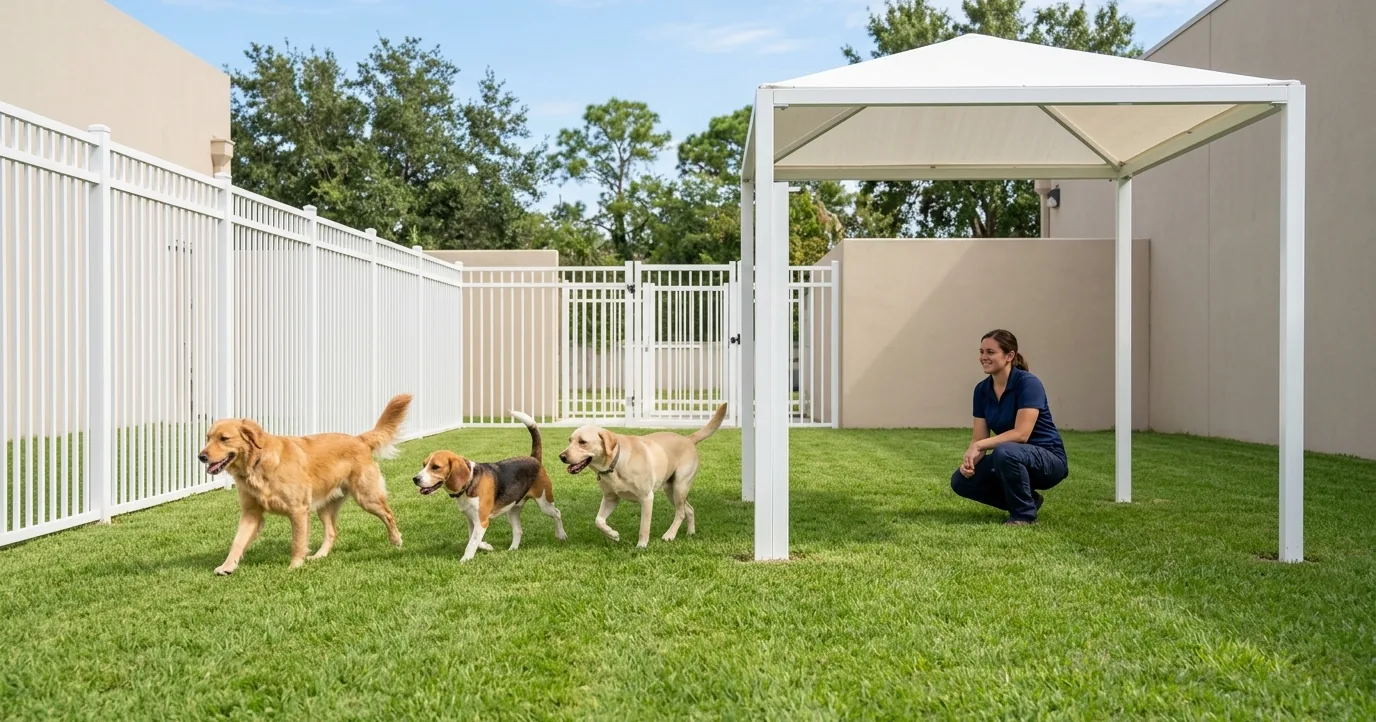
Every boarding website promises an active dog. Read the packages and you will find “four play sessions daily,” “all-day play,” “complimentary turnout included,” and photographs of a labrador mid-air with a frisbee. What you will almost never find is a number of minutes.
That gap matters more than it looks. The same phrase can describe a dog that spends four hours a day running and a dog that spends twenty-five. Owners book on the assumption that more sessions means a tired, satisfied dog, and then collect an animal that is either wound tight from boredom or limping from a sudden week of exertion it was never conditioned for. Both outcomes come from the same root cause, which is that nobody converted the brochure language into real minutes of movement and matched it against the dog.
What the Words on the Price List Actually Mean
There is no industry dictionary here. Two facilities on the same street can use the same six words to describe very different days. These are the terms you will meet most often and what they usually, though not always, translate to.
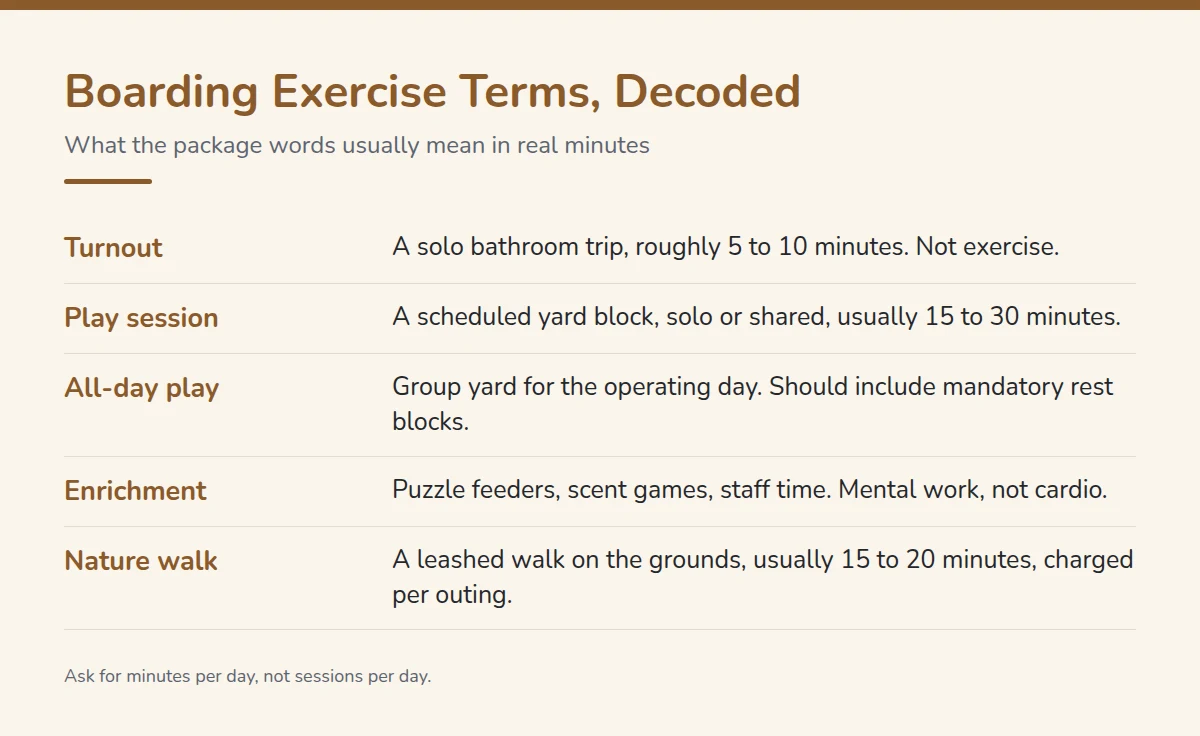
Turnout, or potty break. A short solo trip from the run to a small yard so the dog can relieve itself. Figure five to ten minutes. This is what “complimentary turnout” almost always means, and it is a bathroom trip rather than exercise.
Play session, or play break. A scheduled block in a yard, which may be solo or shared. Fifteen to thirty minutes is typical. Whether it involves a person actively playing with the dog or simply letting it out is the question that separates a good facility from a mediocre one.
Group play, or daycare add-on. Shared yard time with a screened group of compatible dogs, usually sold in half-day or full-day blocks on top of the boarding rate.
All-day play. The dog is with a group for the facility’s operating day. A well-run version of this has mandatory rest blocks built into the middle of it. A version with no rest block is not a premium package, it is an over-arousal problem waiting to happen.
Enrichment, or one-on-one time. Staff attention, a puzzle feeder, scent games, a brushing session, a cuddle on a couch. This is mental work and it is genuinely valuable, but it is not cardiovascular exercise and should not be counted as such.
Nature walk, or private walk. A leashed walk on the grounds with a handler. Usually fifteen to twenty minutes, usually charged per outing.
Do the Arithmetic Before You Book
Take whatever the package promises and convert it. Four fifteen-minute play breaks is one hour of yard access per day, and the portion of that hour spent actually moving is smaller still, because dogs sniff, drink, and stand around. A standard boarding rate with complimentary turnout only, and nothing added, often works out to twenty to forty minutes out of the run across a whole day. The rest of the day is spent in a kennel, where an adjusted dog will sleep through a good deal of it and an unsettled one will not.
None of this makes the cheap package wrong. For a genuinely low-drive dog on a three-night stay, it is often enough. It becomes wrong when an owner pays for it while picturing the frisbee photo.
So ask in units the facility cannot round in its favour. How many minutes, in total, per day? How many of those are outdoors? Is the dog alone or in a group? Is a staff member in the yard interacting, or opening a door? Where does the dog go when it comes back in?
The regulatory floor is worth knowing too, because it is lower than most people assume. In England, councils inspect boarding kennels against statutory guidance that treats daily exercise outside the kennel as a baseline expectation rather than an optional extra, and the higher-standards tiers that earn a facility extra stars ask for more than the minimum. If you are booking in the UK, our guide to reading a council licence and its star rating shows where to find the conditions attached to a specific kennel. In most of the United States, by contrast, exercise provision is not specified at all in state boarding rules, so the contract you sign is the only real commitment.
Match the Plan to the Dog, Not to the Dog’s Size
The most common booking error is using body weight as a proxy for exercise need. Staff do it, owners do it, and the software drop-down often encourages it by offering “small, medium, large.”
Size is a poor predictor. The American Kennel Club makes the point in its own guidance for apartment dwellers: plenty of large breeds have low activity levels and are perfectly happy on the sofa, while a number of small breeds carry high energy that a brisk walk barely touches. A greyhound is a sprinter that sleeps for twenty hours. A ten-pound Jack Russell is not.
What predicts exercise need better is working history and individual temperament. The AKC’s sporting breeds, the pointers, retrievers, setters, and spaniels, were built for sustained field work and generally need real, invigorating exertion rather than a token walk. Herding breeds carry a drive to move and control that yard access alone does not satisfy. And the breeds that top the intelligence lists present the trap owners fall into most often: four hours of running leaves a Border Collie fit, not tired. That dog needs its brain worked, and a facility that offers only more yard time is offering the wrong currency.
If your dog is a mix and nobody can say what is in it, do not guess at a breed and infer from there. Describe the dog instead, as we set out in our guide to planning care without a breed label: what its usual daily exercise actually is at home, how long it takes to settle after excitement, and what it does when it has had enough.
The honest benchmark is your own routine. If your dog gets two twenty-minute leash walks and a garden potter on a normal Tuesday, then a boarding plan of four short play breaks is a reasonable match and eight hours of group play is a dramatic escalation. Facilities cannot know your baseline unless you tell them.
The Injury Pattern That Follows a Sudden Activity Spike
This is the part the brochures never mention, and it is the reason a surprising number of dogs come home from an expensive all-day-play package with a limp.
A dog that exercises moderately and predictably at home is not conditioned for eight hours of running, wrestling, and hard cornering on turf. Put it in that environment for five consecutive days and you get the canine version of the weekend warrior injury: strained shoulders and carpal joints, abraded pads from abrasive surfaces, torn nails, and, in the worst cases, a ruptured cranial cruciate ligament from a bad twist at speed. The AKC’s guidance on lameness is blunt about the mechanism. Injury and trauma are the most common reason dogs limp, sports injuries are squarely in that category, and proper conditioning is what reduces the risk.
The fix is not to avoid activity. It is to ramp it. If you are adding daycare-style play to a stay, start with half days, or alternate a play day with a quiet day, rather than buying five full days for a dog whose last sustained run was in March. Facilities that know what they are doing will suggest this themselves.
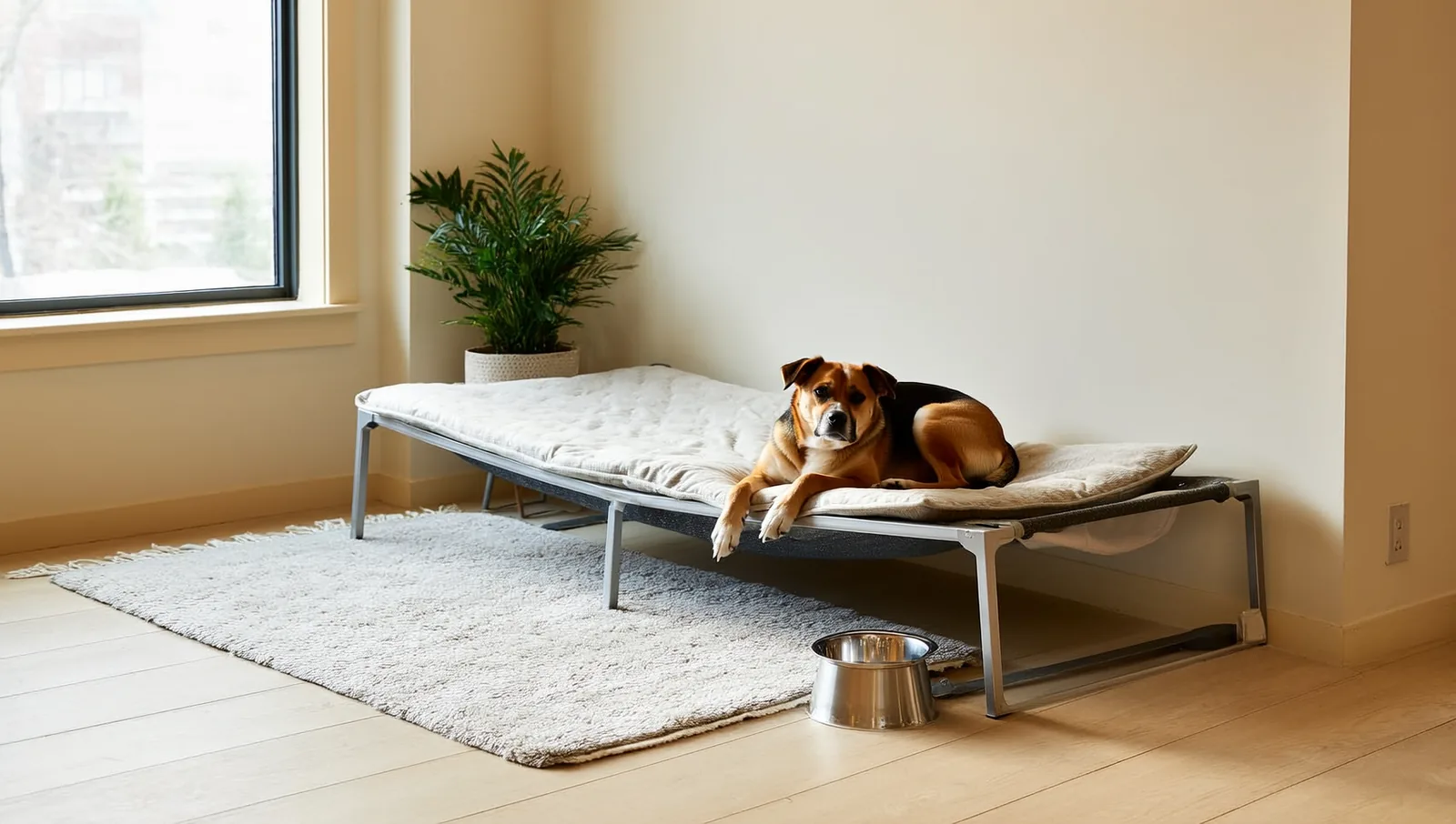
If your dog does come home lame, the AKC’s rule of thumb is useful: keep the dog quiet and still and give it about fifteen minutes, because some acute lameness resolves on its own, particularly in young dogs. If the dog is still limping after that, or will not put weight on the leg at all, it needs a veterinarian rather than rest and observation. Any persistent limp after a boarding stay is a veterinary question, not a training one, and worth raising with the facility as well so it goes on the record.
Heat Is the Other Half of the Turnout Question
Summer turnout deserves its own conversation, because exercise is the dominant trigger for heat-related illness in dogs and it is badly underappreciated.
The largest UK study of the problem, drawing on primary-care veterinary records, found that roughly three-quarters of heat-related illness events followed exertion, while confinement in a hot vehicle, the scenario every public campaign focuses on, accounted for only around five percent. The dangerous version of overheating is far more likely to happen to a dog running in a yard than to a dog left in a car.
Play yards concentrate the risk. Artificial turf and concrete run considerably hotter than the air temperature above them, shade in a yard is often partial, and a dog in a group will keep chasing well past the point where it should stop, because the group is still going. Heavy-coated dogs, overweight dogs, older dogs, and flat-faced breeds sit at the top of the risk list, and for the last of those the margin is thin enough that our brachycephalic boarding guide treats summer yard time as a decision to make deliberately rather than a default.
Ask what the hot-weather protocol actually is. A facility that has one will tell you a temperature or heat-index threshold, describe shifting yard times to early morning and evening, mention shaded yards and water available in the yard rather than only indoors, and say plainly that group sizes shrink or sessions get cut when it is hot. A facility without one will say that the dogs are watched closely.
Solo Exercise Is Not the Consolation Prize
Group play gets marketed as the premium option, which quietly implies that a dog excluded from it is missing out. Plenty of dogs should not be in a group yard: reactive or anxious dogs, resource guarders, seniors with stiff joints, dogs recovering from surgery, and puppies partway through a vaccine series. For those dogs, group play is not enrichment, it is a stressor with an injury risk attached, and our guide to boarding anxious and reactive dogs covers what to insist on instead.
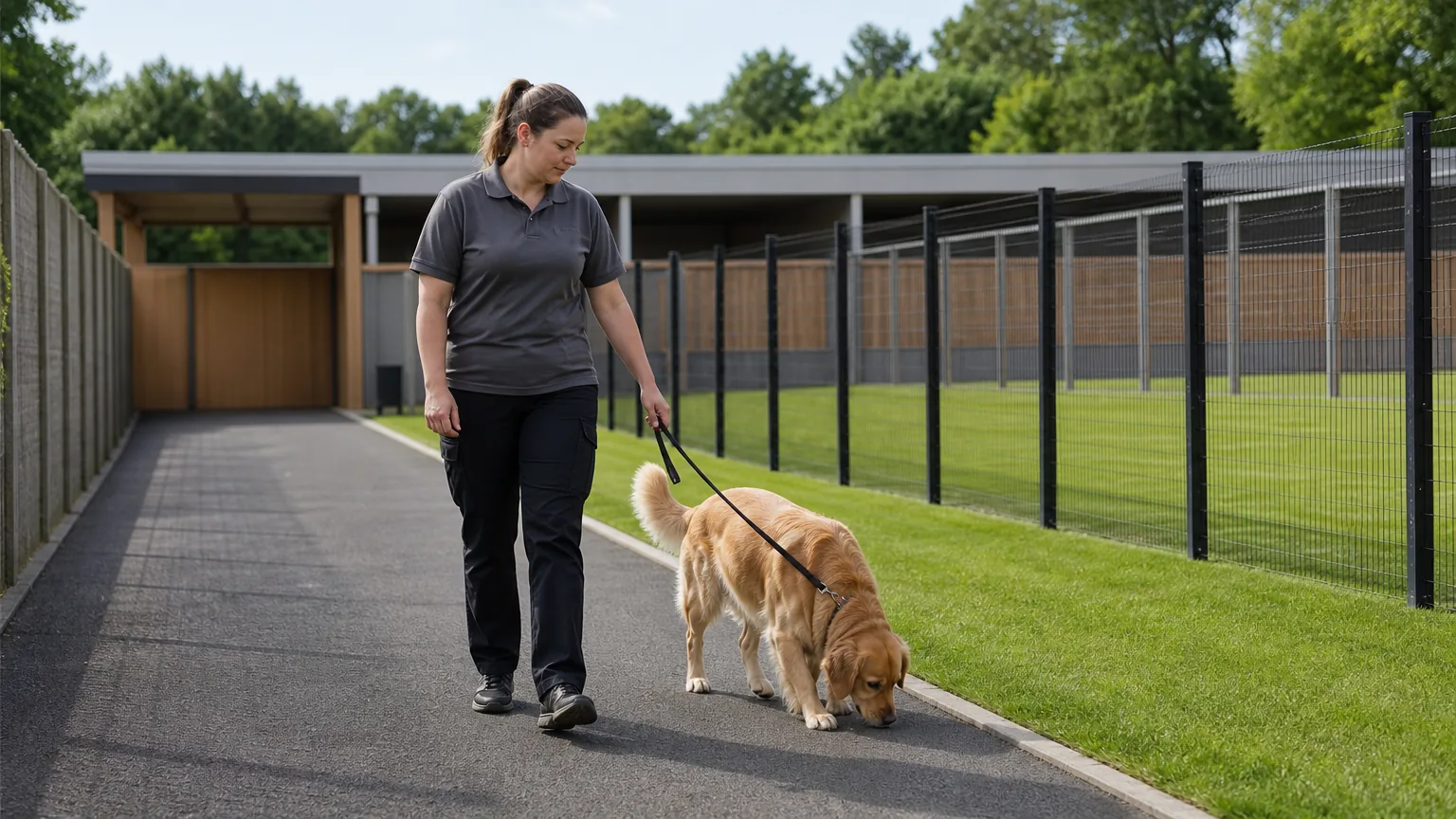
The alternatives are good ones. Solo yard time with a handler throwing a ball, structured leash walks, scatter feeding in grass, snuffle mats, and scent games all produce a genuinely tired dog. A twenty-minute walk where the dog is allowed to sniff at its own pace is more mentally fatiguing than twenty minutes of sprinting, and it costs the dog nothing in cortisol. For dogs that do enjoy company, well-run day camp group play adds social value that solo time cannot, but the value comes from the matching and supervision, not from the hours logged.
Build the Activity Plan at Booking, in Writing
Verbal arrangements made at the counter on drop-off morning do not survive a shift change. Put the plan on the care sheet when you book.
A workable plan states the daily target in minutes, how it is divided, whether each block is solo or group, what substitutes for outdoor yard time in heat or heavy rain, and the hard limits. Hard limits are the most useful line on the page: no fetch or hard sprinting, no group play with dogs over a certain size, no stairs, no swimming, stop at the first sign of heavy panting. Facilities follow written prohibitions far more reliably than they follow remembered preferences.
Include the dog’s normal home routine in one sentence, so staff can judge whether what they are seeing is unusual. A dog that normally walks an hour a day and refuses its second turnout is telling you something quite different from a dog that never walks much and does the same.
The Questions That Reveal Whether It Actually Happens
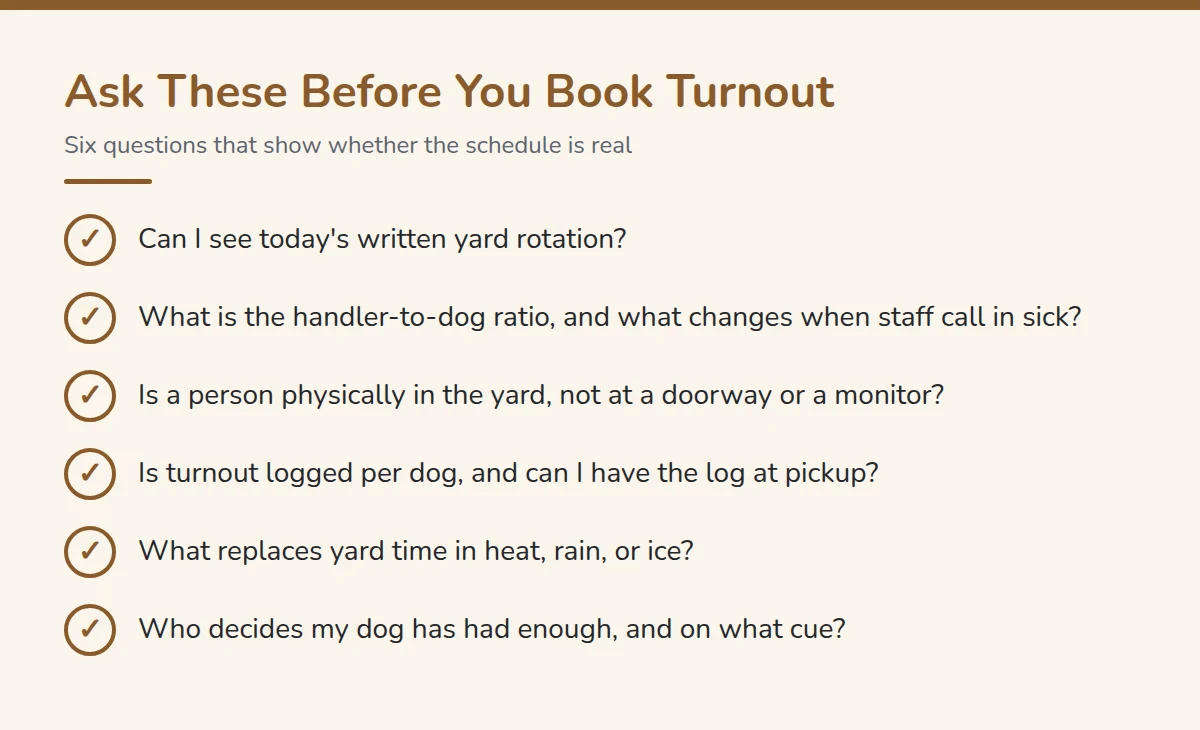
The promise and the practice come apart most often at the same handful of points. These questions surface the difference.
“Can I see today’s yard schedule?” A facility running structured turnout has a written rotation, usually a grid by run number and time block. If nobody can produce one, the schedule lives in someone’s head and it is the first thing to slip on a busy morning.
“What is the staff-to-dog ratio in group play, and what happens when someone calls in sick?” One handler to ten or fifteen dogs is the commonly cited ceiling for group yards, and the second half of the question matters more than the first. Short-staffed days are when sessions get shortened or merged.
“Is a person physically in the yard?” Supervision from a doorway or a monitor is not supervision. The point of a handler in the yard is to interrupt trouble before it becomes an incident.
“Is turnout logged per dog, and can I have the log at pickup?” Facilities that log it will hand over a record showing what your dog did each day. Ask for it, then compare it to what you paid for. This single request tells you a great deal about how a business runs, and it is also one of the reasons in-kennel cameras are worth having, since they let you check the schedule against reality while you are away.
“What happens to yard time in bad weather?” Rain, ice, and heat all cut outdoor sessions. The right answer describes an indoor substitute. The wrong answer is that the dogs stay in.
“Who decides my dog has had enough?” Listen for a named role and an observable cue, such as a handler pulling a dog when it stops taking breaks on its own. Over-tired dogs in group yards are how fights start, and sustained arousal is a meaningful driver of kennel stress.
The Bottom Line
Exercise is the part of a boarding stay most often sold in adjectives and most rarely delivered in numbers. Convert the package into minutes before you book, measure those minutes against what your dog genuinely does at home rather than what it weighs, and ramp activity up rather than jumping it. Then write the plan down, including the limits, and ask for the log at pickup. A facility that welcomes all of that is telling you the schedule is real, which is the whole question. If you are still choosing between options, our guide to choosing the right dog hotel covers the rest of the tour.
Further reading (sources)
- American Kennel Club on what causes a dog to limp and when it needs a vet
- American Kennel Club for why size is a poor guide to a dog’s activity needs
- Animals for the finding that exertion, not hot cars, drives most canine heatstroke
- GOV.UK with the statutory kennel standards English councils inspect against