Feeding Your Dog at Boarding: Portions, Bloat Risk, Food Guarding, and the Dog That Won't Eat
Published on September 12, 2026
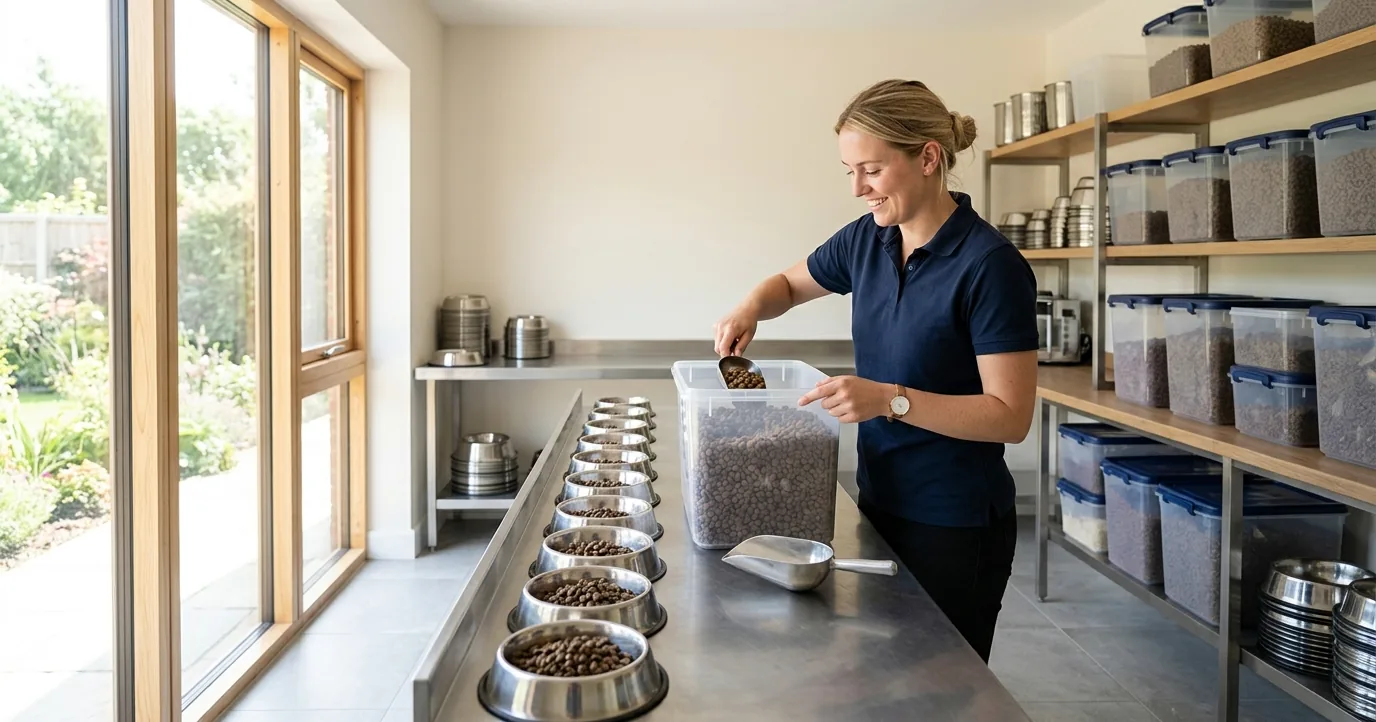
Owners spend weeks choosing a facility, touring the play yards, and reading reviews. Then they hand over a half-full bag of kibble and say “about two cups, twice a day” on their way out the door.
Feeding is the part of a boarding stay with the most moving parts and the least written instruction. It happens twice a day, every day, usually across three or four different staff members on rotating shifts, and almost every common boarding complaint runs through it somewhere: the dog that came home four pounds lighter, the dog with a week of loose stool from an unannounced food switch, the fight in the yard over a dropped chew, the emergency surgery nobody saw coming. None of that is exotic. All of it is preventable at the counter, in about ten minutes, with a pen.
Pre-Bag Every Meal and Retire the Word “Cup”
A cup is not a unit of dog food. It is a unit of whatever scoop is nearest the bin, and the gap between your cup and the kennel’s cup compounds twice a day for ten days.
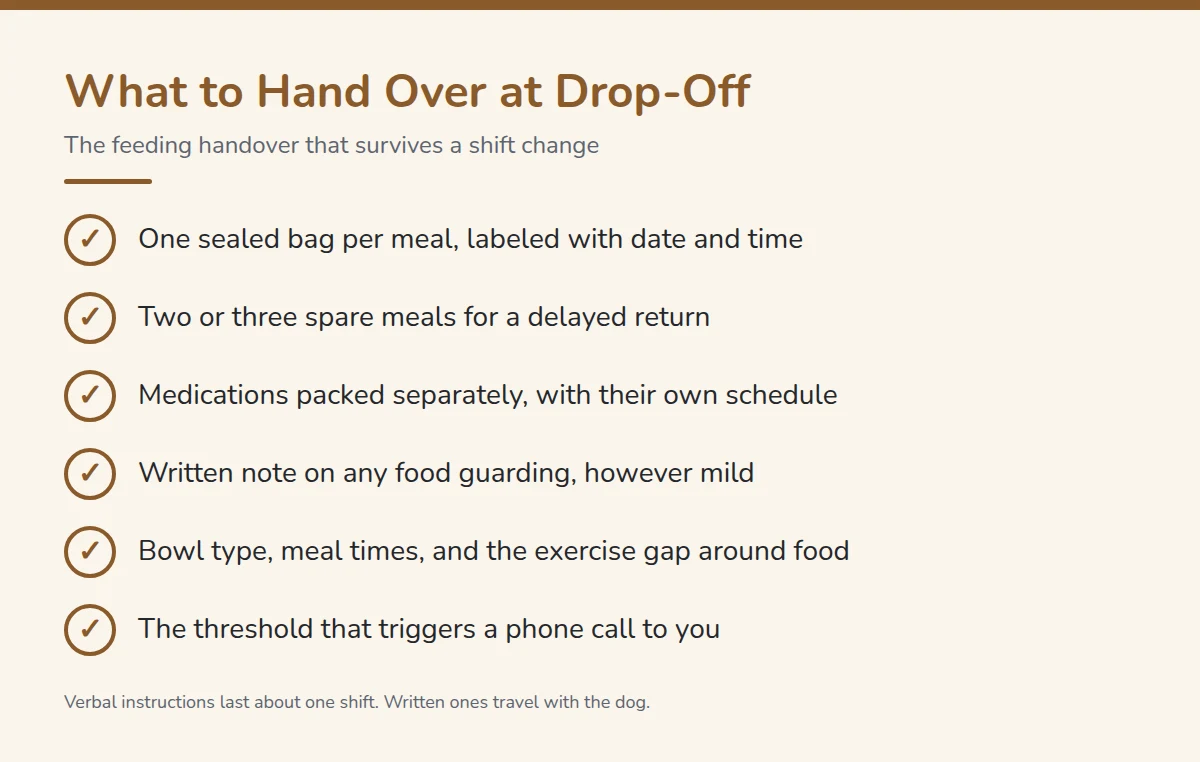
Pre-portion instead. One sealed bag or container per meal, each one labeled with the dog’s name, the date, and whether it is the morning or evening meal. It takes fifteen minutes at the kitchen table and it removes measurement from the equation entirely: a handler on their third shift of the week does not interpret anything, they open the bag for that slot and tip it in. If your dog eats a weighed amount rather than a scooped one, weigh it at home and bag it. Nobody at the facility is going to fetch a kitchen scale at six in the morning.
A few things worth adding to the pile:
- Two or three extra meals beyond the booking. Flights get canceled. A facility with no food left for your dog will feed it house kibble, and a sudden diet change on top of kennel stress is the single most reliable way to produce diarrhea.
- Toppers and mixers pre-mixed in, or bagged separately and named. “A spoon of the wet stuff” is not an instruction.
- Medication kept out of the food bags entirely. Meds go in their own labeled container with their own written schedule. Burying a pill in a portion bag assumes every handler knows it is there.
That last point has a corollary people miss. If a medication has to be given with food, write down what happens when the dog does not eat. Plenty of drugs cause stomach upset on an empty stomach, and some, insulin above all, are genuinely dangerous without a meal behind them. A diabetic dog’s feeding and injection protocol is a veterinary matter and should come to the facility in your vet’s words, not yours.
Why So Many Facilities Refuse Raw
If you feed a raw diet, expect a policy conversation. A large share of boarding kennels either refuse raw outright or accept it only under conditions, and the reasoning is about the building rather than about your dog.
Raw-fed dogs shed more pathogens in their stool. A Swedish study that cultured feces from fifty dogs found extended-spectrum beta-lactamase producing E. coli in thirteen of the twenty-five raw-fed dogs and Campylobacter in twelve, against one and four respectively in the kibble-fed group. In a house with one dog, that is a hand-washing issue. In a facility where forty dogs share yards, drains, hoses, and the same handler’s hands across a morning, it is a transmission network. A 2025 report from a Rottweiler breeding kennel traced an outbreak of Salmonella Agona through the dogs, the food, and the kennel surfaces themselves, and it only cleared after the raw feeding stopped and the environment was disinfected.
Both the FDA and the American Veterinary Medical Association discourage feeding raw or undercooked animal-source protein to pets, largely on these grounds. You do not have to agree with that position to understand why an operator with a license, an insurer, and forty other clients adopts it.
If your facility does accept raw, the questions that matter are about cold chain and cross-contamination. Is there dedicated freezer space, or does your food share a shelf with everyone else’s? Where is it thawed, and on what surface is it prepped? Are bowls washed separately? Is there a hand-wash step written into the protocol between your dog and the next one? An operator who has thought this through will answer in specifics. An operator who says “sure, no problem” has not thought about it at all, which is its own answer.
Some owners transition to a cooked or freeze-dried version of the same protein for the length of a stay. If you go that route, switch at home over a week beforehand rather than on drop-off morning.
Every Dog Eats Alone
This one is not negotiable, and a facility that treats it as optional is telling you something important.
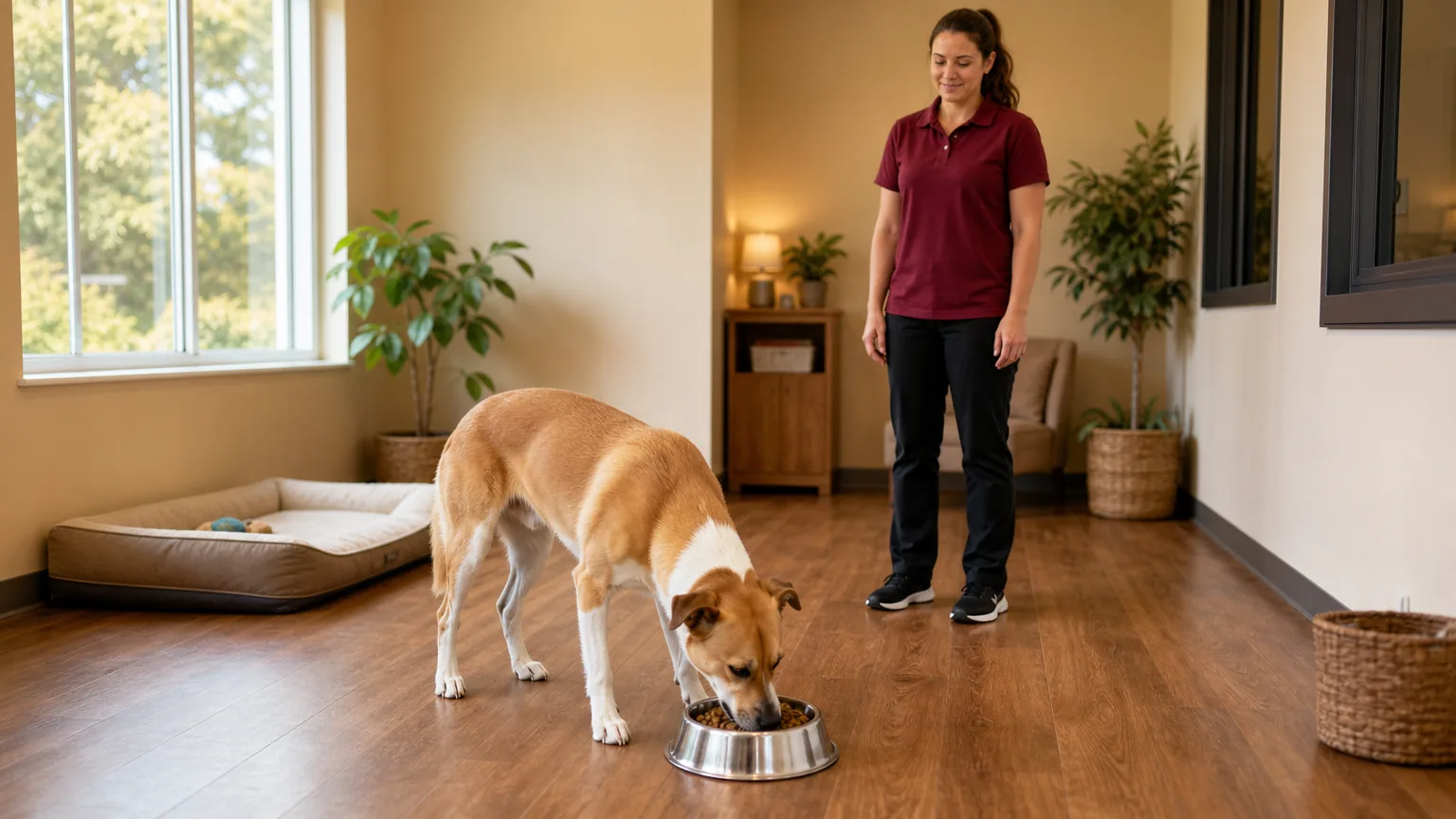
Meals happen in the dog’s own run or suite, behind a closed door, with nobody reaching in. Food is the highest-value resource in a kennel, and resource guarding is ordinary dog behavior rather than a character flaw. More to the point, it is contextual. A dog that has never guarded a bowl in a quiet kitchen may guard one in a noisy building full of strangers where it cannot predict when the next meal is coming. The ASPCA’s guidance is blunt about the mechanics: guarding escalates when a dog learns that people approaching the bowl means the bowl goes away.
The same logic covers food-shaped enrichment. Stuffed toys, bully sticks, and long-lasting chews are excellent in a run and genuinely dangerous in a shared yard, because a group that was playing peacefully will reorganize around a single high-value item in seconds. Ask directly whether chews are ever given in group settings. The right answer is no.
Tell the facility about any guarding history you know of, including the mild version where your dog simply eats faster when someone walks past. Written disclosure protects your dog from a well-meaning handler who tidies the bowl too soon, and it protects a young staff member from a bite. If your dog has a broader pattern of reactivity around resources or people, our guide to boarding anxious and reactive dogs covers the wider setup to ask for.
Bloat Is the Feeding Risk That Actually Kills Dogs
Gastric dilatation-volvulus is the reason feeding protocol is a safety topic and not just a comfort one. The stomach fills with gas and then twists on itself, cutting off its own blood supply and the return of blood to the heart. It kills fast, it requires surgery, and survival tracks closely with how quickly the dog gets to a table.
The risk is concentrated in deep-chested large and giant breeds. A Purdue University cohort that followed 1,637 dogs across eleven such breeds recorded a cumulative GDV incidence of six percent during the study. A separate UK survey of pedigree dogs found GDV was the cause of death in 2.5 percent of all reported deaths, with bloodhounds, Neapolitan mastiffs, and several of the larger scenthounds among the worst affected, and a median age at first diagnosis of five years. This is not an old-dog disease.
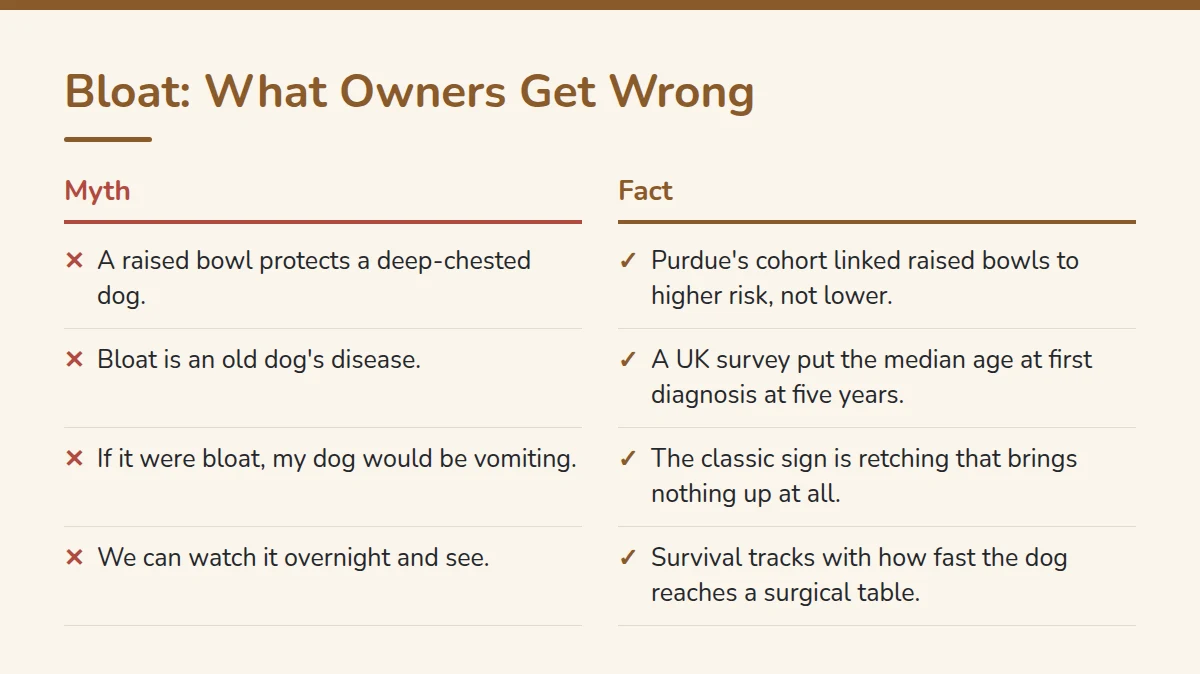
The Purdue work is also where the practical rules come from, and one of them reverses advice that is still repeated on kennel intake forms. Faster eating raised risk, as did increasing age and having a first-degree relative with a history of GDV. So did a raised feeding bowl, which the authors estimated accounted for roughly twenty percent of cases in large breeds and about half in giant ones. If your dog is deep-chested, the elevated stand is not a precaution.
What to put in writing for an at-risk dog:
- Split the daily ration across two or three meals rather than one large one.
- Feed from a slow-feed bowl on the floor, and send yours along if you use one. The same bowl helps flat-faced breeds, who gulp air for reasons of their own anatomy.
- No hard exercise in the hour either side of a meal. Honest caveat: the evidence for this rule is thinner than the evidence for eating speed and bowl height, and the Purdue cohort did not identify exercise timing as a significant factor. It costs nothing to follow, so follow it, but understand it is convention rather than a settled finding. It matters most when a stay includes big group play blocks, which our guide to turnout and play yard schedules covers in detail.
- The emergency signs, spelled out, because a handler who has never seen it will not recognize it. Retching that brings nothing up, a hard or visibly swelling belly, restlessness and an inability to lie down, heavy drooling, and pale gums. That combination means the dog goes to an emergency vet immediately. It is not something to watch overnight.
Ask what the facility’s after-hours veterinary route is and how long it takes to get a dog there at two in the morning. If your dog has had a preventive gastropexy, say so, because it changes what staff are looking for.
When a Skipped Meal Becomes a Veterinary Matter
Most dogs eat less at boarding. Cortisol suppresses appetite, and a dog in an unfamiliar building with unfamiliar noise is a dog whose body has other priorities. A first day of picking at food that resolves by day two is the most common pattern there is, and it is covered in more depth in our guide to kennel stress.
The line worth setting in advance is a refusal, not a reduction. For a healthy adult dog, a full day with no food taken at all is the point to be called. Below that threshold you want the facility trying the ordinary fixes first: feeding in the run rather than in traffic, warming the food slightly, adding a topper you approved in advance, hand-feeding a few pieces, or simply leaving the bowl down and walking away.
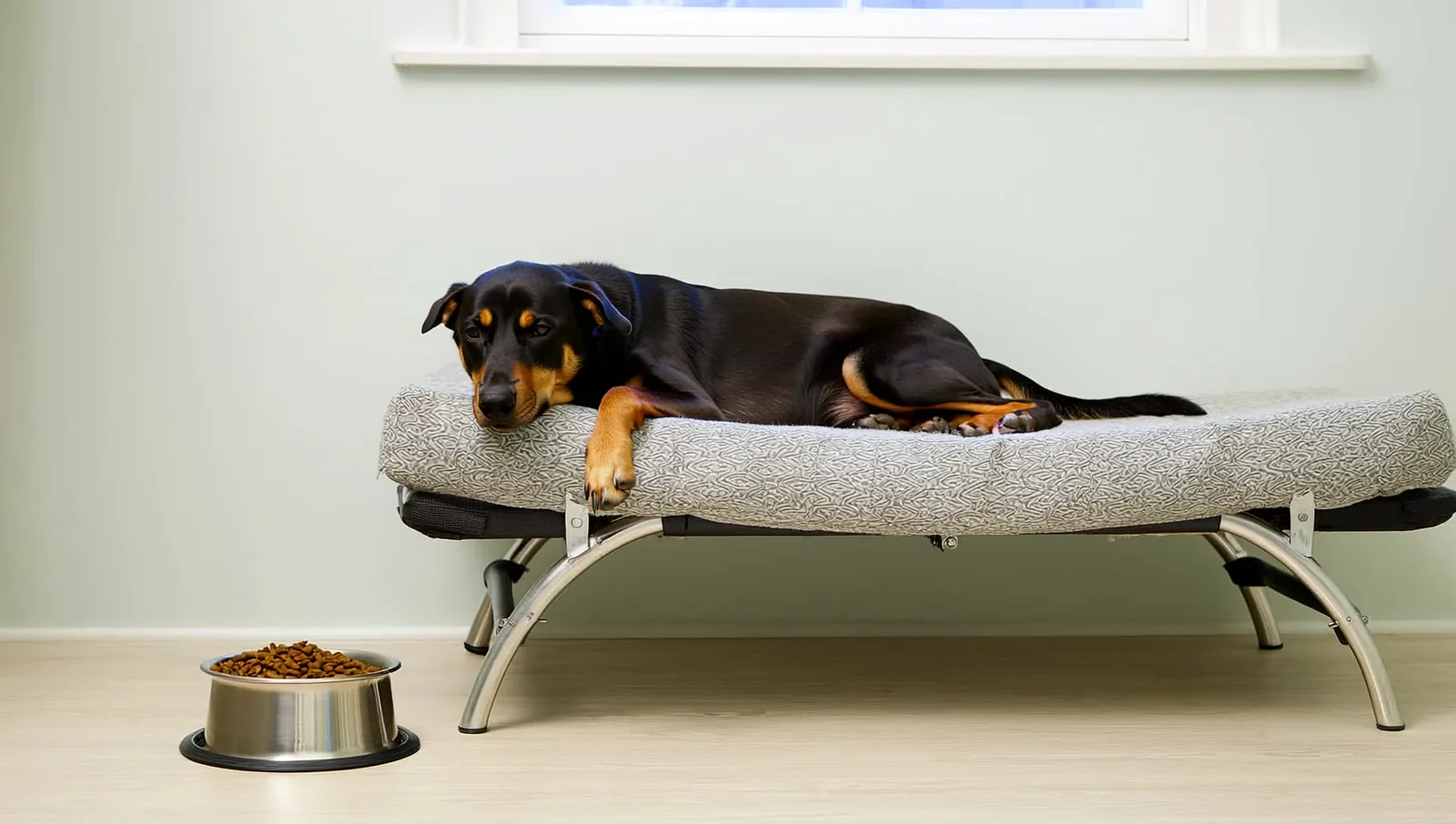
Some dogs need a much shorter fuse. Puppies and toy breeds can drop into hypoglycemia within hours rather than days. Diabetic dogs, dogs on medication that requires food, and dogs already underweight or managing a chronic illness all need a same-day call rather than a wait-and-see. Senior dogs sit in this group more often than their owners expect, because appetite loss in an older dog is more likely to be masking something.
Appetite plus any second symptom changes the math immediately. Not eating alongside vomiting, lethargy, a painful abdomen, or repeated unproductive retching is not a fussy-eater problem. Only a veterinarian can tell you which of those it is, and the facility’s job is to get your dog in front of one rather than to interpret it.
Weigh the dog in at drop-off and out at pickup, and ask for both numbers. A few percent either way over a long stay is normal. A noticeable drop over a week is a conversation, and on stays longer than about ten days a midpoint weigh-in is a reasonable thing to request.
Water and the Bowls It Sits In
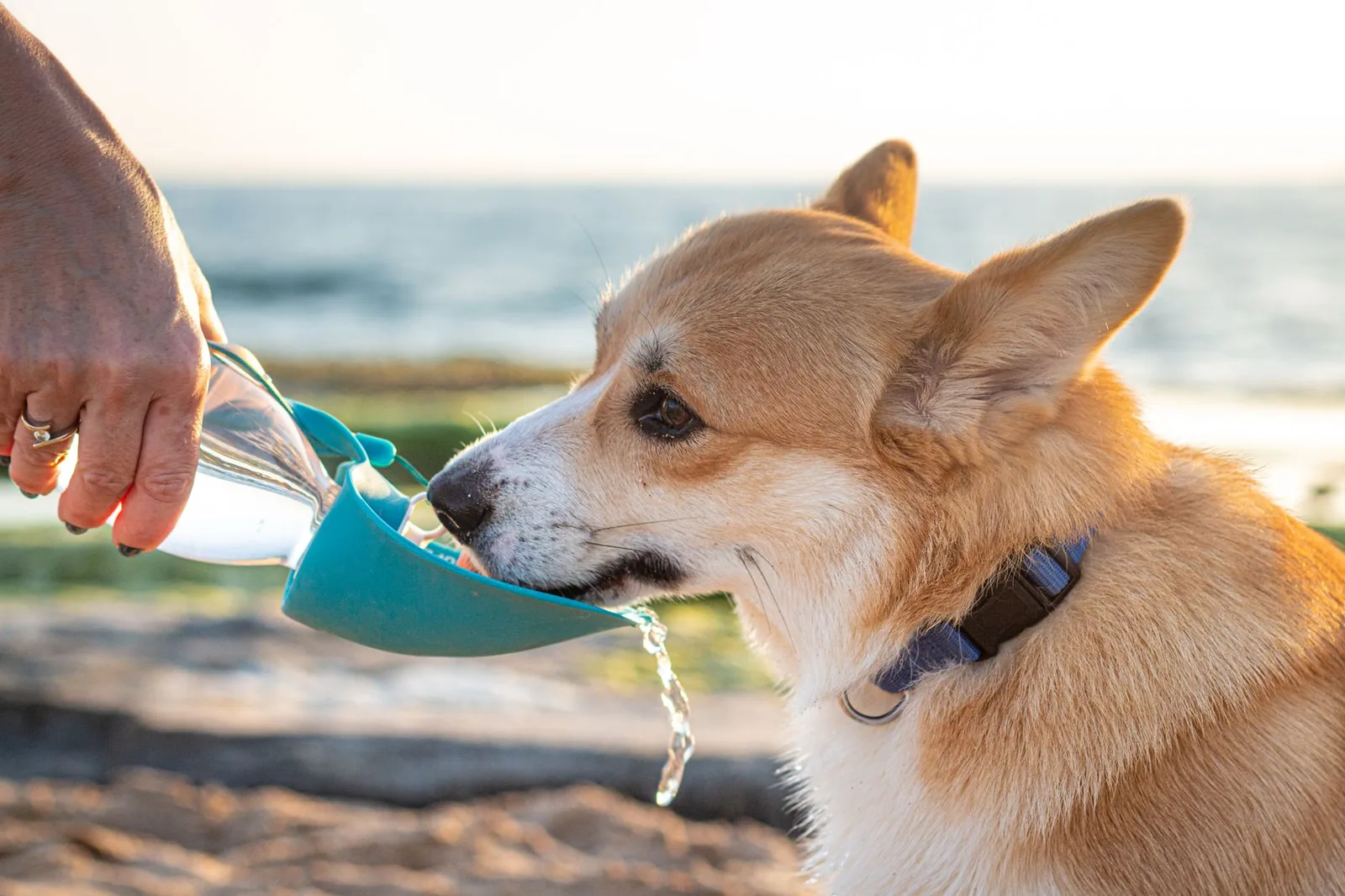
Fresh water should be available in the dog’s own run at all times, not offered at intervals. Most boarded dogs drink more than usual because they pant more than usual, and increased intake is expected. A dog drinking noticeably less is worth flagging, since it usually travels with the appetite problem.
Bowls should be stainless steel or hard non-porous plastic that goes through a sanitizer or dishwasher cycle between uses. Scratched, cloudy plastic holds biofilm in the grooves and no amount of wiping fixes it. Ask whether each dog has assigned bowls or whether bowls are pooled and sanitized, and ask specifically about communal water buckets in the play yards, which are a shared drinking vessel for every dog that passes through and a straightforward fecal-oral route for giardia and similar organisms. A facility that rotates and disinfects yard buckets on a schedule will say so without hesitating.
Put It In Writing, Then Ask for the Log
Verbal instructions given at a busy front desk survive about one shift change. The care sheet is what travels with the dog.
A complete feeding instruction covers the food and brand, the exact portion by weight or volume, the number of meals and the times, the bowl type and whether it sits on the floor, any topper or mixer and how it is prepared, medications with their timing and their food dependency, known guarding behavior, the exercise buffer around meals if the dog is at risk of bloat, and the two thresholds that trigger a phone call: meals refused, and anything about the dog’s water intake or stool that changes.
Then ask what comes back the other way. A facility running a real feeding log records, per meal, what was offered and how much was consumed, usually on a simple all, most, some, or none scale, alongside a stool note and the weigh-in numbers. Ask at booking whether you can have that log at pickup. Operators who keep one hand it over without fuss, and the request tells you a great deal about the building either way. It is also the document you will want if your dog comes home unwell, since our guide to post-boarding illness is much easier to apply against a record than against a memory.
The Bottom Line
Feeding is where a boarding stay quietly succeeds or fails, and it is almost entirely within your control before you leave the building. Bag the meals individually, be honest about raw and about guarding, get the bloat rules written down if your dog is built for that risk, agree on the phone call threshold rather than hoping it is obvious, and ask for the log. Ten minutes of specificity at the counter buys a week of a handler doing exactly the right thing without having to guess. If you are still working through the rest of the checklist, our guide to choosing the right dog hotel covers what else to ask on the tour.
Further reading (sources)
- Journal of the American Veterinary Medical Association on what a Purdue cohort found raises bloat risk in big breeds
- Journal of Small Animal Practice for the breeds losing the most dogs to bloat in the UK
- Veterinary Clinics of North America with an updated look at bloat and preventive gastropexy
- Veterinary Record on how much more raw-fed dogs shed in their stool
- Animals covering a salmonella outbreak traced to raw food in a kennel
- FDA for why regulators warn against raw pet food
- American Veterinary Medical Association with its policy on raw animal-source protein in pet diets
- ASPCA on reading and managing food guarding in dogs
- American Kennel Club for the warning signs of bloat and why it is an emergency
- American Kennel Club with the giant breeds whose build shapes their feeding needs