The Incident Call: When a Kennel Should Phone You Mid-Stay, and What a Late or Vague Call Tells You
Published on September 30, 2026
In late August, KTLA reported on a Los Angeles owner who had enrolled his two Bernese Mountain Dogs in a roughly four-week board-and-train program in Studio City. About 48 hours after drop-off, staff phoned to say that his two-year-old, Dunkin, had died. By the owner’s account, the dogs had been taken to a park, staff decided it was too hot, and they were being driven to a kennel in Hollywood when Dunkin died in the car. “They never communicated that to me,” he told the station. He said he was not told about the death until hours later, and that nobody took Dunkin to a vet until he asked them to. Los Angeles Animal Services confirmed it had opened an investigation, and the owner said he would have a necropsy done to establish the cause of death.
Most boarding stays never come near a call like that. But the three gaps in his account (a change of plan nobody mentioned, news that arrived hours late, a vet brought in only after the owner pushed) turn up in much smaller incidents all the time: the limp noticed at lunch and mentioned at pickup, two skipped meals recorded on a report card, a scuffle described as “a little tiff” three days after it happened. This guide is for the owner who is mid-trip with a living dog in someone else’s care. It covers what should make your phone ring, how fast, what a late or vague call is telling you, and what to do while your dog is still there.
Anything That Changes the Care Plan Is a Call
The simplest test is whether the event changes what happens to your dog next. A soft stool that firms up by the afternoon changes nothing, so it belongs in the pickup report. A soft stool that gets your dog moved to isolation, taken out of group play, or switched to a bland diet has changed the plan, and a plan you agreed at drop-off should not change without you hearing about it.
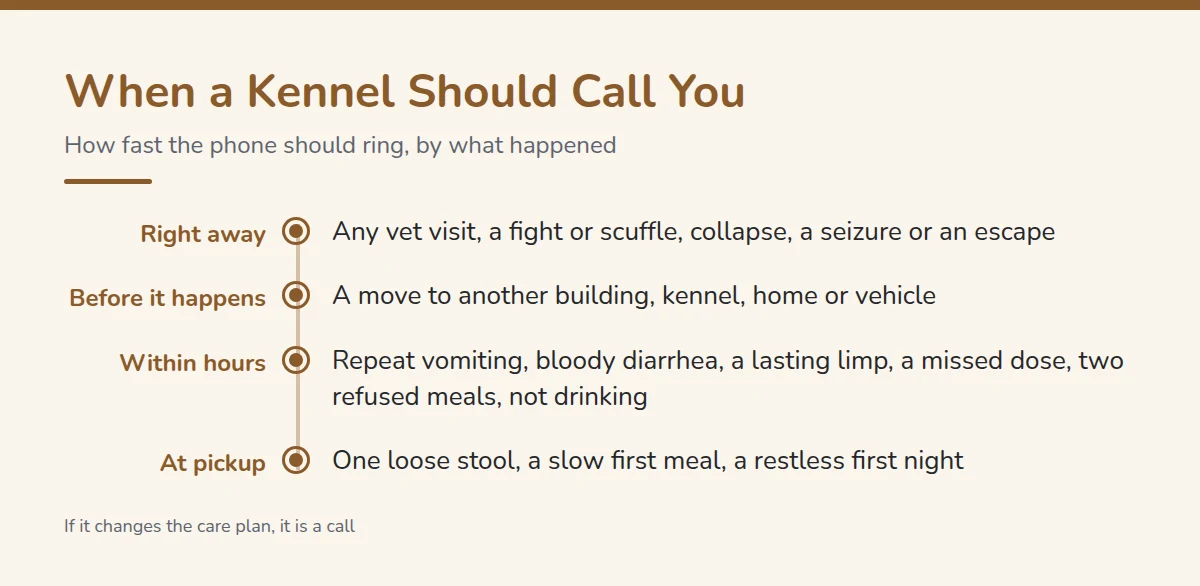
Sorted by urgency, the triggers fall into three groups.
Call as soon as your dog is safe or on the way to a vet:
- Any veterinary visit or phone consultation. If a vet is involved, you should be too.
- Any fight or scuffle where teeth made contact, even if nobody can see a wound. The American Kennel Club’s chief veterinarian compares a bite wound to an iceberg, with most of the damage under the surface, warns that fur hides punctures, and advises getting a dog seen as soon as possible after a fight, ideally within six hours, because prompt treatment lowers the chance of infection. A scuffle you first hear about at pickup is days past that window, and small dogs take the worst of it when sizes mix.
- Collapse, a seizure, labored breathing, or a swollen belly with unproductive retching. These are emergencies first and phone calls second, but the call should follow in minutes, not hours.
- An escape, including a brief one that ended well.
- Any move. Your dog going to another building, another kennel, a staff member’s home, or out in a vehicle when none of that was in the booking. This is the gap the Studio City account turns on, and a planned move is something you should hear about before it happens, not after.
Call within a few hours, on the same shift:
- Vomiting more than once, or diarrhea with blood in it. AAHA, which accredits veterinary hospitals, advises prompt veterinary care when a pet has vomited several times in a short period or has severe diarrhea, especially with blood or other signs, and notes that the dehydration that follows is especially dangerous for puppies and older animals.
- A limp that is still there after rest. A dog that will not put the foot down at all belongs in the first group.
- A missed, late or doubled dose of medication. For a diabetic dog this is not a clerical slip. AAHA’s diabetes guidance warns that a dog’s blood sugar can drop to dangerously low levels after sporadic, strenuous exercise or a change in how insulin is given, which is exactly what an unplanned afternoon of group play or an improvised catch-up dose produces. How to recover a missed dose is your vet’s decision, not a guess made at the front desk.
- Two refused meals in a row, which for a dog fed twice a day is a full day without food. Puppies, toy breeds, diabetic dogs and seniors need a shorter fuse, and our guide to feeding at boarding sets out where those lines sit.
- A dog that is not drinking.
Fine to hear at pickup, as long as it was written down: a slow first breakfast that recovered by dinner, one loose stool on the first day, pacing and barking on the first night, a small scrape that was cleaned, checked and left alone. A good facility logs these and walks you through them at the counter. It does not need to pull you out of a meeting for them.
What the Law Requires (Less Than You Would Hope)
Rules on this vary widely, and plenty of places have none that speak to boarding at all. Where rules do exist, they tend to secure the vet more firmly than the phone call.
California is the clearest case. Its pet boarding statute, in force since 2017, requires an operator to make sure the owner is notified immediately that a pet is sick or injured, unless the owner has said in writing that notification of any illness or injury, or of a particular type, is not required. That exception matters more than it looks, because it means a contract can carry a clause in which you waive the call. Look for any line saying minor issues will be reported at pickup, and ask what counts as minor. The same statute requires an operator to disclose when it will materially depart from the routine it described to you in writing, such as staffed hours, observation practices and the daily schedule.
Colorado works through the paperwork. Its rules for boarding and training facilities require an incident file for any injury or illness that needs veterinary care, any death and any escape, and each report must record the date and time the owner was notified and how. A death or escape must also be reported to the state program in writing within 72 hours. The value to you is that in Colorado, the gap between when something happened and when you were told is written down.
In England, the statutory guidance that councils license kennels against requires staff to contact a vet for advice immediately when a trained first aider suspects a dog is ill or injured, and to tell owners when there are concerns about a dog’s diet. A dog that stays off its food for more than 24 hours must be monitored, with veterinary advice sought if there are concerns. The guidance is explicit about the vet. About the call to you, it says much less.
Wherever you board, the practical conclusion is the same. The notification policy you can rely on is the one in your contract, so it needs to be there.
Put the Windows in Writing Before You Leave
Ask for the facility’s owner contact policy at booking, and ask for it in writing. A well-run operation has one, and it answers four questions without hesitating: who makes the call (a named role such as the manager on duty, not whoever happened to notice), how fast, by what channel, and what happens when they cannot reach you.
Reasonable windows look something like this. For anything in the first group, a phone call as soon as the dog is stable or on the way to a vet, ideally within half an hour. For the second group, a call within a few hours and before the shift that noticed the problem goes home. For everything else, a line in the daily report. A text or an app notification is fine for the last group and not good enough for the first. If your dog is on the way to an emergency clinic, you should hear a voice.
Then make the policy workable from your end. Tell them when you will be unreachable, such as flight times. Give a second number and a local emergency contact who can physically get to the kennel and has your permission to collect your dog. Check that the number on file actually rings where you will be. The veterinary authorization and its spending limit belong in the same conversation, and our guide to emergency preparedness at boarding facilities covers what that paperwork should say.
Why a Late Call Usually Means an Unwritten Policy
A phone call takes two minutes. Even on the busiest holiday weekend, somebody can find two minutes, which is why a delay measured in hours rarely comes down to a slammed shift. It usually comes down to one of a handful of gaps.
Nobody owns the call, so the attendant who noticed assumes the manager will ring, and the manager assumes it was handled. Calls need sign-off from an owner who is off site. The house rule is to tell owners at pickup unless it is serious, and nobody has defined serious. Or somebody hopes the problem will resolve before it has to be reported. Each of those is fixable with a written policy, which is why its absence is the real finding.
You can often hear the gap on the call itself. The person phoning cannot say what time the incident happened. They do not know whether a vet was consulted. They need to check with someone before answering basic questions, or the account shifts between the first call and the second. In the Studio City case, by the owner’s account, the move, the death and the vet all reached him late or only after he pushed. That pattern, more than any single moment, is what a missing policy looks like from the outside.
What a Vague Call Sounds Like
Some calls arrive on time and still tell you almost nothing. “He’s a bit off today.” “They had a little tiff.” “She’s not super interested in her food.” “We’re keeping an eye on it.” Each of those swaps a fact for a reassurance.
Turn each one back into a question whose answer is a number or a time. How many times did she vomit, and when was the last? Which leg, and will he bear weight on it? When did he last eat, and how much? Who saw the scuffle, and did anyone part the fur and check for punctures? Being told a dog is acting normal is not the same as being told a dog is fine. AAHA’s emergency guidance points out that after a trauma a pet may act normally even with internal injuries, because shock can temporarily mask the pain.
Vagueness is not always evasion. The person on the phone may be a junior attendant reading from a note. That is a reason to ask for the manager, not a reason to accept the note.
What to Ask While Your Dog Is Still There
The call is the moment you have the most leverage, because your dog is still in their care and the decisions have not been made yet. Keep a pen handy and ask:
- What happened, at what time, and who saw it?
- Where is my dog right now, and who is with them?
- Has a vet examined my dog or been consulted? Which clinic, and may I speak to them directly?
- What changes from here: isolation, no group play, a different feeding plan?
- Has my dog eaten, drunk and toileted normally since?
- Can you send a photo or a short video within the next half hour?
- When exactly will you call me next?
- Will this go into an incident report, and can I have a copy?
Write down the times as you go, then send a short message afterwards confirming what you were told. Something as simple as “Thanks for the call at 3:10. Confirming she vomited twice this morning, the vet advised a bland diet and no group play, and you’ll update me by 7 p.m.” keeps everyone working from the same facts without turning the conversation into an argument.
When the Answers Do Not Come
If the updates stop, the answers stay vague or the story changes, escalate in order while your dog is still there.
- Ask for the manager or owner by name, and for a direct number rather than the front desk.
- Bring in your own vet. Your vet knows your dog’s history and can call the facility or the treating clinic and talk clinician to clinician, which often gets straighter answers than an owner can.
- Send your local contact in person. A ten-minute visit settles what a string of photos cannot, and it is exactly what a named local contact is for.
- Put your requests in writing: the incident report, the care log for the stay so far, and the name of any vet consulted.
- Bring your dog home early if straight answers are not coming, or have your contact collect them. Check the contract for early pickup terms, but a fee is not a reason to leave your dog somewhere that will not tell you what is happening.
- Report it if you believe your dog is in danger and the facility will not cooperate. That means local animal control, or the licensing body where one exists, such as the council licensing team in England or the state program in Colorado. If a dog’s life is at immediate risk, call animal control or the police and ask for a welfare check.
Board-and-train programs deserve extra care here, because the model keeps owners at arm’s length for weeks by design. Our guide to vetting a board-and-train facility covers the call-me clause worth writing into that contract. Once your dog is home, the pickup checks and complaint routes take it from there.

The Tell Is the Gap
Every facility will eventually have to phone an owner with bad news. What separates a good one is not whether that call ever happens. It is the gap between the moment something happened and the moment you heard, and whether the person on the line can fill it with times, names and a plan. Get the policy in writing before you leave, and listen for the gap if the phone rings.
Further reading (sources)
- KTLA on the Studio City board-and-train death and the owner’s account of the delayed call
- KTLA with Los Angeles Animal Services confirming its investigation
- California Legislative Information for the boarding statute requiring owners to be told immediately of sickness or injury
- California Legislative Information on the duty to disclose departures from a facility’s written routine
- Legal Information Institute with Colorado’s incident file rule, including when the owner was notified
- GOV.UK for the English kennel standards on vet contact, appetite and diet concerns
- American Kennel Club on why a bite wound hides most of its damage under the fur
- American Animal Hospital Association for the signs that turn vomiting, diarrhea or an injury into a pet emergency
- American Animal Hospital Association with what its diabetes guidelines say about exercise, insulin changes and low blood sugar