UK Dog Boarding Licences Explained: Star Ratings, Inspection Conditions, and How to Check a Kennel Before You Book
Published on September 9, 2026
Between July 2024 and January 2026, Billy Woodhouse took bookings at Hatton Boarding Kennels in Shifnal, Shropshire. Owners handed over their dogs, paid, and went on holiday. What none of them knew was that Shropshire Council had suspended his boarding licence back in October 2022 over poor welfare standards and non-compliance with licence conditions, and that rather than fix the premises he had surrendered the licence and simply carried on trading. In July 2026 he was given a 12 month custodial sentence suspended for 12 months, a 10 year ban on keeping animals that cannot be appealed for five years, and £1,000 in council legal costs, after pleading guilty under the Animal Welfare Act 2006 and the Fraud Act 2006. One dog boarded there had to be euthanised on veterinary advice. Several others went home in a condition the council described as consistent with a very poor standard of care. In January 2026, police searching the site found a burial mound containing nine dead dogs.
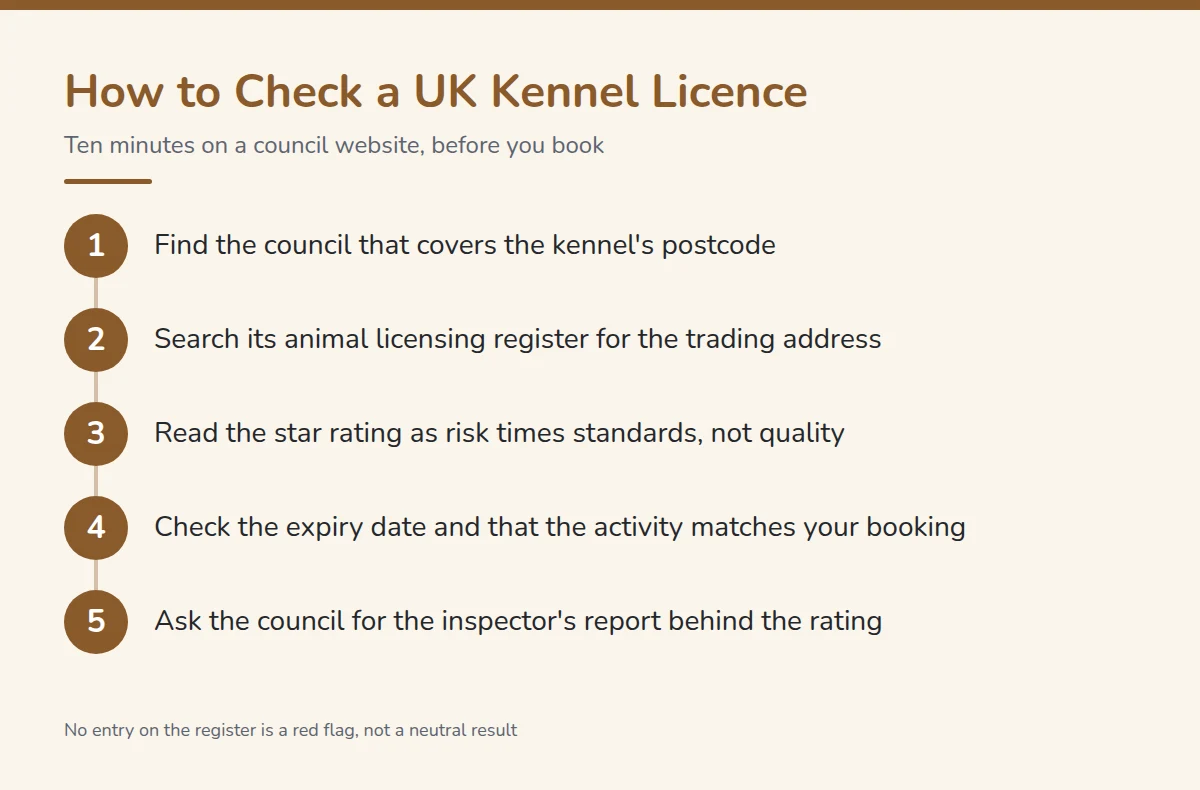
The fraud charge is the part worth sitting with. Customers were not defrauded of money so much as of a belief, the belief that a business advertising boarding was a business allowed to do it. That belief is easy to check and almost nobody checks it. The UK has one of the more transparent animal licensing regimes in the world, with public registers, published star ratings, and inspection reports you can request. Here is how to actually use it.
What Needs a Licence, and Where the Rules Differ
In England, the Animal Welfare (Licensing of Activities Involving Animals) (England) Regulations 2018 came into force on 1 October 2018 and replaced the old Animal Boarding Establishments Act 1963. It made five separate boarding activities licensable by the local council:
- Boarding dogs in kennels
- Home boarding for dogs, where dogs stay in someone’s house
- Dog day care, with no overnight stay
- Arranging home boarding, meaning agencies and franchises that place dogs with host families
- Boarding cats in catteries
That fourth category catches a lot of people out. If you book through a national app or franchise that matches your dog with a host, the arranging business needs its own licence, and so does the host if they are boarding in their own home as a business. A polished website is not a licence.
The rest of the UK has not followed England yet. Wales and Scotland still license boarding under the 1963 Act, which means an annual licence, no star rating, and a maximum penalty for unlicensed operation of a £500 fine or three months in prison. Northern Ireland runs its own scheme through its district councils, and Scotland has consulted on moving boarding into its newer 2021 regulations without doing so yet. If you are booking in Cardiff or Glasgow, you are checking that a licence exists at all rather than reading a score.
The Star Rating Is Two Judgements Stacked Together
English councils publish a rating of one to five stars for every licensed animal business, and owners routinely misread it as a single quality grade. It is not. It is two separate assessments multiplied together.
The first is a risk rating, either low or higher, based on the operator’s compliance history rather than on the building. The second is a standards assessment, either minimum standards or higher standards. To count as meeting higher standards, a business has to satisfy every required higher standard plus at least half of the optional ones in the government’s statutory guidance.
Combine the two and you get the matrix councils actually use:
| Minimum standards | Higher standards | |
|---|---|---|
| Low risk | 3 stars, 2 year licence | 5 stars, 3 year licence |
| Higher risk | 2 stars, 1 year licence | 4 stars, 2 year licence |
A one star rating sits outside that grid. It means the inspector found minor failings that did not compromise animal welfare, typically paperwork or administrative gaps, and granted a one year licence anyway.
Two things follow. Licence duration is a rating in disguise, so a kennel on a one year licence has already told you something without you reading a word. And any business without three years of compliance history with a council or a UKAS accredited scheme is automatically classed as higher risk, which means a brand new kennel built to an excellent standard cannot score five stars in its first year. The rating is partly a record of being watched over time, so do not read three stars at a two year old business the way you would read it at a twenty year old one.
Licence Conditions Are the Cap on the Kennel
The star rating is the headline. The licence conditions are the fine print, and they are where the enforceable limits live.
Every English boarding licence must state the maximum number of dogs permitted on the premises, set against the kennel space and staffing the inspector actually saw. Exceeding it is a breach of the licence, not a busy weekend. If a kennel says it is full and then finds a space at short notice in August, it is fair to ask what their licensed number is.
Conditions also cover vaccination. The statutory requirement in England is that boarded dogs are vaccinated against canine parvovirus, canine distemper, infectious canine hepatitis (adenovirus), and leptospirosis, with the primary course completed at least two weeks before the dog arrives. Note what is missing from that list: kennel cough. Bordetella and parainfluenza vaccination is not a statutory licence condition in England, so when a kennel requires it, that is the facility’s own booking policy rather than the law, and a kennel that does not require it is not breaking any rule. Our guide to kennel cough and CIRDC covers why that vaccine is still worth having and why timing matters.
A copy of the licence has to be displayed prominently at the premises. If you tour a kennel and cannot see one, ask. The answer tells you a great deal either way.
What Higher Standards Actually Buy Your Dog
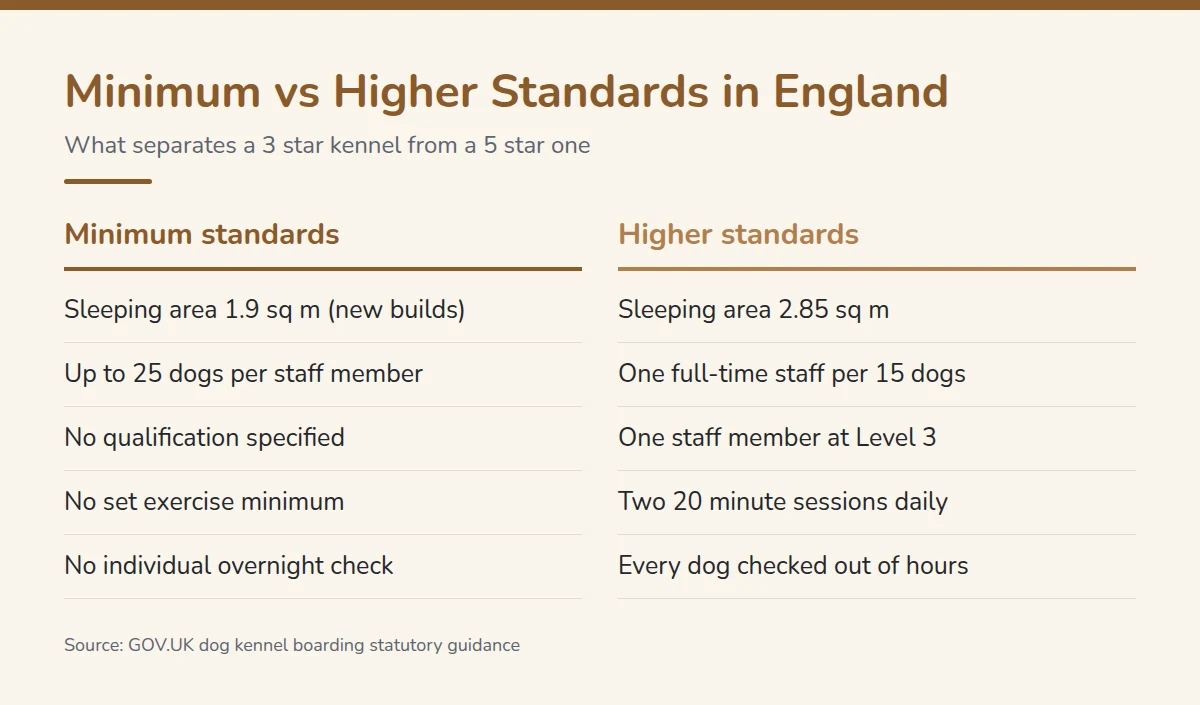
The gap between a three star and a five star kennel is not marketing gloss. The government’s dog kennel boarding guidance sets out concrete differences, and they are the sort of thing a dog experiences hour by hour.
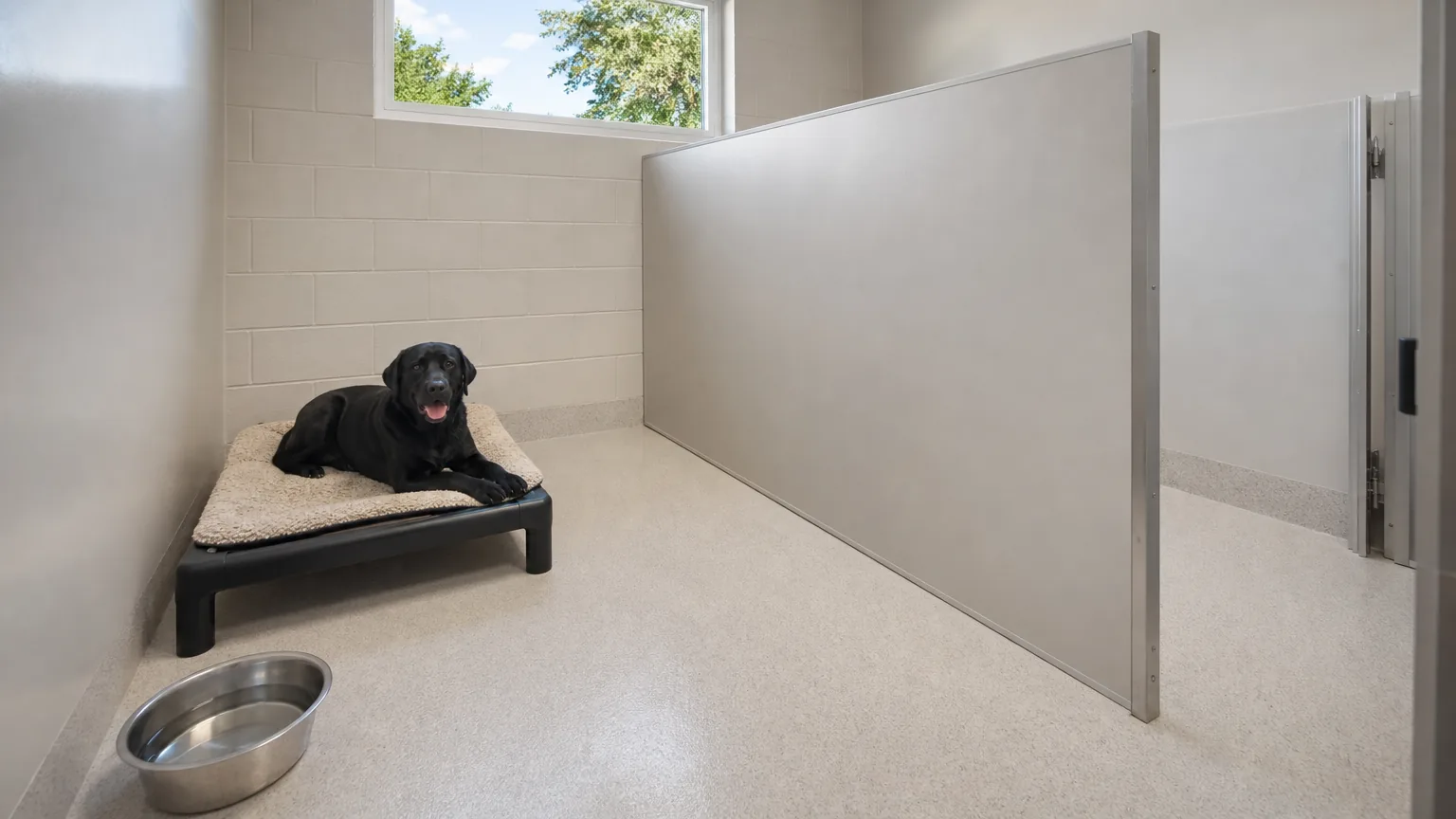
Space. A new build kennel meeting minimum standards needs a sleeping area of at least 1.9 square metres. Higher standards raise that to at least 2.85 square metres, roughly half as much floor again.
Staffing. At minimum standards, each member of staff may be responsible for up to 25 dogs. At higher standards, there must be at least one full time member of staff for every 15 dogs, and at least one permanent full time staff member must hold an appropriate Level 3 Ofqual regulated qualification.
Exercise. Higher standards require two exercise periods per dog per day of at least 20 minutes each. Minimum standards do not specify that.
Overnight cover. This is the one I weigh most heavily. At higher standards, every individual dog must be checked at least once at an appropriate interval during the out of hours period. Minimum standards carry no equivalent individual overnight check. For a dog that bloats, overheats, gets a limb caught, or panics at 2am, the difference between one look overnight and none is the whole ballgame, and it is why overnight fire risk deserves its own set of questions.
How to Look Up a Licence in Five Minutes
- Find the right council. Licences are issued by the district, borough, city, or unitary authority where the kennel physically sits, which is often not the town in its business name. Search the kennel’s postcode on the GOV.UK council finder.
- Search the council’s animal licensing register. Most publish a page called something like “licensed animal establishments” or “animal activity licences”, usually as a PDF or spreadsheet listing business name, address, activity, star rating, and expiry date. Many councils also publish to data.gov.uk.
- Match the trading address, not just the name. Kennels rebrand, change hands, and trade under names that differ from the licence holder. The address is the reliable key.
- Check the expiry date and the activity. A licence for dog day care does not authorise overnight boarding, and a licence that expired last month is not a licence.
- Ask for the inspection report. Councils hold the inspector’s report behind the rating and will usually release it on request, sometimes as a freedom of information request. It is far more informative than the star, because it names the specific conditions that were and were not met.

If the kennel is not on the register at all, that is not an administrative quirk. Ask them for their licence number and check it against the council directly before you book.
Reading a Suspended, Surrendered, or Conditional Licence
Three states get confused, and the Shropshire case turns on the difference.
A suspended licence means the council has stopped the business trading while problems are addressed. A surrendered licence means the holder gave it up voluntarily, which sounds tidier and can be anything but. Woodhouse surrendered his during suspension, said he would improve the premises and reapply, and then traded unlicensed for 18 months. A surrendered licence leaves no active entry, so the business vanishes from the list rather than appearing with a warning attached. Absence from a register is a red flag, not a neutral result.
A conditional or varied licence carries extra requirements added by the council after an inspection, such as a reduced maximum dog number or a deadline for building work. Those extra conditions are the most useful document a prospective customer can read, because they tell you exactly what the inspector was worried about.
Scotland shows what the unlicensed end of the market looks like. In June 2026, Gary and Eden Hopkins were sentenced at Hamilton Sheriff Court for running a Lanarkshire boarding business without a licence. A client’s lurcher, Monty, came home limping and soaked in urine with infected, badly swollen hocks. A Scottish SPCA inspector attending with police found seven dogs stacked in collapsing cages in a hot kitchen with no bedding and no water, including a Doberman and a collie so tightly confined their legs were intertwined. Gary Hopkins received 160 hours of unpaid work, his wife was tagged for 60 days, and both were disqualified from keeping dogs for 24 months.
Planning permission is a separate process, incidentally, and the two get conflated. A proposed kennel at Castleford in West Yorkshire had its plans withdrawn in 2026 after public consultation, which is a planning outcome and says nothing about anyone’s licence.
What a Licence Does Not Tell You
A licence is a floor, not a recommendation. It confirms that on the day of inspection the premises met a defined standard and that the operator sits on a register with a named officer who can act. It says nothing about who is handling your dog today, whether staff turnover is brutal, or how the place feels at 7pm on a wet Tuesday.
Both businesses above were, at some point, either licensed or trading as though they were. Regulation caught them eventually, but “eventually” was measured in years and the dogs were in the buildings the whole time. Use the register as your first filter and your own eyes as the second. Our guide to choosing the right dog hotel covers what to look for on a tour, how dogs die at boarding facilities maps the failure modes worth asking about, and if something feels wrong at pickup, the signs of mistreatment covers how to document and escalate it.
The Bottom Line
Ten minutes on a council website is the cheapest due diligence available to a UK dog owner. Find the council by postcode, find the business by address, read the star as risk times standards rather than as a quality score, note the duration and expiry, and ask for the inspection report. Treat a five star three year licence as meaningful, a one or two star licence as a prompt for harder questions, and a business you cannot find on any register as one that has not yet earned your dog. For longer stays and residential training programmes, where nobody outside the building sees your dog for weeks, these checks matter more rather than less, and our guide to vetting a board-and-train facility sets out what else to get in writing.
Further reading (sources)
- Shropshire Council on the licensing team’s prosecution of the Shifnal kennels owner
- BBC News for the dog euthanised after a stay at the suspended-licence kennels
- Shropshire Star with what police found at the Hatton kennels site
- Glasgow Times covering the Lanarkshire couple who boarded dogs without a licence
- GOV.UK for the statutory kennel standards councils inspect against
- Stafford Borough Council on how the star rating and risk scoring matrix is applied
- GOV.UK covering the annual boarding licence that still applies in Wales and Scotland
- Wakefield Express for the Castleford kennel plans withdrawn after consultation