Adventure Daycare and Off-Site Outings: How to Vet a Facility That Takes Your Dog Hiking, Swimming, or Paddling
Published on September 22, 2026
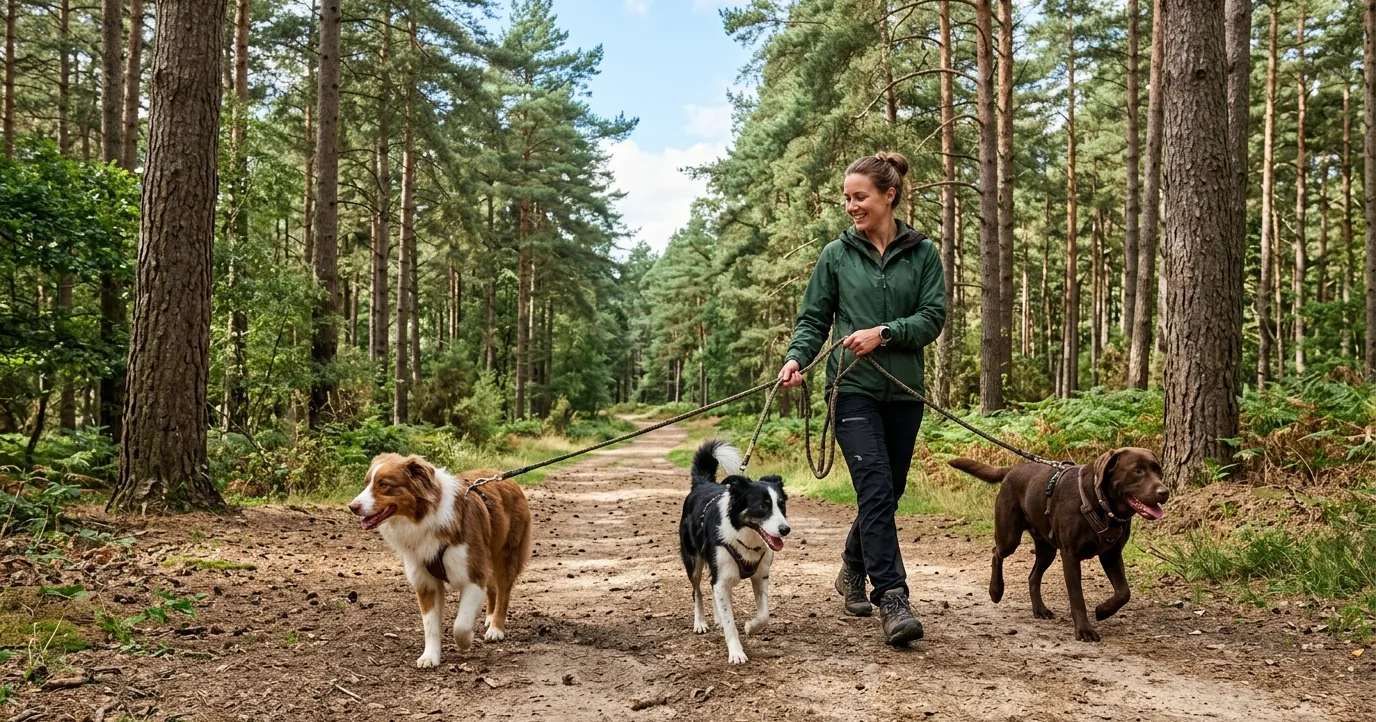
The pitch is genuinely good. A dog that spends the morning on a forest trail comes home differently tired than a dog that spent the morning in a play yard, and a growing tier of daycare and boarding operators has built a business on exactly that. Pack hikes at dawn, lake and beach swims through summer, and at the premium end, kayak and paddleboard trips. The photographs are lovely. The dogs in them look happy, and they probably were.
What nobody mentions is that the tour you took is now largely beside the point. Everything you inspected, the double-gated entry, the fence height, the latch design, the ratio of handlers to dogs in the yard, the camera over the play area, all of it stays behind the moment the van pulls out of the car park. The activity your dog is actually doing happens somewhere you have never seen, under rules you have not read, with containment that consists of a leash clip and one person paying attention. Here is how to vet that part.
You Are Trading a Fence for a Person
It is worth being blunt about what changes. On the property, containment is engineered. It exists whether or not anybody is looking, and it keeps working when a handler is distracted by a scuffle at the other end of the yard. Off the property, containment is behavioural and it depends on attention that can lapse.
Engineering fails too, of course. In one Ontario case, a boarded dog named Harley got out of an enclosed play area by squeezing between two boards of a six-foot fence while being exercised, and the kennel was found negligent on appeal. That is what a bad day looks like with a fence in place. On a trail there is no fence at all, which means the question you need answered is not whether the outing is fun. It is what the operator has put in place instead of the fence.
Ratios Mean Something Different Off Leash
A play-yard ratio and a trail ratio are not the same number, and a facility that quotes you the same figure for both has not thought about it. In a yard, one handler supervising a dozen dogs has sightlines across the whole space and a locked gate behind them. On a trail with bends, undergrowth, and other users, the same handler can lose visual contact with half the group in seconds.
The American Kennel Club lists group sizes too large for a handler to control on the trail as a straightforward red flag, alongside handlers you cannot identify and a company that offers no start, finish, or location updates. What a defensible operation looks like in practice is smaller groups than the yard, a second handler on anything beyond a modest pack, and a deliberate answer to the question of who is grouped with whom and why.
Ask three things. What is the maximum number of dogs one handler takes off leash at once? Is there ever a solo handler on an outing, and what happens if a dog needs carrying out? And how is a new dog introduced to an established pack? The answers should be specific and slightly boring. If they are not, that is your answer. The same logic that governs licensed capacity and staff ratios back at the kennel applies here with less margin for error.
Recall Is Either Tested or It Is Assumed
This is the single most important thing to ask about, and the one most likely to get a vague response. Off-leash time should follow a recall assessment, not a hunch, and the AKC is explicit that groups should be primarily on leash, going off leash only with the owner’s permission, only where it is legal, and only once a dog has reliable recall and an established relationship with that specific handler.
A real recall test has a shape. It happens in a fenced or enclosed space first. It is run by the handler who will actually take the dog out, not by whoever was free at intake. It includes at least one meaningful distraction, because a dog that recalls from sniffing grass tells you nothing about a dog that has just spotted a deer. And it happens more than once, on more than one day.
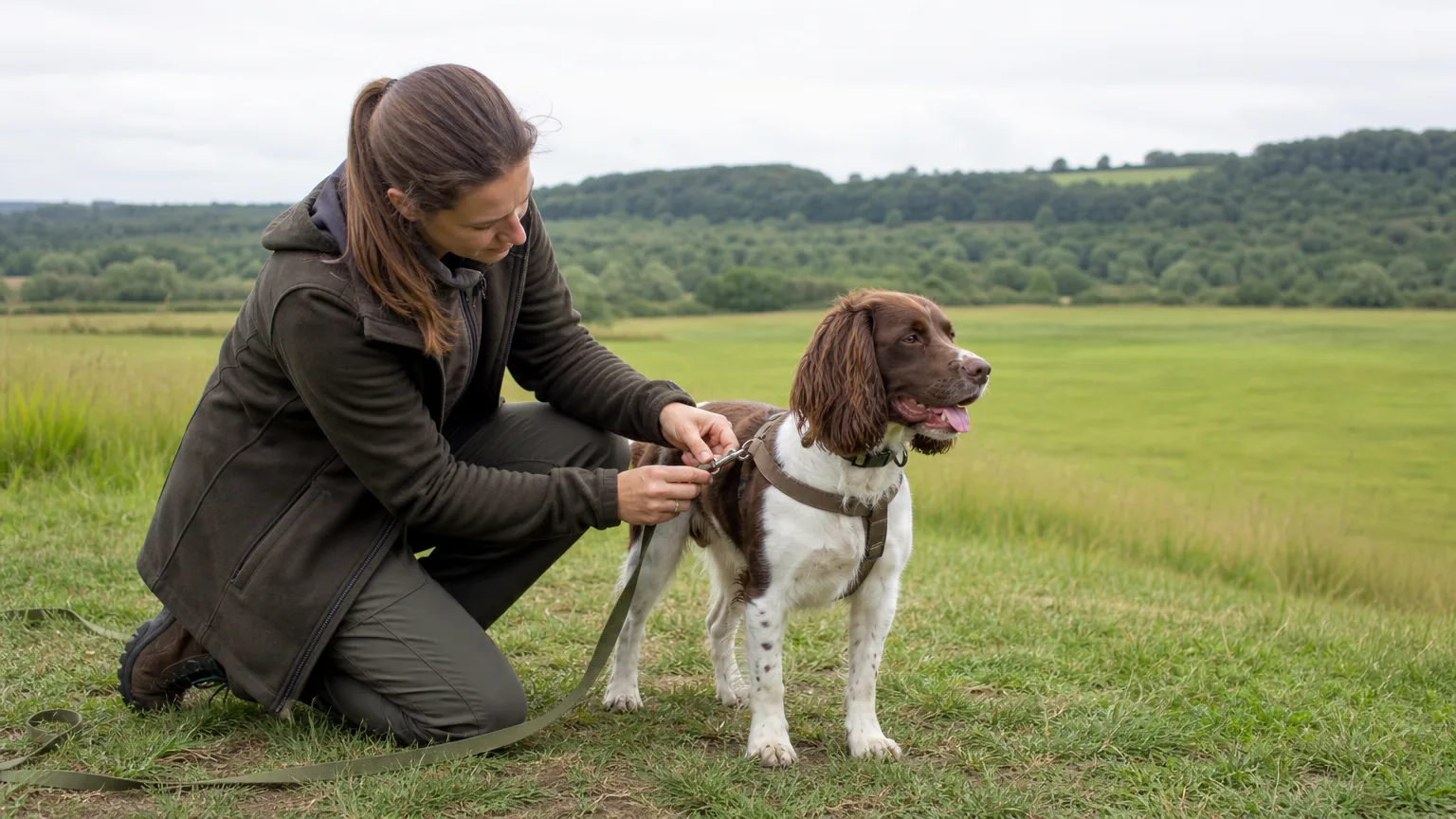
The more revealing question is what the facility does with a dog that fails. The right answer is dull: that dog stays on a long line, indefinitely, and the owner is told. The wrong answer is any version of “we see how they do out there.” If the operator tells you every dog in the programme goes off leash, they are not testing anything.
Not every dog belongs on a group outing at all. Dogs that are reactive toward people or other animals, puppies still growing and still finishing their vaccine series, and seniors who should not be on rocky ground are all better served by a solo walk. If your dog is already on the quiet, low-arousal end of the boarding spectrum, a pack hike is not the upgrade it looks like.
”Off-Leash Hiking” Is Not One Legal Thing
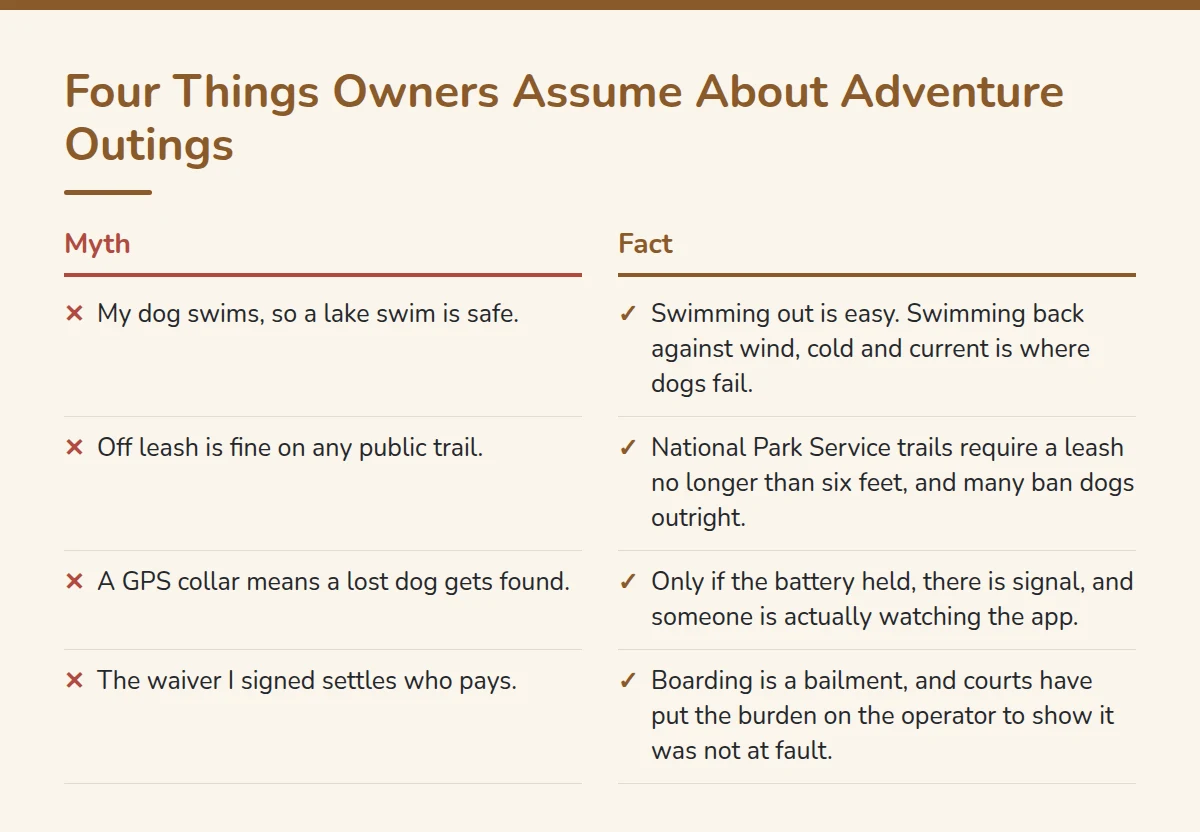
Owners assume public land is public land. It is not. On National Park Service trails, dogs must be on a leash no longer than six feet, and many park trails do not allow dogs at all. On National Forest land the picture is completely different: the Forest Service requires a six-foot leash in developed recreation areas and on interpretive trails, but there is no leash requirement across most of the forest, with individual districts adding their own orders, some of them seasonal.
So the same off-leash hike can be perfectly lawful at one trailhead and a citation at another twenty minutes down the road. Ask where they actually go, by name. An operator who can tell you the trail, the managing agency, and the leash rule there is running a real programme. One who answers “various local trails” is telling you they have not checked.
Lost-Dog Protocol, and What GPS Does Not Do
Most lost dogs come home. A national survey by Weiss, Slater and Lord found that 93 percent of lost dogs were recovered, and that the two most common routes to recovery were the owner searching the neighbourhood and the dog simply returning on its own. Only 14 percent were found because of an identification tag.
Read those numbers again in the context of a trail. A dog lost thirty miles from home has no neighbourhood to be searched and no familiar route back. The two mechanisms that recover most lost dogs are both unavailable, which is why an off-site programme needs a written protocol rather than a reassuring sentence.
A GPS collar is useful and is not a solution. It helps only if the battery was charged that morning, if there is cell coverage in the drainage the dog ran into, and if somebody is actually watching the app rather than managing the other eight dogs. Ask whether every dog wears one or only some, who monitors it during the outing, and what the fallback is when the signal drops.
Then ask for the sequence. At what point does the handler stop searching and call you? Who takes the remaining dogs back, and does the search continue while that happens? Does anybody stay at the trailhead into the evening, and who pays for that? Is your microchip registration current in their file, along with the number for the chip registry rather than just the vet? A facility with a real protocol will answer this in order. A facility without one will tell you it has never happened.
Water: Swimming Out Is Easy, Swimming Back Is Not
Open water is where the gap between marketing and risk is widest. The relevant distinction is not whether your dog can swim. It is whether your dog can swim back, into wind, across a current, in water cold enough to sap muscle, from a distance that looked trivial from the shore.
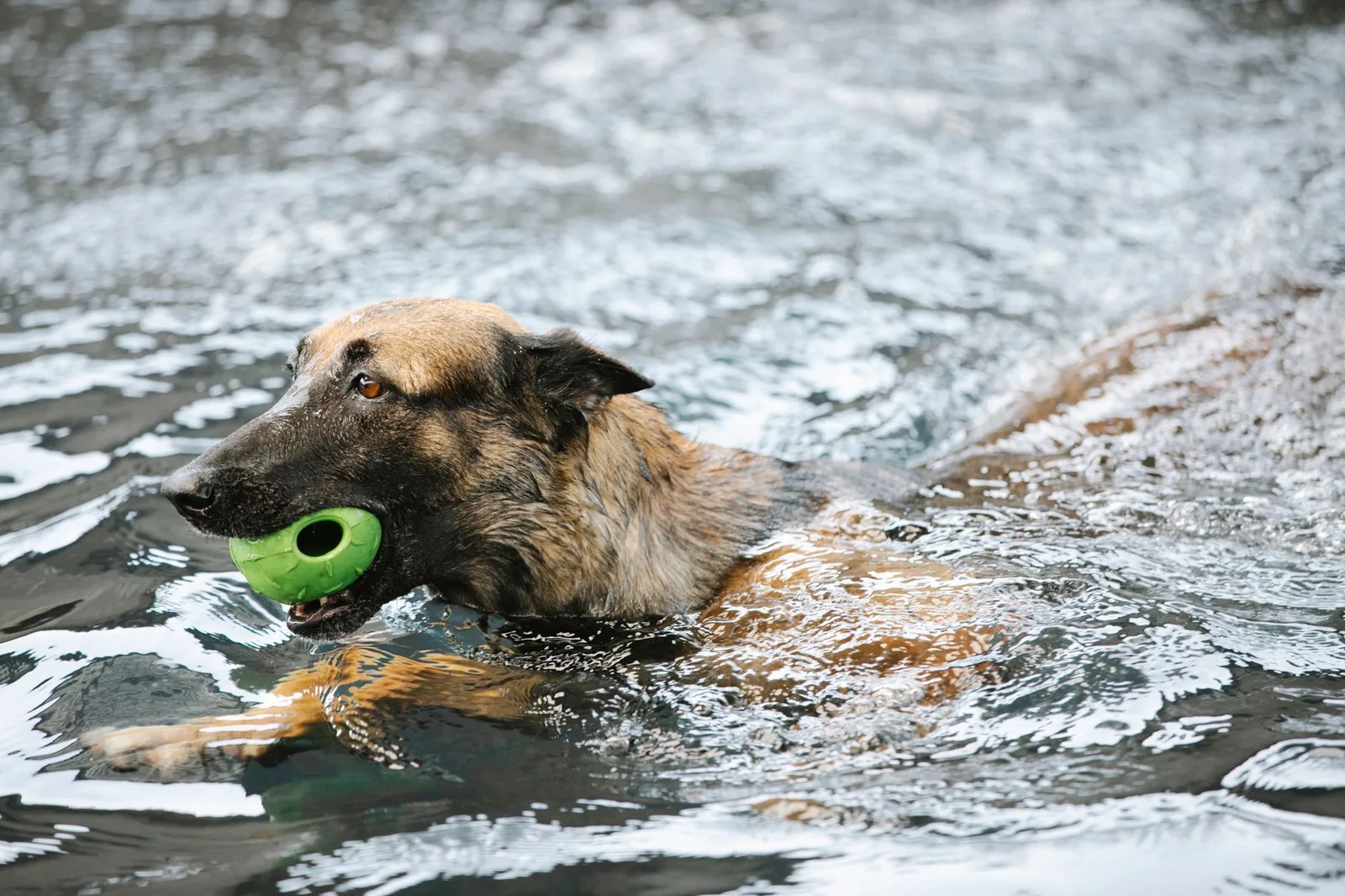
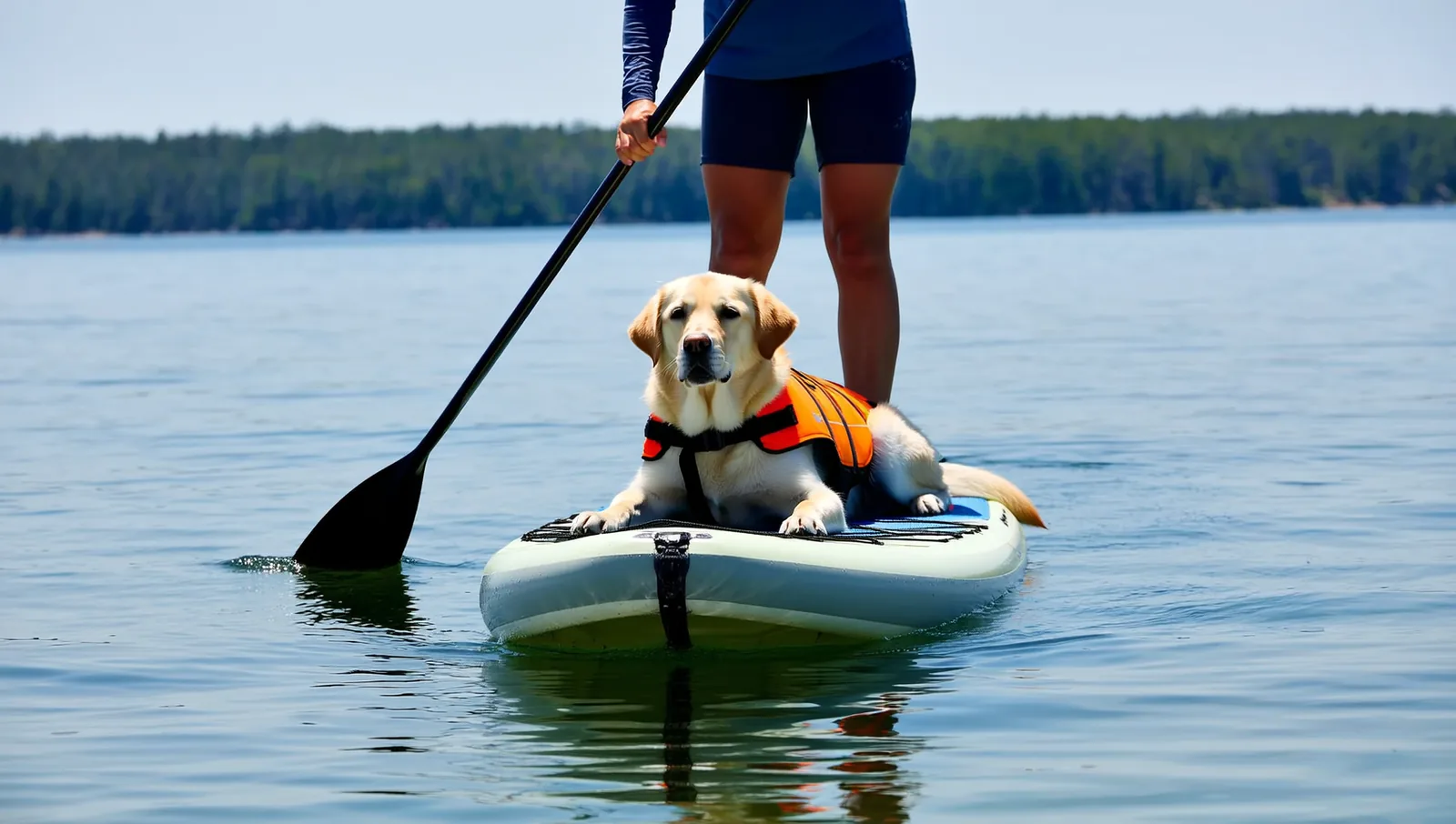
A life jacket with a strong grab handle across the shoulders is the baseline for any boat work, including for strong swimmers, because a capsize produces a disoriented and exhausted dog rather than a confident one. The AKC’s guidance on boating adds one rule that is absolute: never tether a dog to a boat, kayak, or raft, because a tethered dog goes under with it. Ask who supplies the jacket, whether it is fitted to your dog or grabbed from a communal bin, and whether the handler has ever practised a recovery.
Then there is what is in the water. The CDC warns that animals can sicken and die within hours of swallowing toxins from a harmful algal bloom, and that dogs are more exposed than people precisely because they will drink water that looks and smells wrong, and will eat algae or dead fish off the shoreline. A facility running lake swims should be checking state or county bloom advisories before it goes, and rinsing dogs afterwards so they are not licking cyanobacteria off their coats. This belongs in the same mental file as the things dogs swallow that they should not back at the kennel, and it sits alongside the pool and hydration questions that apply on the property.
Heat on a Trail Has No Indoors
Research by Hall and colleagues on UK dogs found that exertional heat illness, the kind brought on by activity, is a greater threat than the parked car that dominates public warnings. An off-site outing is exertion by definition, and it removes the one control a kennel has: when a dog overheats in a yard, staff bring it inside. Three miles up a trail there is no inside.
Ask what temperature or heat index cancels an outing, whether the route changes in summer to shaded or water-adjacent ground, how much water is carried per dog, and what the turnaround trigger is when one dog starts struggling. The answer should include cancelling. An operator who has never cancelled a hike for weather is running to a schedule, not to the dogs. The drive itself carries its own heat risk and deserves its own conversation about crating, harnesses, and air conditioning in the vehicle.
Wildlife, and What the Ground Does to a Dog
BearWise, an education programme funded by state wildlife agencies, reports that dogs were involved in more than half of recorded human encounters with black bears over a recent five-year period, that 46 percent of those dogs were injured or killed, and that 62 percent of the humans with them were injured. Off-leash dogs fare considerably worse, because an unrestrained dog can chase or corner a bear and then run back to its people with the bear following.
The mundane hazards cost more money more often. Foxtails and other grass awns are shaped to burrow forward and cannot reverse out, so an awn that enters through a nostril, an ear, or between the toes migrates inward and frequently needs surgery to retrieve. Standing water and wildlife urine put leptospirosis on the table, which the updated ACVIM consensus statement treats as a widespread risk rather than a rural curiosity, so ask whether the programme requires the lepto vaccine and not just the core three. And trail dogs collect far more ticks than yard dogs, which makes the prevention conversation you would have before summer boarding a baseline requirement here rather than a nice extra.
The Paperwork That Should Exist Before Your Dog Leaves the Property
Off-site consent should be its own document, not a clause inside a general daycare waiver you sign at the counter on a busy morning. At minimum it should name the activities permitted (hiking, swimming, boat work, each ticked separately), state plainly whether your dog may be off leash, identify the locations, name the handler or handlers, confirm liability insurance, and carry an emergency veterinary authorisation with a spending limit and a phone number that reaches you.
It is worth understanding what the waiver does and does not do. Boarding a dog is legally a bailment, and courts have generally held that the burden falls on the operator to show that a loss happened without neglect on its part, which is how the Ontario kennel above ended up liable for a dog that got through its own fence. A consent form does not erase that duty, though it shapes the argument about what you agreed to. Liability rules vary widely by jurisdiction, so if real money or a real dispute is involved, that is a question for a lawyer where you live, not for a kennel’s form.
What to Ask Before You Say Yes
Work through these on the phone, before the first outing rather than after it:
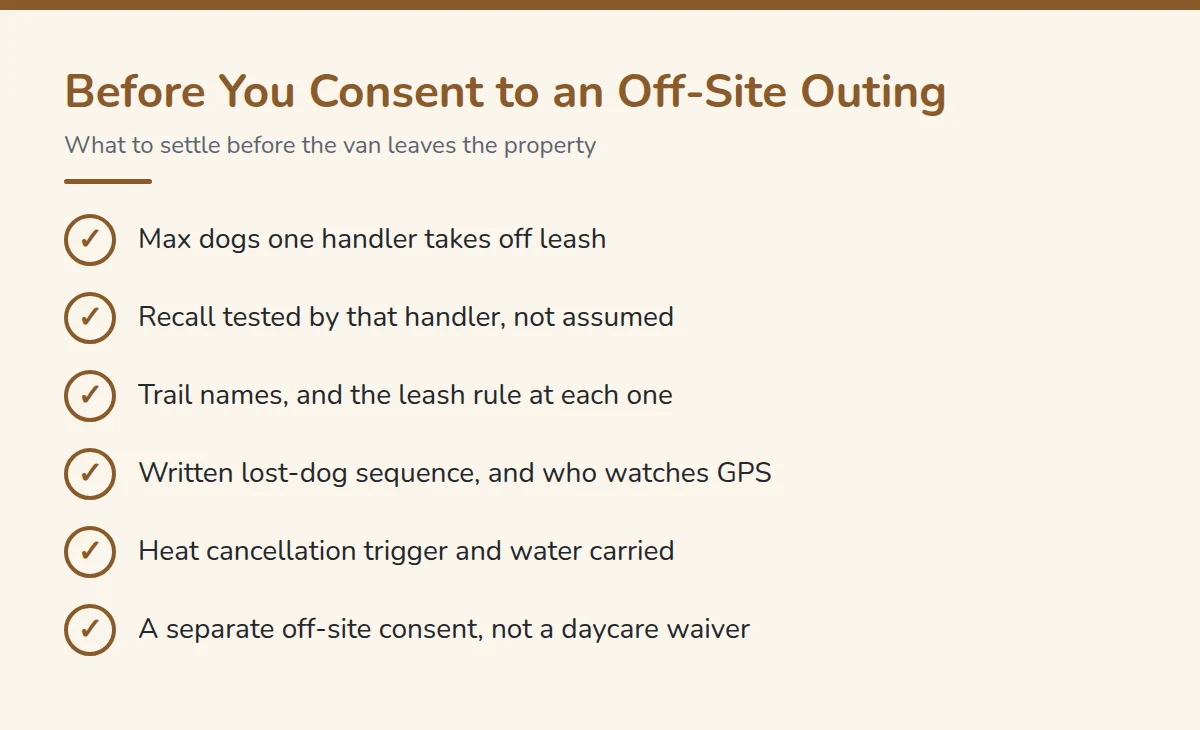
- How many dogs does one handler take off leash, and is there ever a solo handler?
- How do you test recall, who runs the test, and what happens to a dog that fails?
- Which specific trails or beaches do you use, and what are the leash rules there?
- Is my dog GPS-tracked, who watches it, and what is your written lost-dog sequence?
- At what point do you call me, and at what point do you call a vet?
- What temperature cancels an outing, and how much water do you carry per dog?
- Who supplies the life jacket, and is it fitted to my dog?
- Do you check algal bloom advisories before a lake swim?
- Do you require the leptospirosis vaccine, and what is your tick protocol?
- Can I see the off-site consent form and your certificate of insurance?
None of these are unreasonable, and a good operator will have heard most of them before. The tell is not whether the answers are perfect. It is whether the person you are speaking to has clearly thought about each of these before you asked.
Further reading (sources)
- American Kennel Club on the questions to put to a dog hiking group before you book
- American Kennel Club for why a dog should never be tethered to a kayak or boat
- BearWise with what happens when loose dogs and black bears meet
- National Park Service on the six-foot leash rule for dogs on park trails
- US Forest Service for how leash rules differ between developed areas and the rest of a forest
- CDC with how quickly harmful algal blooms can kill a dog that drinks the water
- UC Davis School of Veterinary Medicine on why a foxtail cannot back out once it enters a dog
- Weiss, Slater and Lord for how owners actually find a lost dog, and how rarely a tag is the reason
- Hall and colleagues on exertion rather than parked cars being the bigger heatstroke threat
- Sykes and colleagues with the updated ACVIM consensus statement on leptospirosis in dogs
- Animal Legal & Historical Center for the case of a boarded dog that squeezed through a play-yard fence