Why Dogs Come Home Sick From Boarding: A Complete Guide to Post-Stay Illness
Published on August 30, 2026
You collect a happy, exhausted dog, drive home, and by the next morning something is off. Loose stools on the kitchen floor. A cough that was not there at drop-off. A paw the dog keeps licking. Most of what shows up in the week after boarding is minor and self-resolving, but “most” is not “all,” and the difference between the two usually comes down to timing and trend. This guide walks through the conditions that genuinely follow a kennel stay, what each one looks like, how long after pickup it typically appears, which ones resolve on their own, and the specific signs that mean you stop watching and call the vet today.
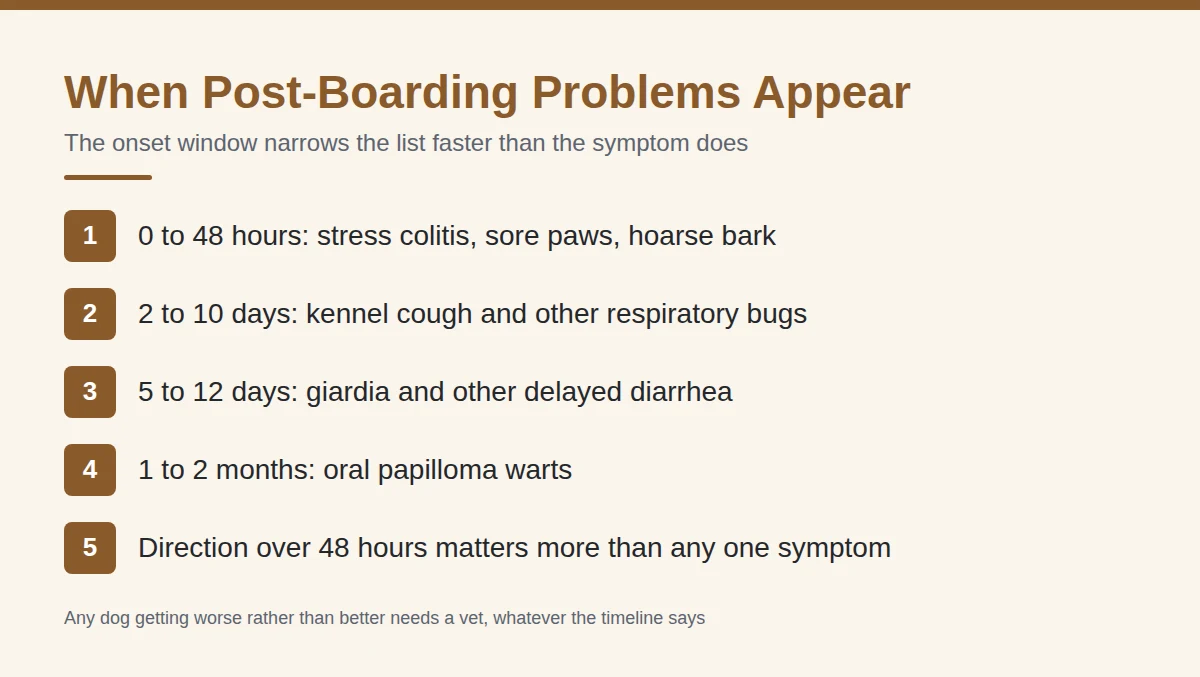
The Timeline Is Your First Diagnostic Tool
Before looking at any single symptom, look at the calendar. Different problems have different incubation or onset windows, and that window narrows the list faster than the symptom itself does.
- Same day to 48 hours: stress colitis, appetite loss, sleep debt, hoarse bark, chemical irritation or abrasion on paws and skin.
- Two to ten days: canine infectious respiratory disease complex, the group of bugs most people call kennel cough.
- Five to twelve days: giardia, which is why the diarrhea that starts a full week after you got home is often a different problem from the diarrhea that started in the car.
- One to two months, sometimes longer: canine oral papillomas, the wart-like growths a dog can pick up from a shared toy or water bowl.
A dog that was fine at pickup and unwell three days later has almost certainly not been mistreated. It has been exposed. That distinction matters both for your peace of mind and for the conversation you are about to have with the facility.
Stress Colitis: The Most Common Reason by Far
If your dog comes home with diarrhea, this is the first suspect. Stress colitis is inflammation of the large intestine triggered by a change in environment and routine, and boarding is one of its classic triggers. The colon stops absorbing water properly and loses its capacity to store stool, so the picture is not one big puddle but frequent small volumes of soft or liquid stool, often with jelly-like mucus and sometimes a streak of bright red blood at the very end of the movement.
That blood is the part that panics owners, and it is usually the least alarming detail. Fresh red blood on the surface of otherwise small, mucousy stools points to the colon, the last stop on the way out, which is exactly what colitis is. Most cases settle within a few days on rest, unrestricted water and a bland, easily digested diet. The physiology behind it is the same cortisol response covered in our guide to kennel stress in dogs, which is worth reading if your dog reacts to every stay this way.
Call the vet if: the diarrhea passes 72 hours without improving, your dog is also vomiting, the stool is black and tarry rather than streaked with red, you can see a substantial volume of blood, or the dog is lethargic, refusing water, or has a tense painful belly. Puppies, seniors and small breeds dehydrate faster and deserve a lower threshold.
Giardia and Other Parasites: The Delayed Diarrhea
Diarrhea that begins five to twelve days after pickup is a different animal. That is the incubation window for giardia, a protozoan parasite picked up from contaminated ground, standing water or shared bowls, and it is common wherever dogs congregate. The signature is soft, pale, greasy, foul-smelling stool that may come and go rather than resolving in a straight line, sometimes with gas and weight loss in an otherwise bright dog.
Giardia will not clear on rest and chicken and rice. It needs a fecal test and prescription treatment, usually fenbendazole, metronidazole or both, and a repeat test afterward, because cysts shed intermittently and a single negative sample does not rule it out. Coccidia and whipworm produce a similar delayed, stubborn diarrhea and are diagnosed from the same sample, so ask for a full fecal panel rather than a giardia snap test alone. Cysts are hardy in wet environments and survive many routine disinfectants, which is why drainage and yard surfaces matter as much as spray bottles in a kennel.
Bathe the dog after treatment starts, pick up stool promptly, and mention it to your household. Giardia’s zoonotic risk to people is considered low, but hand washing is not optional.
Urinary Problems From Holding It
This one is underdiscussed and easy to miss. Plenty of house-trained dogs will not eliminate on concrete, on gravel, in front of other dogs, or anywhere that is not grass, and a dog that holds urine through a stay comes home with concentrated urine that has sat in the bladder far longer than usual. That is a setup for cystitis.
Watch for straining with little production, squatting repeatedly, small frequent puddles, accidents from a reliably clean dog, blood-tinged or cloudy urine, a strong odor, or persistent licking at the genitals. Unlike stress colitis, this is not a wait-and-see condition. A urinary tract infection needs a urine sample and antibiotics, and a dog that is straining and producing nothing at all, particularly a male dog, is a same-day emergency because obstruction is life-threatening within hours.
Prevention is a booking question, not a treatment question. Ask how many outdoor breaks a dog gets, what the surfaces are, and whether staff log eliminations. A facility that records who peed and when will spot a non-urinator on day one and take them out separately.
Skin, Paws, and Pressure Sores
Kennels are cleaned aggressively, and cleaning chemistry has consequences. Quaternary ammonium disinfectants, the workhorse of kennel sanitation, are safe when diluted and rinsed correctly and irritating when they are not. Documented effects range from redness and soreness on the paws to ulcerated skin lesions, and veterinary toxicology case reports include fatal exposures in kennel-type facilities where products were misused. Signs usually appear within a day or two of contact: pink or raw pads, limping on all four feet rather than favoring one, a dog that will not stop licking its feet, or patchy irritation on the belly and undercarriage where the dog lay down.
The mechanical version is more common and more benign. Abraded pads and split nails come from running on rough concrete or textured flooring, and elbow calluses or fluid-filled hygromas come from hard surfaces with no bedding, which is a particular risk for large and heavy-boned dogs. Rinse the feet on arrival home, look between the toes, and check elbows and hips for hairless pressure points.
Call the vet for blistered or ulcerated skin, open wounds, swelling, a limp that has not improved in 48 hours, or any suspicion of chemical contact, since decontamination is time-sensitive.
Warts and Other Contact Infections
Canine oral papillomavirus is spread by direct contact and by shared toys, bowls and water, and the growths take one to two months to appear, occasionally as long as six. By the time you see the cauliflower-shaped growths on the lips, gums or tongue, you have long since forgotten about the stay that caused them.
Papillomas mainly affect dogs under two and dogs with immature or suppressed immune systems, and they are self-limiting: they regress over weeks to months, after which the dog is generally immune. Treatment is usually unnecessary. See a vet if the growths interfere with eating, bleed, smell foul or become infected, if they spread widely, or if a growth appears in an adult dog, where the differential list is broader and a look from a professional is warranted.
Respiratory Disease and the Two Sounds That Are Not the Same
A dry, honking cough with a gag at the end, appearing two to ten days after a stay, is the classic presentation of canine infectious respiratory disease complex. Our complete guide to kennel cough and CIRDC covers the pathogen mix, vaccine timing and recovery in full. Most dogs clear it in one to three weeks with rest.
The version that needs urgency is different in character: fast or labored breathing, a wet productive cough, a fever that will not break, refusal to eat, or genuine collapse-level lethargy. Those can signal pneumonia, and one cause in particular moves fast enough to matter, as covered in our article on strep zoo and hemorrhagic pneumonia.
Then there is the sound that is not illness at all. A dog that barked for three days straight comes home hoarse, with a weak or squeaky bark and no cough, no fever and a normal appetite. That is laryngeal irritation from overuse and it fades over a couple of weeks. The differentiator is simple: hoarseness plus coughing or effortful breathing means see the vet, while hoarseness alone in a bright, eating, playing dog means give it a few days.
Behavior That Looks Like Illness
Not everything that worries you at pickup is medical. Dogs come home carrying real sleep debt, because kennels are loud and few dogs sleep properly during a stay, and a dog that sleeps hard for two days, drinks a great deal, seems clingy or seems flat is usually just catching up. Appetite often lags a day or two behind. House-training regression is common and typically fades once the home routine reasserts itself.

The honest exception is behavior that is new, targeted and lasting: flinching from a particular type of person, a dog that shrinks from being handled, or one that will not get back in the car at the next drop-off. That is worth taking seriously, and our guide to the signs a dog may have been mistreated at boarding covers how to tell ordinary stress from something else and what to do about it.
Raising It With the Facility
Tell them, even when the problem is minor and even when you do not blame them. One owner reporting loose stools is noise, but three in a week is an outbreak signal a manager needs, and a good operator will thank you for it.
Be specific and factual: dates of the stay, the day symptoms started, what you observed, and any diagnosis or invoice from your vet. Ask three things. Have other dogs from those dates reported the same thing? What is your isolation and notification protocol when a dog develops symptoms mid-stay? What was my dog’s eating, drinking and elimination record for the stay? A facility that keeps daily logs can answer the third question immediately, and how they handle the first two tells you whether the emergency and illness planning covered in our guide to boarding facility emergency preparedness is real or theoretical.
Also give your own vet the boarding dates unprompted. Exposure history changes what they test for, and “back from a kennel eight days ago” moves giardia up the list in a way that “chronic diarrhea” does not.
The Bottom Line
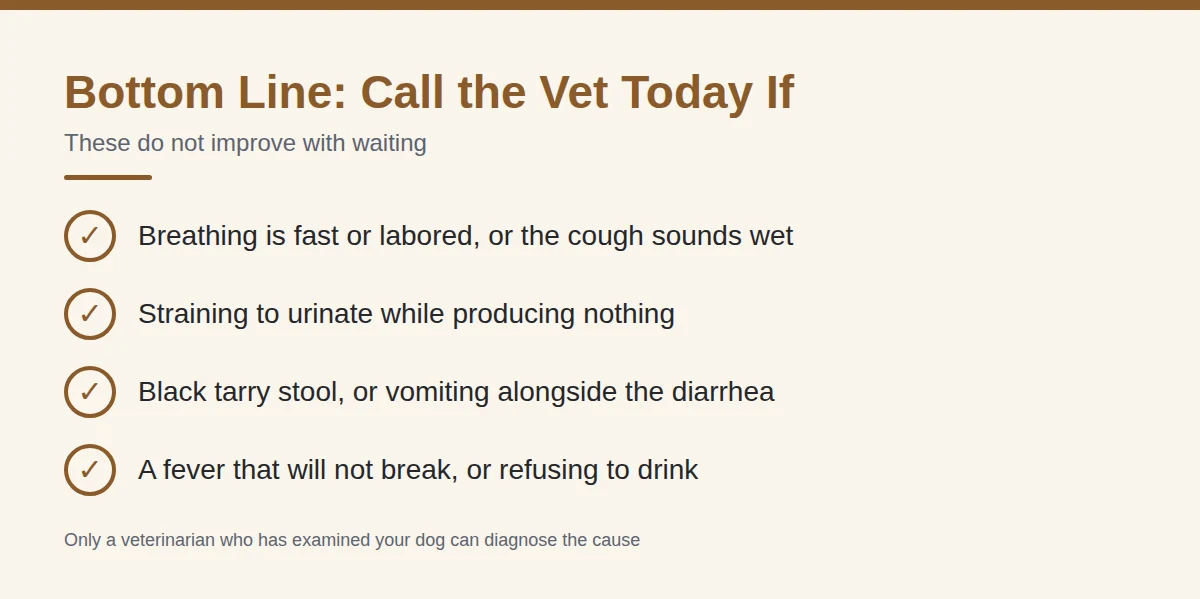
Boarding does not make dogs sick so much as it concentrates them, and concentration is how ordinary canine bugs and ordinary stress physiology find their opening. Nearly all of it resolves. Use the timeline to narrow what you are looking at, treat any single symptom as less informative than its direction over 48 hours, and hold a short list of genuine emergencies in mind: labored breathing, straining to urinate with nothing produced, black tarry stool, repeated vomiting alongside diarrhea, a fever that will not break, or a dog that will not drink. Everything on that list is a call to your veterinarian today, and only a veterinarian who has examined your dog can diagnose what is actually going on.
Further reading (sources)
- VCA Animal Hospitals on what colitis looks like in dogs and why the stool changes
- VCA Animal Hospitals for giardia symptoms, the incubation window, and how it is treated
- Companion Animal Parasite Council with its clinical guidance on diagnosing and controlling giardia
- Merck Veterinary Manual on the course of kennel cough and infectious tracheobronchitis
- Veterinary Partner for why viral papillomas appear in young dogs and clear on their own
- Clinician’s Brief reporting quaternary ammonium disinfectant exposures in kennel settings
- Veterinary Partner with a rundown of which disinfectants are safe around pets
- PetMD on why a dog loses its voice and when hoarseness matters